Gunda IV
Gunda IV, called Pindi-Gunda in the Bayyaram inscription, was an early Kakatiya chief of the tenth century and the father of Beta I. P. V. Parabrahma Sastry identified him with Kakatya Gundyana, at whose request an Eastern Chalukya grant of about 956 gave the village of Mangallu to a Brahmin. In Parabrahma Sastry's account he was a general of the Rashtrakutas, held the Koravi region after their fall, and was killed in the 990s by a chief backed by the new Chalukya king Tailapa II.
Download
Gunda IV was an early chief of the Kakatiyas, the family that later ruled the Telugu country from Warangal.12 He lived in the tenth century, when the Kakatiyas were still minor chiefs under the Rashtrakuta kings.34 Almost everything known about him comes from two grants and from the reasoning of the historian P. V. Parabrahma Sastry.25 His son was Beta I.1
Pindi-Gunda of the Bayyaram inscription
The tank inscription of Ganapatideva’s sister Mailama at Bayyaram gives the early line of the family.1 It names Venna, then three kings called Gunda, then Erra, the ruler of Kurravadi, and then Pindi-Gunda.1 Pindi-Gunda’s son was Garudanka Beta.1 In Parabrahma Sastry’s numbering, Pindi-Gunda is Gunda IV.6 See the Bayyaram inscription.
Kakatya Gundyana of the Mangallu grant
The Mangallu grant is an Eastern Chalukya copper-plate grant issued in the name of Amma II, while his half-brother Danarnava ruled.7 It gives the village of Mangallu to a Brahmin named Dommana, at the request of a feudatory chief called Kakatya Gundyana.7 Dommana had kept the karpati vow, a set of strict religious rules, for Gundyana’s merit and favour.7
The grant gives Gundyana’s family. It says that he belonged to the family of Samanta Voddi.78 His grandfather Gundiya-rashtrakuta had done great service to a Chalukya king, and his father Erija-rashtrakuta was a skilled horseman.78 His mother was Vandyanamba.78
Parabrahma Sastry took Kakatya Gundyana to be the earliest member of the Kakatiya family in the records.9 He dated the grant to about 956.9 He identified Gundyana with Pindi-Gunda, that is Gunda IV.2
A Rashtrakuta general
Parabrahma Sastry placed the grant in a civil war in the Eastern Chalukya kingdom of Vengi.103 In his account, Danarnava asked the Rashtrakuta king Krishna III for help against his half-brother Amma II.3 Krishna sent his general Gunda IV, who was already posted in the Koravi region of Telangana.3 With Gunda’s help Danarnava drove out Amma II for a short time.3 Parabrahma Sastry thought that Dommana’s vow was perhaps meant to win Gunda success in this war.3
Gunda then served the Rashtrakutas loyally until their sudden fall in 973.4 After that, Parabrahma Sastry argues, he refused to submit to the new Chalukya king Tailapa II.4 Instead he tried to keep a small kingdom of his own in Koravi.4 He drove out the Mudigonda Chalukya chief, whose capital Koravi then was.4
His death
The Gudur inscription of 1124 says that the chief Viriyala Erra killed the enemy of Bottu Beta in battle and restored Bottu Beta at Koravi.4 The inscription does not name that enemy. Parabrahma Sastry identified him with Gunda IV.45
In his reconstruction, the Mudigonda chiefs backed Tailapa II, and with Tailapa’s support Viriyala Erra killed Gunda in battle.5 Parabrahma Sastry could not fix the date exactly, but he placed it in the last decade of the tenth century.5 The earliest record of Tailapa II in the region, at Jammikunta near Anumakonda, is dated 995.5
Gunda’s son Beta was then too young to fight, and he lost all that his father had won.511 The Gudur inscription says that Erra’s own wife, Kamavasani, took up the young Beta’s cause and restored the family.11 Much later, the family chronicle Siddhesvara-charitra told a similar story of a lady Kuntaladevi acting as regent for Gunda’s young son.11 Parabrahma Sastry thought that chronicle unreliable in several respects.11
Dates
No record gives Gunda’s years. Parabrahma Sastry reasoned from two dates: the Mangallu grant of about 956, and his son Beta’s last record of 1051.2 He supposed that Gunda was a young man of about twenty-five in 956 and lived until about 1000.2 On that basis he gave Gunda IV, tentatively, the years 955 to 995.2 In an article of 1975 he also argued that Beta came to power young, which helps to explain the long gap.12
Where the sources disagree
- His father. In the reading of the 1917 epigraphy report and of V. Rangacharya, who edited the grant in 1960, the Mangallu grant makes Gundyana the son of Erija-rashtrakuta.78 Parabrahma Sastry read it as naming his father Betiya, his grandfather Eriya and his great-grandfather Gundiya.13 He thought Betiya died young, so the Bayyaram inscription left him out.142
- Who issued the grant. Parabrahma Sastry held that Danarnava issued it on his own, using Amma II’s title because he was never crowned.3 Rangacharya thought that Danarnava governed as regent for his brother and made the grant in his brother’s name.15
- His death. No inscription names Gunda’s killer. The story of his death in battle with Viriyala Erra is Parabrahma Sastry’s reconstruction from the Gudur inscription.45
Footnotes
-
P. V. Parabrahma Sastry, “Bayyaram Tank Inscription of Kakati Mailama”, Epigraphia Andhrica I (1974), pp. 71–94, reprinted in Gajjala Vasanta Lakshmi (ed.), Epigraphia Telanganica, vol. 2 (2023), pp. 316–317, No. 310. Paraphrased. ↩ ↩2 ↩3 ↩4 ↩5
-
Parabrahma Sastry, The Kakatiyas of Warangal (1978), p. 34. Cite-only; paraphrased. ↩ ↩2 ↩3 ↩4 ↩5 ↩6 ↩7
-
Parabrahma Sastry, The Kakatiyas of Warangal (1978), p. 40. Cite-only; paraphrased. ↩ ↩2 ↩3 ↩4 ↩5 ↩6 ↩7
-
Parabrahma Sastry, The Kakatiyas of Warangal (1978), p. 41. Cite-only; paraphrased. ↩ ↩2 ↩3 ↩4 ↩5 ↩6 ↩7 ↩8
-
Parabrahma Sastry, The Kakatiyas of Warangal (1978), p. 42. Cite-only; paraphrased. ↩ ↩2 ↩3 ↩4 ↩5 ↩6 ↩7
-
Parabrahma Sastry, “Bayyaram Tank Inscription”, in Epigraphia Telanganica, vol. 2 (2023), p. 320. Paraphrased. ↩
-
V. Rangacharya, “Mangallu Grant of Amma II”, Epigraphia Indica XXXI (1955–56, publ. 1960), p. 38 (archive.org (opens in a new tab)). ↩ ↩2 ↩3 ↩4 ↩5 ↩6 ↩7
-
Annual Report on Epigraphy, Madras, for 1916–17 (1917), Part II, para. 24, p. 118 (archive.org (opens in a new tab)). ↩ ↩2 ↩3 ↩4
-
P. V. Parabrahma Sastry, The Kakatiyas of Warangal (1978), p. 14. Cite-only; paraphrased. ↩ ↩2
-
Parabrahma Sastry, The Kakatiyas of Warangal (1978), p. 39. Cite-only; paraphrased. ↩
-
Parabrahma Sastry, The Kakatiyas of Warangal (1978), p. 43. Cite-only; paraphrased. ↩ ↩2 ↩3 ↩4
-
Epigraphia Telanganica, vol. 2 (2023), p. 25, reprinting P. V. Parabrahma Sastry, “Sanigaram Epigraphs of the Early Kakatiyas”, Epigraphia Andhrica IV (1975). ↩
-
Parabrahma Sastry, The Kakatiyas of Warangal (1978), p. 17. Cite-only; paraphrased. ↩
-
Parabrahma Sastry, The Kakatiyas of Warangal (1978), p. 18. Cite-only; paraphrased. ↩
-
Rangacharya, “Mangallu Grant of Amma II” (1960), p. 40 and notes 2–4 (archive.org (opens in a new tab)). ↩
Photos
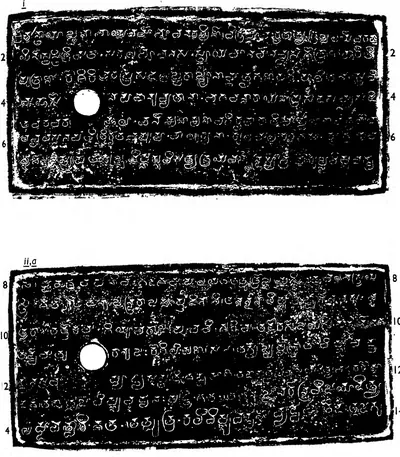 "Mangallu Grant of Amma II", plates i and ii a (Epigraphia Indica XXXI, Plate I (PDF p. 76))Inscription rubbing · 1960
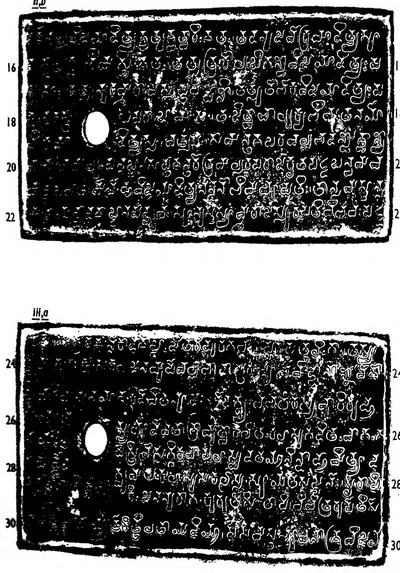 "Mangallu Grant of Amma II", plates ii b and iii a (Epigraphia Indica XXXI, Plate I (PDF p. 77))Inscription rubbing · 1960
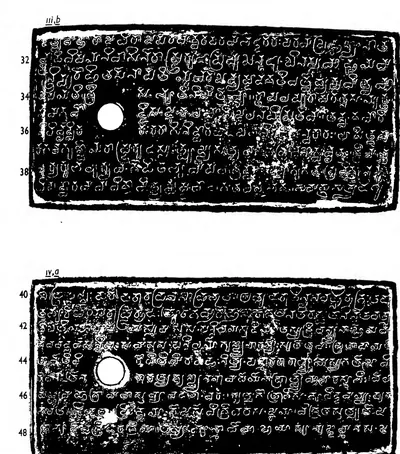 "Mangallu Grant of Amma II", plates iii b and iv a (Epigraphia Indica XXXI, Plate II (PDF p. 80))Inscription rubbing · 1960
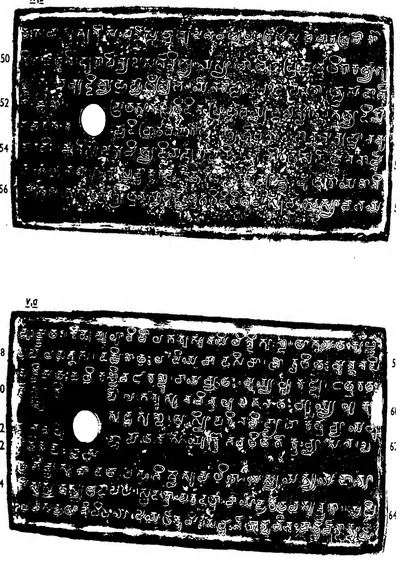 "Mangallu Grant of Amma II", plates iv b and v a (Epigraphia Indica XXXI, Plate II (PDF p. 81))Inscription rubbing · 1960
Related
Dynasties
References
Notes (0)
Sources (4)
Spotted an error on this page? Tell us
Last updated: