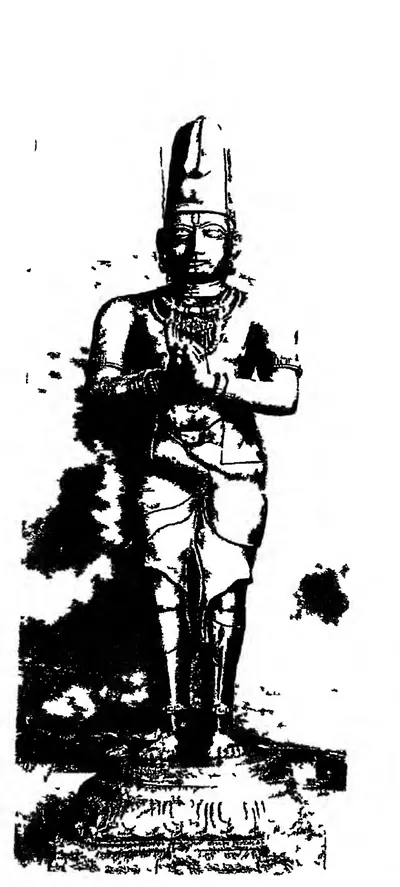
Immadi Narasimha
Immadi Narasimha, a son of Saluva Narasimha, was the second and last king of Vijayanagara's Saluva dynasty, from 1492 to 1505. He came to the throne as a boy after his elder brother's death, and the regent Narasa Nayaka held the real power. When the young king protected his brother's killer, Narasa besieged him and forced him to give the man up. After that he was kept under guard at Penukonda. He was murdered in 1505, and the Tuluva family took the throne. His inscriptions are found from Kurnool and Anantapur to Chittoor.
Download
Immadi Narasimha was the second and last king of Vijayanagara’s Saluva dynasty. He reigned from 1492 to 1505, but only in name.12 The real ruler was the regent Narasa Nayaka, a general of his father’s, of the Tuluva family.34 When the young king was murdered in 1505, the Tuluvas took the throne for themselves.25 See Vijayanagara and Saluva Narasimha.
A boy on the throne
He was the younger of the two sons of Saluva Narasimha, who had taken the throne from the first dynasty.31 Sewell’s later work says that his name was Tammaya, or Dharma Raya, and that he took the title Immadi Narasimha.1 Nuniz calls him “Tamarao”.6 Inscriptions also call him “Tammaya Deva” and “Dharma Raya”.78 Even before he was king, a record of 1491 in the Kurnool district names a Timma Raja as minister to “prince Immadi Narasimha”.1
On his deathbed, Nuniz says, Saluva Narasimha left the kingdom in the care of his minister Narasa Nayaka.3 Narasa was to govern until the princes came of age, and then give the throne to whichever son was more fit to rule.3 Narasa first made the elder son king, but that prince was soon killed.36 Then Narasa raised the younger son, Immadi Narasimha.6 An inscription names him king on 27 January 1493.1
The quarrel with Narasa
Nuniz tells why the king and his regent fell out.6 Narasa blamed a captain named Timmarasa for the elder prince’s death.36 But the young king was fond of Timmarasa, because the captain had helped make him king, and took his side.6
So Narasa went to Penukonda, gathered troops, horses and elephants, and marched against the king.6 He besieged him for four or five days, until the king had Timmarasa put to death and sent his head to Narasa.6 Nilakanta Sastri dates this siege to 1492.4
After this, Nuniz says, Narasa saw how young the king was, and kept him at Penukonda under a large guard.91 The king was given 20,000 gold cruzados a year for his food and expenses.9 Narasa himself governed from the capital, and sent 20,000 men to guard the king and stop him leaving the city.9 Nilakanta Sastri called this a second usurpation.10
Records of the reign
Inscriptions in the king’s name come from many parts of the empire, among them these Telugu districts:11178
- the Kadapa (then Cuddapah) district in 1493 and 1498117
- Kottakota near Madanapalle, in the Chittoor district, where a mosque was built in 149411
- the Anantapur district in 14987
- the Kurnool district in 1492–93 and 150318
- the Chittoor district in 1504, where the king gave a village by the Divulapalli plates8
One inscription of 1498, Sewell noted, calls Narasa not so much the king’s minister as his partner (pampu).7 Sewell took this to show how much power Narasa had gained.7 Meanwhile the Gajapati kings of Orissa held Udayagiri and Kondavidu. An inscription of 1500 in the Guntur district shows the Gajapati ruling there.7
Death
Nuniz tells how the king died.121314 A captain, acting by agreement with Narasa, went to Penukonda as if he had quarrelled with the minister.12 He showed the king forged letters from chiefs, urging him to escape to the fort of Chandragiri (then “Chandigary”) and raise an army there.13 One night he led the king out through the palace garden.1314 There guards he had paid killed the king, without knowing who he was, and buried him under a tree.14 Then Narasa was raised to be king.15
Sewell’s later work dates the murder to some day between 28 February and 14 August 1505.2 Nilakanta Sastri places it early in 1505.5 See Narasa Nayaka and Vira Narasimha.
Where the sources disagree
- How his elder brother died. Nuniz says a page bribed by the captain Timmarasa killed him.36 Nilakanta Sastri also says Timmarasa had him murdered, and names him Timmabhupa.4 Krishnaswami Aiyangar (1928) says he died of wounds from an expedition into the Raichur doab.16 Ferishta, as Sewell printed him, says a “young roy” died of an arrow wound after a battle near Raichur in 1493.17
- Who took the throne after him. Nuniz says Narasa had him killed and became king himself.1415 Sewell’s later work agrees that Narasa seized the throne, and adds that he died soon after.2 Krishnaswami Aiyangar (1928) says Narasa died in 1505, and that his son Vira Narasimha deposed the Saluva king.1618 Nilakanta Sastri says Narasa died in 1503, and that Vira Narasimha took the throne after the king’s murder.5
Footnotes
-
Robert Sewell, ed. S. Krishnaswami Aiyangar, The Historical Inscriptions of Southern India (1932), p. 231 (archive.org (opens in a new tab)). ↩ ↩2 ↩3 ↩4 ↩5 ↩6 ↩7 ↩8
-
Sewell, Historical Inscriptions (1932), p. 235 (archive.org (opens in a new tab)). ↩ ↩2 ↩3 ↩4
-
Fernao Nuniz, “Chronicle”, in Sewell, A Forgotten Empire (1900), p. 308 (archive.org (opens in a new tab)). ↩ ↩2 ↩3 ↩4 ↩5 ↩6 ↩7
-
K. A. Nilakanta Sastri, A History of South India from Prehistoric Times to the Fall of Vijayanagar, 3rd ed. (1966), p. 274 (archive.org (opens in a new tab)). Paraphrased. ↩ ↩2 ↩3
-
Nilakanta Sastri, A History of South India, 3rd ed. (1966), p. 276 (archive.org (opens in a new tab)). Paraphrased. ↩ ↩2 ↩3
-
Nuniz, in Sewell, A Forgotten Empire (1900), p. 309 (archive.org (opens in a new tab)). ↩ ↩2 ↩3 ↩4 ↩5 ↩6 ↩7 ↩8 ↩9
-
Sewell, Historical Inscriptions (1932), p. 233 (archive.org (opens in a new tab)). ↩ ↩2 ↩3 ↩4 ↩5 ↩6 ↩7
-
Sewell, Historical Inscriptions (1932), p. 234 (archive.org (opens in a new tab)). ↩ ↩2 ↩3 ↩4
-
Nuniz, in Sewell, A Forgotten Empire (1900), p. 310 (archive.org (opens in a new tab)). ↩ ↩2 ↩3
-
Nilakanta Sastri, A History of South India, 3rd ed. (1966), p. 275 (archive.org (opens in a new tab)). Paraphrased. ↩
-
Sewell, Historical Inscriptions (1932), p. 232 (archive.org (opens in a new tab)). ↩ ↩2 ↩3
-
Nuniz, in Sewell, A Forgotten Empire (1900), p. 311 (archive.org (opens in a new tab)). ↩ ↩2
-
Nuniz, in Sewell, A Forgotten Empire (1900), p. 312 (archive.org (opens in a new tab)). ↩ ↩2 ↩3
-
Nuniz, in Sewell, A Forgotten Empire (1900), p. 313 (archive.org (opens in a new tab)). ↩ ↩2 ↩3 ↩4
-
Nuniz, in Sewell, A Forgotten Empire (1900), p. 314 (archive.org (opens in a new tab)). ↩ ↩2
-
S. Krishnaswami Aiyangar, “Hindu States in Southern India”, in Wolseley Haig (ed.), The Cambridge History of India, Vol. III (1928), p. 494 (archive.org (opens in a new tab)). ↩ ↩2
-
Robert Sewell, A Forgotten Empire (Vijayanagar) (1900), p. 114, quoting Ferishta (archive.org (opens in a new tab)). ↩
-
Krishnaswami Aiyangar, in Cambridge History of India, Vol. III (1928), p. 495 (archive.org (opens in a new tab)). ↩
Related
Dynasties
References
Notes (0)
Sources (4)
Spotted an error on this page? Tell us
Last updated: