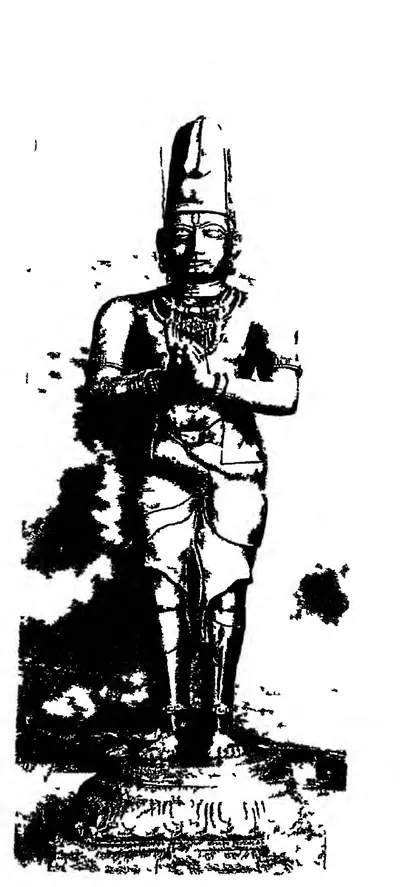
Saluva Narasimha
Chief of the Saluva family of Chandragiri. He drove the Gajapatis of Orissa back up the coast towards Rajahmundry and faced the Bahmani sultan there in the 1470s. In 1485–86 he took the throne of Vijayanagara from the last Sangama king and founded the second, Saluva, dynasty. He died in 1492–93 and left his young sons in the charge of his general Narasa Nayaka. Whether he recovered Udayagiri from Orissa is disputed.
Saluva Narasimha was the chief of the Saluva family who took the throne of Vijayanagara from the last king of the Sangama line. He founded the second dynasty. Sewell’s later work dates the usurpation to between July 1485 and November 1486, and the end of the reign to 1492–93.12 S. Krishnaswami Aiyangar dated the deposition of the old king to 1487 and gave Narasimha six years as king.3
Nuniz, writing about fifty years later, gave him a reign of forty-four years.4 Sewell thought this might count from his rise as a great noble.5 See Vijayanagara.
Family
The Saluvas had served Vijayanagara for several generations. Krishnaswami Aiyangar wrote that their home territory lay around Chandragiri or Narayanavanam, in the present Chittoor district.6 One of the family had married into the royal house.6
The Ramabhyudaya is a Sanskrit poem attributed to Narasimha himself.7 According to its introduction, his ancestor Saluva Mangi had joined Kumara Kampana in his campaign against the sultan of Madura.7 The same poem, as Krishnaswami Aiyangar summarised it, says that Saluva Mangi’s son was Gautama.8 Gautama’s son Gunda and his wife Mallambika prayed for a son at Ahobilam.8 They named the child Narasimha after the god of that shrine.8
The Saluvabhyudayam of his court poet Rajanatha Dindima gives the same descent.9 It makes Narasimha’s father Gunda “the third of that name in the family”.9 See Ahobilam.
Nuniz says that at his death Narasimha left two sons in the charge of his minister Narasa Nayaka.1011 The elder was raised to the throne but was killed by a page bribed by a captain named “Tymarsaa”.1011 After this, Narasa raised the younger brother, “Tamarao”.1011 Sewell’s later pedigree names this younger son Immadi Narasimha, or Tammaya.2 It says that he was assassinated in 1505, when the Tuluva minister took the throne.2
Against Orissa and the Bahmanis
Narasimha rose in the years after the death of Deva Raya II, when the Gajapati kings of Orissa had taken the Telugu coast. Krishnaswami Aiyangar wrote in 1919 that it was “this successful aggression on the part of Orissa that gave the occasion for Saluva Narasimha to build up his power”.1213 He added that the Gajapati was then “already in effective possession of the Nellore district”.1213
His court poem, the Saluvabhyudayam, has his ministers urge him to take Udayagiri.14 It describes a war with “the Ruler of Kalinga”, who surrendered after a siege.14 It also makes him fight a Muslim army near Penukonda.14
The Telugu Jaimini Bharatamu of Pina Virabhadra was dedicated to him.15 It says that he took away the strength of the Oddiya, the king of Orissa.15 It lists among his conquests Bonagiri, Gingi and Penukonda.15 See the Gajapatis and Purushottama Gajapati.
His advance brought him to the Godavari. The Bahmani sultan Muhammad Shah III came to Rajahmundry.163 There, the Burhan-i Ma’asir says, he found beyond the river “the infidel Narasimha Raya with 700,000 cursed infantry”.163 They stood behind a wall “like the rampart of Alexander”.163
Krishnaswami Aiyangar dated this to 1474–75 in 1919.16 In 1928 he dated it to about 1476.3 He wrote that the sultan could not dislodge Narasimha and had to content himself with a raid as far as Kanchi.163
Ferishta calls him “a powerful raja, possessing the country between Carnatic and Telingana, extending along the sea-coast to Matchiliputtum”.17 His generals included Isvara Nayaka.1618 According to the Telugu Varahapuranamu, Isvara destroyed the cavalry of the sultan of Bidar near Kandukur.18 Isvara’s son Narasa, later regent, was another of the generals.1618 See Rajahmundry, Muhammad Shah III and Kanchipuram.
Seizing the throne
Inscriptions of 1472–73 and 1482–83 still give Narasimha only the titles of a great lord.19 Nuniz tells the story of how he took the throne:204
- The last king of the old line, whom Nuniz calls Padearao, gave himself up to his women.204
- Narasimha won over the captains with presents.204
- His captain found the gates of the capital undefended, and the king fled.204
- From then on, “this kingdom of Bisnaga was called the kingdom of Narsymga”.204
Krishnaswami Aiyangar wrote that it was Narasa, commanding Narasimha’s troops, who deposed the old king.3 He wrote that Narasimha “found his justification in the perils which menaced” the kingdom.3 Sewell noted that the Portuguese always knew the Vijayanagara territories as the “kingdom of Narsinga”.21
As king
Nuniz says that Narasimha recovered the lands his predecessors had lost.4 He bought horses from Ormuz and Aden at whatever price the merchants asked.4 He paid even for horses that died at sea, when their tails were brought to him.4
Nuniz also says that three great forts, Raichur, Udayagiri and Kondavidu, were still in revolt at his death.1022 His testament charged his successors to take them.1022
Krishnaswami Aiyangar, in 1928, likewise wrote that he failed to recover the Raichur doab.3 He also failed “to recover Udayagiri, which remained in the possession of the raja of Orissa”.3 But in 1919 Krishnaswami Aiyangar had written that Narasimha “took possession of Udayagiri, which was the headquarters of an early viceroyalty”.16 He then went on to Penukonda and Gingi.16
On his deathbed, Krishnaswami Aiyangar wrote, he entrusted the kingdom and his two sons to Narasa.3 See Udayagiri and Kondavidu.
Footnotes
-
Robert Sewell, ed. S. Krishnaswami Aiyangar, The Historical Inscriptions of Southern India (1932), p. 400 (archive.org (opens in a new tab)). ↩
-
Sewell, Historical Inscriptions (1932), p. 401 (archive.org (opens in a new tab)). ↩ ↩2 ↩3
-
Krishnaswami Aiyangar, in Cambridge History of India, Vol. III (1928), p. 494 (archive.org (opens in a new tab)). ↩ ↩2 ↩3 ↩4 ↩5 ↩6 ↩7 ↩8 ↩9 ↩10 ↩11
-
Nuniz, in Sewell, A Forgotten Empire (1900), p. 307 (archive.org (opens in a new tab)). ↩ ↩2 ↩3 ↩4 ↩5 ↩6 ↩7 ↩8 ↩9
-
Sewell, A Forgotten Empire (1900), pp. 110–111 (archive.org (opens in a new tab)). ↩
-
S. Krishnaswami Aiyangar, “Hindu States in Southern India”, in Wolseley Haig (ed.), The Cambridge History of India, Vol. III (1928), p. 493 (archive.org (opens in a new tab)). ↩ ↩2
-
Krishnaswami Aiyangar, Sources of Vijayanagar History (1919), p. 32, extract 4, the Ramabhyudaya (archive.org (opens in a new tab)). ↩ ↩2
-
Krishnaswami Aiyangar, Sources of Vijayanagar History (1919), p. 83, extract 29, the Ramabhyudaya (archive.org (opens in a new tab)). ↩ ↩2 ↩3
-
Krishnaswami Aiyangar, Sources of Vijayanagar History (1919), p. 90, extract 33, the Saluvabhyudayam (archive.org (opens in a new tab)). ↩ ↩2
-
Nuniz, in Sewell, A Forgotten Empire (1900), p. 308 and note (archive.org (opens in a new tab)). ↩ ↩2 ↩3 ↩4 ↩5
-
Nuniz, in Sewell, A Forgotten Empire (1900), p. 309 (archive.org (opens in a new tab)). ↩ ↩2 ↩3
-
S. Krishnaswami Aiyangar (ed.), Sources of Vijayanagar History (1919), introduction, pp. 5–6 (archive.org (opens in a new tab)). ↩ ↩2
-
Krishnaswami Aiyangar, Sources of Vijayanagar History (1919), introduction, p. 7 (archive.org (opens in a new tab)). ↩ ↩2
-
Krishnaswami Aiyangar, Sources of Vijayanagar History (1919), pp. 90–93, the Saluvabhyudayam (archive.org (opens in a new tab)). ↩ ↩2 ↩3
-
Krishnaswami Aiyangar, Sources of Vijayanagar History (1919), p. 86 and note, extract 31, the Jaimini Bharatamu of Pina Virabhadra (archive.org (opens in a new tab)). ↩ ↩2 ↩3
-
Krishnaswami Aiyangar, Sources of Vijayanagar History (1919), introduction, p. 8 (archive.org (opens in a new tab)). ↩ ↩2 ↩3 ↩4 ↩5 ↩6 ↩7 ↩8 ↩9
-
Robert Sewell, A Forgotten Empire (Vijayanagar) (1900), p. 101, quoting Ferishta (archive.org (opens in a new tab)). ↩
-
Krishnaswami Aiyangar, Sources of Vijayanagar History (1919), p. 88, extract 32, the Varahapuranamu of Nandi Mallayya and Ghanta Singayya (archive.org (opens in a new tab)). ↩ ↩2 ↩3
-
Sewell, A Forgotten Empire (1900), pp. 108–109 (archive.org (opens in a new tab)). ↩
-
Fernao Nuniz, “Chronicle”, in Sewell, A Forgotten Empire (1900), p. 306 (archive.org (opens in a new tab)). ↩ ↩2 ↩3 ↩4 ↩5
-
Sewell, A Forgotten Empire (1900), p. 128 (archive.org (opens in a new tab)). ↩
-
Nuniz, in Sewell, A Forgotten Empire (1900), p. 316 (archive.org (opens in a new tab)). ↩ ↩2
Related
Dynasties
References
Notes (0)
Sources (4)
Spotted an error on this page? Tell us
Last updated: