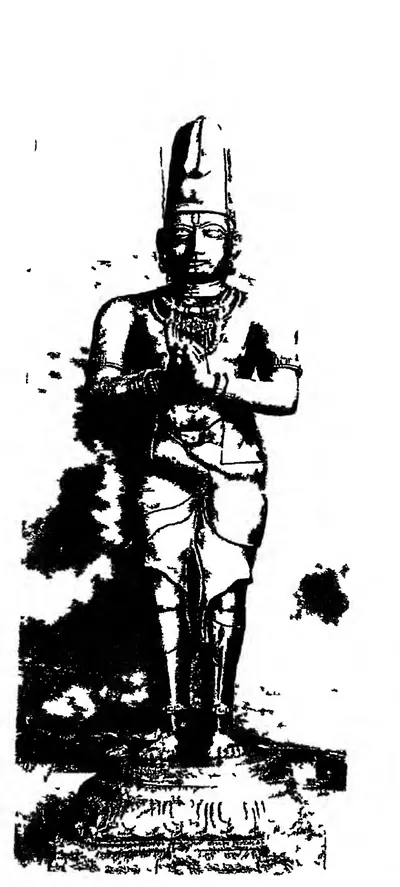
Vira Narasimha (Tuluva)
Vira Narasimha, eldest son of Narasa Nayaka, was king of Vijayanagara from 1505 to 1509, and is often counted as the first king of its third dynasty, the Tuluvas. He took the throne after the murder of the last Saluva king, and his whole short reign went in fighting chiefs who rebelled. The Aravidu chiefs Rama Raja and Timma held Kurnool and Adoni for him against Bijapur, but he failed to take Ummattur. On his deathbed, Nuniz says, he ordered his half-brother Krishnadeva Raya blinded, but the minister Saluva Timma saved Krishna, who became king.
Download
Vira Narasimha was king of Vijayanagara from 1505 to 1509.12 Nilakanta Sastri counts him as the first king of its third dynasty, the Tuluvas.3 He was the eldest son of the regent Narasa Nayaka.34 He came to the throne after the murder of the last Saluva king, and he spent his short reign at war with chiefs who would not accept him.52 His half-brother was Krishnadeva Raya, the greatest of the Vijayanagara kings.42 See Vijayanagara and Narasa Nayaka.
Family
Nandi Timmana’s Parijatapaharanamu and Krishnadeva Raya’s own Amuktamalyada name his mother as Tippamba, one of Narasa’s queens.46 Krishnadeva Raya was Narasa’s son by another queen, Nagamba.46 An inscription of 1507 also names Vira Narasimha’s mother, as Tippaji.7 The Amuktamalyada says that Vira Narasimha destroyed his enemies and brought the whole kingdom under his rule.8
Nuniz calls him “Busbalrao”.5 Sewell’s later work explains the name.7 It comes from Bhujabala, “strength of arm”, a title given to him in an inscription of 1506.7
Coming to the throne
Nilakanta Sastri wrote that when Narasa died in 1503, Vira Narasimha took his place as regent.3 The young Saluva king, Immadi Narasimha, was still kept under guard.3 He was murdered early in 1505, and Vira Narasimha then took the throne.3 Sewell’s later work has an inscription naming Vira Narasimha king on 14 August 1505.1 See Immadi Narasimha.
A reign of wars
Nuniz says that as soon as his father died, “the whole land revolted under its captains”.5 The king put them down in a short time and took their lands.5 Nuniz adds that he spent eight million gold pardaos in six years, restoring the country to what it had been.5
S. Krishnaswami Aiyangar wrote that this second seizure of the throne caused rebellion everywhere.2 On the whole the king won back the provinces that had revolted.2 But Gangaraja, the chief of Ummattur, stayed in revolt.2 Nilakanta Sastri says the king besieged Ummattur for three months, then attacked Srirangapatna, and failed at both.9
The Telugu frontier was held for him by the Aravidu family.3 In Nilakanta Sastri’s account, Yusuf Adil Khan of Bijapur crossed the Tungabhadra and besieged Kurnool.3 Rama Raja of the Aravidu family and his son Timma drove him back, defeated his retreating army and took Adoni from its disloyal captain.3 The king gave them Adoni and Kurnool to hold.3 The Telugu Ramarajiyamu says that Rama Raja, son of Aravidu Bukka, took Kurnool and drove the chief of Adoni from his fort.10 Sewell’s list records Aravidu Timma in the Bellary district in 1508.7 See Kurnool, Adoni and Aliya Rama Raya.
Inscriptions show him ruling in the Kurnool district in 1505 and in the Kadapa (then Cuddapah) district in 1506–7 and 1508.17 Nilakanta Sastri says that his inscriptions record rich gifts to the great temples of the south, among them Srisailam, Mahanandi and Kalahasti.9
The Portuguese
The Portuguese were now settling on the west coast. In 1505 their viceroy Almeida learned of the great kingdom of Vijayanagar and of the power of its king.11 Almeida later asked the king to let him build a fort at Bhatkal, but got no answer.119 The Italian traveller Varthema reported in 1506 that the Muslim governor of Goa was at war with Vijayanagar.129 Varthema described Vijayanagar as a great walled city, and said its king kept 40,000 horsemen and 400 elephants.12
Death
Sewell’s later work says that Vira Narasimha died between April and July 1509.713 Nuniz says that he died of sickness at Vijayanagar.5 On his deathbed he wanted his own son, eight years old, to be king.514 So he ordered the minister Saluva Timma to put out the eyes of his half-brother Krishnaraya.514 The minister showed the dying king the eyes of a goat instead, and Krishnadeva Raya became king.14 See Krishnadeva Raya and Saluva Timma.
Another chief named Vira Narasimha, also called Sellappa, governed the Chola country under Krishnadeva Raya.15 He is a different man.15
Where the sources disagree
- How he came to the throne. Krishnaswami Aiyangar (1928) says that Narasa died in 1505, and that Vira Narasimha deposed the Saluva king.2 Nilakanta Sastri has Narasa die in 1503 and Vira Narasimha rule as regent until the king was murdered in 1505.3 Sewell’s later work says that Narasa himself seized the throne after the murder and died very soon after.1
- The order to blind Krishna. Nuniz tells the story of the goat’s eyes.14 Nilakanta Sastri found no evidence that the half-brothers were anything but friendly. He notes that local tradition says Vira Narasimha himself chose Krishnadeva Raya to rule after him.9
- Krishnadeva Raya’s father. The Rayavachakamu and the Krishnarayavijayam call Krishnadeva Raya’s father Vira Narasimha, and leave out the elder brother who ruled before him.16 The Parijatapaharanamu and the Amuktamalyada make Narasa the father of both.46
Footnotes
-
Robert Sewell, ed. S. Krishnaswami Aiyangar, The Historical Inscriptions of Southern India (1932), p. 235 (archive.org (opens in a new tab)). ↩ ↩2 ↩3 ↩4
-
S. Krishnaswami Aiyangar, “Hindu States in Southern India”, in Wolseley Haig (ed.), The Cambridge History of India, Vol. III (1928), p. 495 (archive.org (opens in a new tab)). ↩ ↩2 ↩3 ↩4 ↩5 ↩6 ↩7
-
K. A. Nilakanta Sastri, A History of South India from Prehistoric Times to the Fall of Vijayanagar, 3rd ed. (1966), p. 276 (archive.org (opens in a new tab)). Paraphrased. ↩ ↩2 ↩3 ↩4 ↩5 ↩6 ↩7 ↩8 ↩9 ↩10
-
Krishnaswami Aiyangar, Sources of Vijayanagar History (1919), p. 106, extract 35, the Parijatapaharanamu of Nandi Timmana (archive.org (opens in a new tab)). ↩ ↩2 ↩3 ↩4 ↩5
-
Fernao Nuniz, “Chronicle”, in Sewell, A Forgotten Empire (1900), p. 314 (archive.org (opens in a new tab)). ↩ ↩2 ↩3 ↩4 ↩5 ↩6 ↩7 ↩8
-
Krishnaswami Aiyangar, Sources of Vijayanagar History (1919), pp. 109–110, extract 37, the Amuktamalyada (archive.org (opens in a new tab)). ↩ ↩2 ↩3
-
Sewell, Historical Inscriptions (1932), p. 236 (archive.org (opens in a new tab)). ↩ ↩2 ↩3 ↩4 ↩5 ↩6
-
Krishnaswami Aiyangar, Sources of Vijayanagar History (1919), p. 110, the Amuktamalyada (archive.org (opens in a new tab)). ↩
-
Nilakanta Sastri, A History of South India, 3rd ed. (1966), p. 277 (archive.org (opens in a new tab)). Paraphrased. ↩ ↩2 ↩3 ↩4 ↩5
-
Krishnaswami Aiyangar, Sources of Vijayanagar History (1919), p. 102, extract 34, the Ramarajiyamu (archive.org (opens in a new tab)). ↩
-
Robert Sewell, A Forgotten Empire (Vijayanagar) (1900), p. 117 (archive.org (opens in a new tab)). ↩ ↩2
-
Sewell, A Forgotten Empire (1900), p. 118, quoting Varthema (archive.org (opens in a new tab)). ↩ ↩2
-
Sewell, Historical Inscriptions (1932), p. 237 (archive.org (opens in a new tab)). ↩
-
Nuniz, in Sewell, A Forgotten Empire (1900), p. 315 (archive.org (opens in a new tab)). ↩ ↩2 ↩3 ↩4
-
S. Krishnaswami Aiyangar (ed.), Sources of Vijayanagar History (1919), introduction, p. 12 (archive.org (opens in a new tab)). ↩ ↩2
-
Krishnaswami Aiyangar, Sources of Vijayanagar History (1919), p. 111, extract 38, the Rayavachakamu (archive.org (opens in a new tab)). ↩
Related
Dynasties
References
Notes (0)
Sources (5)
Spotted an error on this page? Tell us
Last updated: