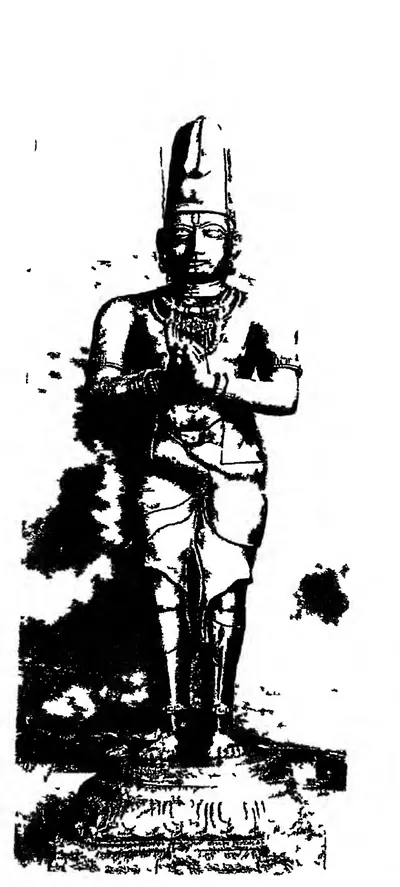
Narasa Nayaka
Narasa Nayaka, of the Tuluva family, was a general of Saluva Narasimha and then regent of Vijayanagara for his young sons from 1492. As regent he held the real power, kept the young king Immadi Narasimha under guard at Penukonda, fought Yusuf Adil Khan of Bijapur and marched as far as Madurai, Srirangapatna and Gokarna. He was the father of Vira Narasimha, Krishnadeva Raya and Achyuta Raya. The sources disagree on whether he died in 1503 or 1505, and on whether he took the throne himself.
Download
Narasa Nayaka was a general of the Tuluva family who ruled Vijayanagara as regent from 1492.12 He served Saluva Narasimha through all his wars, and after Narasimha’s death he governed the kingdom for his young sons.134 He was the father of three kings: Vira Narasimha, Krishnadeva Raya and Achyuta Raya.5 See Vijayanagara and Saluva Narasimha.
Family
Narasa was the son of Isvara Nayaka, the commander of Saluva Narasimha’s armies.67 The Telugu Varahapuranamu says that Isvara, at Narasimha’s order, destroyed the cavalry of the sultan of Bidar near Kandukur.6 Nandi Timmana’s Parijatapaharanamu tells the same story.7
Two poems name Narasa’s queens and their sons:58
- Tippamba, the mother of Vira Narasimha58
- Nagamamba, the mother of Krishnadeva Raya58
- Obamamba, the mother of Achyuta Raya59
Sewell’s later family tree gives the same three queens, as Tippaji, Nagala and Obambika.10 See Krishnadeva Raya and Achyuta Raya.
General of Saluva Narasimha
S. Krishnaswami Aiyangar named four generals who stood out in Saluva Narasimha’s wars: Aravidu Bukka and his son Rama, and Isvara Nayaka and his son Narasa.1 Narasa was probably the youngest of them, and in his view the most distinguished.1
Krishnaswami Aiyangar followed the order of events in the poems.11 Narasa first fought beside his father against the sultan of Bidar.11 Then he campaigned in the Telugu country, probably with his master against the Gajapati and the Bahmani sultan.11 By this reckoning he was on the banks of the Godavari with Narasimha in 1475.11 His fighting life, Krishnaswami Aiyangar thought, began in the 1450s.3
Narasa also gave money to poets. The Telugu Varahapuranamu of Nandi Mallayya and Ghanta Singayya was dedicated to him.12 That poem says that two other works, the Varalakshmikalyanam and the Narasimhapuranam, were also dedicated to him.6
Krishnaswami Aiyangar wrote in 1928 that in 1487 Narasa, commanding Narasimha’s troops, deposed the last Sangama king and took over the government for his master.13 Nilakanta Sastri also says that Narasimha sent Narasa to take the capital.14 See Virupaksha.
Regent
On his deathbed, Nuniz says, Saluva Narasimha left the kingdom to Narasa to govern until his sons came of age.4 He asked Narasa to give the throne to whichever son proved more fit.4 He also reminded him that three rebel forts were still untaken: Raichur, Udayagiri and one that Sewell took to be Kondavidu.154 Krishnaswami Aiyangar gives the forts Narasa was to recover as Raichur, Umagal and Udayagiri.13
The elder son died soon after he was crowned, and Narasa raised the younger son, Immadi Narasimha.1613 When the young king took the side of a captain whom Narasa blamed for his brother’s death, Narasa marched on him.16 After that, Nuniz says, Narasa kept the king at Penukonda under a guard of 20,000 men and governed the kingdom himself.17 An inscription of 1498 calls him not so much the king’s minister as his partner.18 See Immadi Narasimha.
Wars as regent
Nilakanta Sastri describes Narasa’s war in the Raichur doab (the land between the Krishna and the Tungabhadra).19 In 1492–93 the Bahmani minister Qasim Barid offered him Raichur and Mudgal if he would attack Yusuf Adil Khan of Bijapur.19 Narasa’s army laid waste the country as far as those forts.19 Later Yusuf Adil Khan invited Narasa to a peace meeting near Manvi and attacked him there by treachery.19 Even so, in Nilakanta Sastri’s account, the doab stayed with Vijayanagara until 1502.19
The poems written for Narasa’s sons tell of a great march south and west.7520 They say that he did these things:7520
- He defeated the Chola ruler and took Madurai (then Madura).
- He made gifts at Rameswaram.
- He crossed the Kaveri by a bridge, built while the river was in flood, and took Srirangapatna (then Seringapatam).
- He made gifts at Gokarna on the west coast.
- He defeated a sultan at Manavadurga, or Manvi, and gave the fort back to him when he submitted.7520
Krishnaswami Aiyangar thought the war at Manvi was the campaign against Yusuf Adil Shah that Narasa fought as regent in 1493, just after Saluva Narasimha’s death.3 Nilakanta Sastri dates the southern march to about 1496, and the visit to Gokarna to 1497.1921 He adds that about 1499 the new Gajapati king, Prataparudra, attacked, but neither side gained much.21
Death
Nuniz says that Narasa had the young king killed and was then raised to be king himself.2223 The Parijatapaharanamu also says that Narasa ascended the throne of Vijayanagara.7 Sewell’s later work dates the king’s murder to 1505.24 It says that Narasa then seized the throne, but died very soon after.2410
Where the sources disagree
- His mother. The Varadambikaparinayam and the Achyutarayabhyudayam name her Bukkama.525 The Parijatapaharanamu calls her Lakkamba.7
- The Chola and Madurai. The Parijatapaharanamu says Narasa killed the Chola ruler, but the Varadambikaparinayam says the Chola was taken prisoner and later escaped.720 The Varadambikaparinayam says the ruler of Madurai submitted without a fight. The Achyutarayabhyudayam says Narasa killed its Marava ruler in battle.520
- When he died, and whether he was king. Nilakanta Sastri dates his death to 1503, and says he ruled as regent to the end.21 Krishnaswami Aiyangar (1928) dates it to 1505, and says it was his son Vira Narasimha who deposed the Saluva king.26 Sewell’s later work has Narasa seize the throne in 1505 and die soon after.24 Sewell noted that Krishnaswami Aiyangar thought Narasa possibly never took the throne himself.24
Footnotes
-
S. Krishnaswami Aiyangar (ed.), Sources of Vijayanagar History (1919), introduction, p. 8 (archive.org (opens in a new tab)). ↩ ↩2 ↩3 ↩4
-
Nilakanta Sastri, A History of South India, 3rd ed. (1966), p. 274 (archive.org (opens in a new tab)). Paraphrased. ↩
-
Krishnaswami Aiyangar, Sources of Vijayanagar History (1919), introduction, p. 10 (archive.org (opens in a new tab)). ↩ ↩2 ↩3
-
Nuniz, in Sewell, A Forgotten Empire (1900), p. 308 and note (archive.org (opens in a new tab)). ↩ ↩2 ↩3 ↩4
-
Krishnaswami Aiyangar, Sources of Vijayanagar History (1919), p. 108, extract 36, the Achyutarayabhyudayam of Rajanatha (archive.org (opens in a new tab)). ↩ ↩2 ↩3 ↩4 ↩5 ↩6 ↩7 ↩8 ↩9 ↩10
-
Krishnaswami Aiyangar, Sources of Vijayanagar History (1919), p. 88, the Varahapuranamu (archive.org (opens in a new tab)). ↩ ↩2 ↩3
-
Krishnaswami Aiyangar, Sources of Vijayanagar History (1919), p. 106, extract 35, the Parijatapaharanamu of Nandi Timmana (archive.org (opens in a new tab)). ↩ ↩2 ↩3 ↩4 ↩5 ↩6 ↩7 ↩8
-
Krishnaswami Aiyangar, Sources of Vijayanagar History (1919), pp. 109–110, extract 37, the Amuktamalyada (archive.org (opens in a new tab)). ↩ ↩2 ↩3
-
Krishnaswami Aiyangar, Sources of Vijayanagar History (1919), p. 172, the Varadambikaparinayam (archive.org (opens in a new tab)). ↩
-
Sewell, Historical Inscriptions (1932), p. 401, pedigrees of the second and third dynasties (archive.org (opens in a new tab)). ↩ ↩2
-
Krishnaswami Aiyangar, Sources of Vijayanagar History (1919), introduction, p. 9 (archive.org (opens in a new tab)). ↩ ↩2 ↩3 ↩4
-
Krishnaswami Aiyangar, Sources of Vijayanagar History (1919), p. 87, the Varahapuranamu of Nandi Mallayya and Ghanta Singayya (archive.org (opens in a new tab)). ↩
-
S. Krishnaswami Aiyangar, “Hindu States in Southern India”, in Wolseley Haig (ed.), The Cambridge History of India, Vol. III (1928), p. 494 (archive.org (opens in a new tab)). ↩ ↩2 ↩3
-
K. A. Nilakanta Sastri, A History of South India from Prehistoric Times to the Fall of Vijayanagar, 3rd ed. (1966), p. 273 (archive.org (opens in a new tab)). Paraphrased. ↩
-
Fernao Nuniz, “Chronicle”, in Robert Sewell, A Forgotten Empire (Vijayanagar) (1900), p. 307 (archive.org (opens in a new tab)). ↩
-
Nuniz, in Sewell, A Forgotten Empire (1900), p. 309 (archive.org (opens in a new tab)). ↩ ↩2
-
Nuniz, in Sewell, A Forgotten Empire (1900), p. 310 (archive.org (opens in a new tab)). ↩
-
Robert Sewell, ed. S. Krishnaswami Aiyangar, The Historical Inscriptions of Southern India (1932), p. 233 (archive.org (opens in a new tab)). ↩
-
Nilakanta Sastri, A History of South India, 3rd ed. (1966), p. 275 (archive.org (opens in a new tab)). Paraphrased. ↩ ↩2 ↩3 ↩4 ↩5 ↩6
-
Krishnaswami Aiyangar, Sources of Vijayanagar History (1919), p. 171, the Varadambikaparinayam and note (archive.org (opens in a new tab)). ↩ ↩2 ↩3 ↩4 ↩5
-
Nilakanta Sastri, A History of South India, 3rd ed. (1966), p. 276 (archive.org (opens in a new tab)). Paraphrased. ↩ ↩2 ↩3
-
Nuniz, in Sewell, A Forgotten Empire (1900), p. 313 (archive.org (opens in a new tab)). ↩
-
Nuniz, in Sewell, A Forgotten Empire (1900), p. 314 (archive.org (opens in a new tab)). ↩
-
Sewell, Historical Inscriptions (1932), p. 235 (archive.org (opens in a new tab)). ↩ ↩2 ↩3 ↩4
-
Krishnaswami Aiyangar, Sources of Vijayanagar History (1919), p. 170, extract 55, the Varadambikaparinayam of Tirumalamba (archive.org (opens in a new tab)). ↩
-
Krishnaswami Aiyangar, in Cambridge History of India, Vol. III (1928), p. 495 (archive.org (opens in a new tab)). ↩
Related
Dynasties
References
Notes (0)
Sources (5)
Spotted an error on this page? Tell us
Last updated: