Madhu-Kamarnava (Eastern Ganga)
Madhu-Kamarnava was the eldest son of the Eastern Ganga king Anantavarman Chodaganga to rule Kalinga after him, in the middle of the 12th century. He was anointed in 1142, while his very old father was still alive. His records, which call him Anantavarman or Jatesvara, are found only at Srikurmam and Mukhalingam in today's Srikakulam district. Robert Sewell dates his reign to 1142 or 1146–1152, and R. D. Banerji thought he died in 1156.
Download
Madhu-Kamarnava was a king of the Eastern Gangas of Kalinga, the coast north of the Godavari.12 He was the first of four sons of Anantavarman Chodaganga who ruled one after another.1 His records are found only in the Telugu north, at Srikurmam and Mukhalingam in today’s Srikakulam district.3
Family
Anantavarman Chodaganga had many queens.1 R. D. Banerji, in his History of Orissa (1930), named Kasturikamodini as Madhu-Kamarnava’s mother.1 His brothers Raghava, Rajaraja II and Aniyanka-Bhima ruled after him.1 Banerji thought that the sons were already old men when they came to the throne.4
Crowned in his father’s lifetime
Madhu-Kamarnava was anointed king in Saka 1064, about 1142 (Saka is an Indian way of counting years).4 But a votive record at Mukhalingam shows his father still alive and ruling in Saka 1069, about 1148.4 So Banerji concluded that the anointing did not mean that Madhu-Kamarnava really took power.4 He accepted an earlier suggestion that the old king was by then unable to govern.4
Names and records
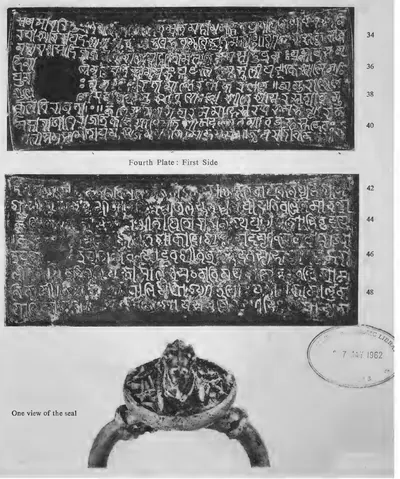
His votive inscriptions call him Anantavarman, like his father.3 In one or two of them he is called Anantavarman Madhu-Kamarnava, to mark him off from his father.3 One record at Mukhalingam calls him Jatesvaradeva.3 Robert Sewell’s table (1932) also gives him the names Kumara and Jatesvara.2
V. Rangacharya’s list of inscriptions shows two of these records:
- a Telugu record at Srikurmam of the Ganga king Anantavarma-Madhukamarnavadeva, in Saka 1071 and his fourth year, now badly damaged5
- a record of Jatesvaradeva at Mukhalingam, in Saka 1070 and his third year, about the gift of a lamp6
Rangacharya took Jatesvara to be a title of the Anantavarman who followed Chodaganga.6 See the temples of Mukhalingam and the Srikurmam temple.
End of the reign
Later grants of the family say that Madhu-Kamarnava ruled for ten years.4 Banerji noted that it is not known from when these years were counted.4 His latest known date, Saka 1077, is called his tenth year.4 Banerji thought that he died, probably without a son, in Saka 1078, about 1156.43 His half-brother Raghava followed him.4
Where the sources disagree
- When did he begin to rule? F. Kielhorn placed his accession in 1142, the year of his anointing.1 Banerji showed that his father was still ruling in 1148.4 Rangacharya took 1146 as the year he succeeded Chodaganga.6 Sewell gives both 1142 and 1146.2
- When did he die? Sewell’s table ends his reign in 1152.2 Banerji placed his death in 1156.4
Footnotes
-
R. D. Banerji, History of Orissa from the Earliest Times to the British Period, Vol. I (1930), p. 252 (archive.org (opens in a new tab)). ↩ ↩2 ↩3 ↩4 ↩5 ↩6
-
Robert Sewell, The Historical Inscriptions of Southern India (1932), p. 358, genealogical table of the Eastern Gangas (archive.org (opens in a new tab)). Paraphrased. ↩ ↩2 ↩3 ↩4
-
Banerji, History of Orissa, Vol. I (1930), p. 254 (archive.org (opens in a new tab)). ↩ ↩2 ↩3 ↩4 ↩5
-
Banerji, History of Orissa, Vol. I (1930), p. 253 (archive.org (opens in a new tab)). ↩ ↩2 ↩3 ↩4 ↩5 ↩6 ↩7 ↩8 ↩9 ↩10 ↩11 ↩12
-
V. Rangacharya, A Topographical List of the Inscriptions of the Madras Presidency, Vol. I (1919), p. 695, Ganjam No. 261 (archive.org (opens in a new tab)). ↩
-
Rangacharya, Topographical List, Vol. I (1919), p. 702, Ganjam No. 329 (archive.org (opens in a new tab)). ↩ ↩2 ↩3
Related
Dynasties
References
Notes (0)
Sources (3)
Spotted an error on this page? Tell us
Last updated: