Muhammad bin Tughluq
Sultan of Delhi (1325–1351). As Prince Ulugh Khan he besieged Warangal twice in the early 1320s, captured the Kakatiya king Prataparudra and renamed the city Sultanpur. As sultan he held Telingana as a province until a Telugu rising, after his visit of 1335, took Warangal from his governor. This page covers only his part in the history of the Telugu country.
Muhammad bin Tughluq was a sultan of Delhi.12 As Prince Ulugh Khan, he captured Warangal and sent the Kakatiya king Prataparudra to Delhi.3 He became sultan in 1325, and later lost Warangal to a Hindu revolt under Kanya Naik.14 This page covers only his part in the history of the Telugu country.
Ulugh Khan and Warangal
Muhammad bin Tughluq was the eldest son of Ghiyas-ud-din Tughluq.56 On his accession in 1320, his father gave him the title of Ulugh Khan and named him heir.56 Ferishta calls him Aluf Khan.6
Barani says that in AH 721 (1321; AH is the Islamic way of counting years) the sultan sent him “with a canopy and an army against Arangal and Tilang” (Warangal and Telangana).7 The first siege broke up when false news of the sultan’s death spread through the camp, and several of the old nobles deserted.8 The prince retreated to Devagiri.8 Ibn Battuta, followed by Haig, says that the prince had himself planned to seize the throne and had the rumour spread.910
With fresh troops he took Bidar, returned to Warangal and captured it.3 He sent Prataparudra and his family to Delhi.3 Barani says that “the name of Arangal was changed to Sultanpur, and all the country of Tilang was conquered”.3 Haig dates the second campaign to 1323.10
He then marched into Jajnagar in Orissa and took forty elephants.1112 He stayed at Warangal until his father called him back to Delhi.1112 See the page of the Delhi Sultanate in the Telugu country for the campaigns, and also Prataparudra and Warangal.
The Vilasa grant of Prolaya Nayaka was issued about 1330.13 In it, the sultan who fought Prataparudra and carried him off is called “Ahammada Suratrana”, lord of the Turushkas (Turks).13 His army is put at nine lakh horses.13 The grant’s editors set this account beside the Persian narratives of Ulugh Khan’s two sieges.14
Sultan of Delhi
Ulugh Khan became sultan in AH 725 (1325) on the death of his father.12 His father was killed when a wooden pavilion built by the prince at Afghanpur collapsed on him.12 Haig, following Ibn Battuta, thought the collapse was planned on purpose.2
Ferishta says that he brought the distant provinces, Warangal among them, fully under his rule.15 They were “as effectually incorporated with the empire as the villages in the vicinity of Dehly”.15 S. Krishnaswami Aiyangar dates a campaign that brought Warangal and Dvarasamudra back to obedience to about 1327–28.16
According to the editors of the Vilasa grant, his officer Salar Ulwi built the great mosque of Rajahmundry in 1324, while he was still prince.17 Coins of his reign struck at Sultanpur are listed in the British Museum catalogue of 1884.1 The catalogue identifies the mint with Warangal.1
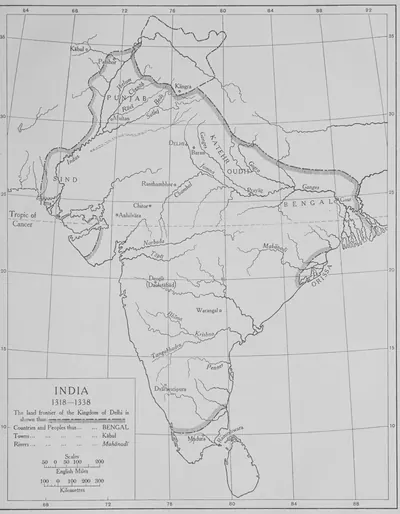
In 1335 he marched south against the rebel governor of Madurai (then Madura), by way of Daulatabad, Bidar and Warangal. Barani says that he found cholera at Warangal and caught it himself.1819 He “appointed Malik Kabul, the naib-wazir, to be ruler over Tilang, and himself returned homewards with all speed”.1819
Ibn Battuta calls the place Badrakot, “capital of Tilang”.20 Ferishta says that the officer left in command was Imad-ul-Mulk.21 Soon afterwards, Barani says, a Hindu revolt under Kanya Naik drove Malik Makbul out of Warangal, “which was thus entirely lost”.4 Ferishta dates the loss to AH 744 (1343–44).22 See Malik Maqbul and Kapaya Nayaka.
Evidence and disagreements
- The first siege of Warangal. Mutiny caused by malicious favourites and a false rumour (Barani), or by the prince’s own attempt at the throne (Ibn Battuta, Haig).8910
- The capture of Warangal. 1321 (Barani’s year for the campaign), after a retreat in 1322 (Ferishta), or 1323 (Haig).72310
- The loss of Warangal. After 1335 (Barani’s order of events) or 1343–44 (Ferishta).422
Footnotes
-
Stanley Lane-Poole, The Coins of the Sultans of Dehli in the British Museum (1884), p. xv and note (archive.org (opens in a new tab)). ↩ ↩2 ↩3 ↩4 ↩5 ↩6
-
Haig, Cambridge History of India, Vol. III (1928), p. 134 (archive.org (opens in a new tab)). ↩ ↩2 ↩3 ↩4
-
Elliot and Dowson, Vol. III (1871), p. 233, Barani (archive.org (opens in a new tab)). ↩ ↩2 ↩3 ↩4
-
Elliot and Dowson, Vol. III (1871), p. 245, Barani (archive.org (opens in a new tab)). ↩ ↩2 ↩3
-
Wolseley Haig (ed.), The Cambridge History of India, Vol. III (1928), p. 127 (archive.org (opens in a new tab)). ↩ ↩2
-
Muhammad Qasim Ferishta, tr. John Briggs, History of the Rise of the Mahomedan Power in India, Vol. I (1829), p. 402 (archive.org (opens in a new tab)). ↩ ↩2 ↩3
-
H. M. Elliot and John Dowson, The History of India as Told by Its Own Historians, Vol. III (1871), p. 231, Barani (archive.org (opens in a new tab)). ↩ ↩2
-
Elliot and Dowson, Vol. III (1871), p. 232, Barani (archive.org (opens in a new tab)). ↩ ↩2 ↩3
-
Elliot and Dowson, Vol. III (1871), p. 609, Ibn Batuta (archive.org (opens in a new tab)). ↩ ↩2
-
Haig, Cambridge History of India, Vol. III (1928), pp. 130–131 (archive.org (opens in a new tab)). ↩ ↩2 ↩3 ↩4
-
Elliot and Dowson, Vol. III (1871), p. 234, Barani (archive.org (opens in a new tab)). ↩ ↩2
-
Ferishta, tr. Briggs, Vol. I (1829), pp. 405–406 (archive.org (opens in a new tab)). ↩ ↩2
-
N. Venkataramanayya and M. Somasekhara Sarma, “Vilasa Grant of Prolaya-nayaka”, Epigraphia Indica XXXII (1957–58), p. 241 (archive.org (opens in a new tab)). Paraphrased. ↩ ↩2 ↩3
-
Venkataramanayya and Somasekhara Sarma, “Vilasa Grant” (1957–58), p. 244 (archive.org (opens in a new tab)). Paraphrased. ↩
-
Ferishta, tr. Briggs, Vol. I (1829), p. 413 (archive.org (opens in a new tab)). ↩ ↩2
-
S. Krishnaswami Aiyangar, South India and her Muhammadan Invaders (1921), p. 136 (archive.org (opens in a new tab)). ↩
-
Venkataramanayya and Somasekhara Sarma, “Vilasa Grant” (1957–58), pp. 252–253 (archive.org (opens in a new tab)). Paraphrased. ↩
-
Elliot and Dowson, Vol. III (1871), pp. 243–244, Barani (archive.org (opens in a new tab)). ↩ ↩2
-
Haig, Cambridge History of India, Vol. III (1928), p. 149 (archive.org (opens in a new tab)). ↩ ↩2
-
Elliot and Dowson, Vol. III (1871), p. 619, Ibn Batuta (archive.org (opens in a new tab)). ↩
-
Ferishta, tr. Briggs, Vol. I (1829), p. 423 (archive.org (opens in a new tab)). ↩
-
Ferishta, tr. Briggs, Vol. I (1829), p. 427 (archive.org (opens in a new tab)). ↩ ↩2
-
Ferishta, tr. Briggs, Vol. I (1829), p. 404 (archive.org (opens in a new tab)). ↩
Photos
References
Notes (0)
Sources (6)
Spotted an error on this page? Tell us
Last updated: