Narasimha II (Eastern Ganga)
Narasimha II was an Eastern Ganga king of Kalinga and Orissa from about 1275 to 1306, the son of Bhanudeva I. A Madhva hymn says that he came to the throne as a baby and that the teacher Naraharitirtha governed for him, and Naraharitirtha's inscriptions at Srikurmam and Simhachalam fall in these years. Many gifts in the temples of Srikurmam and Simhachalam are dated in his reign. His Kenduapatna plates of 1296 show him on campaign near the Ganges against the Muslim rulers of Bengal.
Download
Narasimha II was a king of the Eastern Gangas, who ruled Kalinga and Orissa, from about 1275 to 1306.12 He was the son of Bhanudeva I.3 More records of his reign survive in the Telugu north than of almost any other Ganga king, mostly in the temples of Srikurmam and Simhachalam.24
Family
R. D. Banerji, in his History of Orissa (1930), made Narasimha II the son of Bhanudeva I and Jakalladevi, of the Chalukya family.3 His queen was Chodadevi, and their son Bhanudeva II followed him.5
A boy king and his regent
Banerji followed the Narahari-yati-stotra, a hymn of the Madhva school, on the start of the reign.3 It says that Narasimha II was a baby when his father died.3 The Madhva teacher Naraharitirtha, a pupil of the philosopher Anandatirtha, ruled for him as regent for twelve years.3 When the king grew up, Naraharitirtha asked for images of Rama and Sita from the royal treasury, and took them to his master.36
An inscription at Srikurmam, edited by H. Krishna Sastri, says that Naraharitirtha “seems to have been the governor of the Kalinga country”.7 It says that he defended Srikurmam against the forest people called Savaras, and built a shrine of Yogananda-Narasimha there on 29 March 1281.76 Krishna Sastri found that Naraharitirtha’s inscriptions in the Kalinga country range from 1264 to 1294.8 One of 1293 is dated in the 18th year of Narasimha II.8 See the Srikurmam inscription of Naraharitirtha.
Gifts in the Telugu temples
V. Rangacharya’s lists show many gifts in the reign of a king Vira-Narasimha, whom Rangacharya identified with Narasimha II:
- at Srikurmam, a minister of Vira-Narasimhadeva gave gold in Saka 1212, his 14th year (Saka is an Indian way of counting years)4
- also at Srikurmam, the minister Garudanarayanadeva gave gold and cows in Saka 1219, his 23rd year9
- at Simhachalam, Nagumandalika, leader of the Kalinga forces, gave two lamps in Saka 1213, his 15th year10
- at Simhachalam, the minister Anantangamahapatra paid for temple musicians in Saka 121211
- a slab at Kasimkota, near Anakapalle, records land given to the goddess Durga at Bhogapura in his 7th year12
Banerji wrote that his last known date is Saka 1227, about 1305.2 His inscriptions give him 34 ankas, which Banerji took to be 28 real years.2
Wars with Bengal
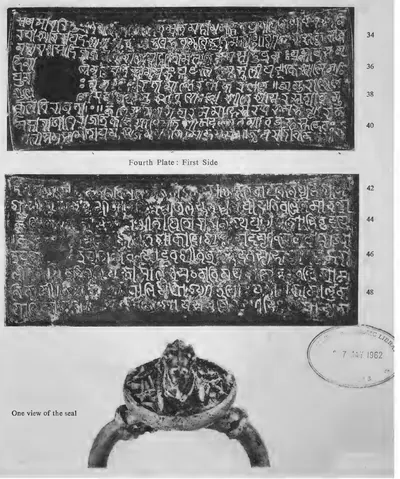
Three sets of copper plates of Narasimha II were found at Kenduapatna, in the Cuttack district.213 They give the whole family tree of the Eastern Gangas in 105 verses.13 One set was issued on 6 August 1296, while the king was at Remuna, near the Ganges, “in the time of conquest”.13 Banerji took this to mean a campaign against the Muslim rulers of Bengal.1314
Narasimha II died in Saka 1228, about 1306, and his son Bhanudeva II followed him.5
Where the sources disagree
- When did he come to the throne? Robert Sewell placed his accession between May and September 1275.1 E. Hultzsch, in 1896, put it about 1275–76.15 Rangacharya worked out 1276 from a Srikurmam record of the king’s 14th year.4
- The regency. The Madhva hymn says that Naraharitirtha ruled Kalinga for twelve years.8 Krishna Sastri noted that his inscriptions there cover thirty years.8 Banerji also noted that the great Srikurmam inscription of 1281 seems to show him still governing, against the twelve-year story.2
Footnotes
-
Robert Sewell, The Historical Inscriptions of Southern India (1932), p. 359, notes to the genealogy of the Eastern Gangas (archive.org (opens in a new tab)). Paraphrased. ↩ ↩2
-
Banerji, History of Orissa, Vol. I (1930), p. 272 (archive.org (opens in a new tab)). ↩ ↩2 ↩3 ↩4 ↩5 ↩6
-
R. D. Banerji, History of Orissa from the Earliest Times to the British Period, Vol. I (1930), p. 270 (archive.org (opens in a new tab)). ↩ ↩2 ↩3 ↩4 ↩5 ↩6
-
Rangacharya, Topographical List, Vol. I (1919), p. 686, Ganjam No. 150 (archive.org (opens in a new tab)). ↩ ↩2 ↩3
-
Banerji, History of Orissa, Vol. I (1930), p. 275 (archive.org (opens in a new tab)). ↩ ↩2
-
Banerji, History of Orissa, Vol. I (1930), p. 271 (archive.org (opens in a new tab)). ↩ ↩2
-
H. Krishna Sastri, “Srikurmam Inscription of Naraharitirtha; Saka-Samvat 1203”, Epigraphia Indica VI (1900–01), p. 260 (archive.org (opens in a new tab)). ↩ ↩2
-
Krishna Sastri, “Srikurmam Inscription of Naraharitirtha” (1901), p. 262 and notes 4–5 (archive.org (opens in a new tab)). ↩ ↩2 ↩3 ↩4
-
Rangacharya, Topographical List, Vol. I (1919), p. 690, Ganjam No. 201 (archive.org (opens in a new tab)). ↩
-
Rangacharya, Topographical List, Vol. III (1919), p. 1680, Vizagapatam No. 125 (archive.org (opens in a new tab)). ↩
-
Rangacharya, Topographical List, Vol. III (1919), p. 1685, Vizagapatam No. 185 (archive.org (opens in a new tab)). ↩
-
Rangacharya, Topographical List, Vol. III (1919), p. 1665, Vizagapatam No. 3 (archive.org (opens in a new tab)). ↩
-
Banerji, History of Orissa, Vol. I (1930), p. 273 (archive.org (opens in a new tab)). ↩ ↩2 ↩3 ↩4
-
Banerji, History of Orissa, Vol. I (1930), p. 274 (archive.org (opens in a new tab)). ↩
-
V. Rangacharya, A Topographical List of the Inscriptions of the Madras Presidency, Vol. I (1919), p. 685, introduction to Srikurmam, quoting the Madras epigraphical report for 1896 (archive.org (opens in a new tab)). ↩
Related
Dynasties
References
Notes (0)
Sources (5)
Spotted an error on this page? Tell us
Last updated: