Bhanudeva II (Eastern Ganga)
Bhanudeva II was an Eastern Ganga king of Kalinga and Orissa in the early 14th century, the son of Narasimha II. Chiefs descended from the Eastern Chalukyas served him at Srikurmam and Simhachalam. The Puri plates of his grandson credit him with a war against Ghiyasuddin, whom scholars identify with the Delhi sultan Ghiyasuddin Tughluq. R. D. Banerji argued that for some years a usurper named Purushottama kept him a prisoner in his own palace at Puri.
Download
Bhanudeva II was a king of the Eastern Gangas, who ruled Kalinga and Orissa in the early 14th century.12 He was the son of Narasimha II.1 In his time the Delhi sultans destroyed the Kakatiya kingdom to the south, and their armies also reached Bengal and Orissa.13
Family
R. D. Banerji, in his History of Orissa (1930), made Bhanudeva II the son of Narasimha II by his queen Chodadevi.1 His queen was Lakshmidevi, and their son Narasimha III followed him.45 Banerji noted that, until his time, his reign was known almost only from the Puri plates of his grandson Narasimha IV and from a few gifts at Srikurmam.1
Vassals in the Telugu north
Chiefs who traced their descent from the Eastern Chalukya kings of Vengi served the Gangas at Srikurmam.6 E. Hultzsch edited their records in 1899.6 One of them, Jagannatha or Visvanatha, made a gift there in Saka 1231, about 1309 (Saka is an Indian way of counting years).6 His record calls him a vassal of Virabhanudeva, whom Hultzsch identified with Bhanudeva II, the successor of Narasimha II.6 See the inscriptions of the Chalukya chiefs.
At Simhachalam, several chiefs gave cows to the temple in the third year of Anantavarma-Pratapavira-Bhanudeva, Saka 1229, about 1307.78 Among them were Anantajiyana, governor of Chikati and minister of the Ganga kings, and the Chalukya chief Visvanatha.78 V. Rangacharya took this king to be the son of Narasimha II.8 At Srikurmam a military officer of Viradhivira-Bhanudeva gave a lamp in Saka 1243, about 1321.9
War with Ghiyasuddin
The Puri plates of Narasimha IV praise Bhanudeva II for a war with “Ghayasud-din”.3 They say that the blood of the enemy’s chiefs and elephants “filled the world”.3 Banerji followed the scholar M. Chakravarti in identifying this enemy with the Delhi sultan Ghiyasuddin Tughluq.3
In Banerji’s account, the sultan marched into Bengal in 1324, while his son Ulugh Khan took Warangal and then Rajahmundry.13 Chakravarti had linked the war to the fall of Rajahmundry.3 Banerji argued instead that Bhanudeva fought the sultan himself, during his campaign in Bengal.3 See Muhammad bin Tughluq.
A rival at Puri
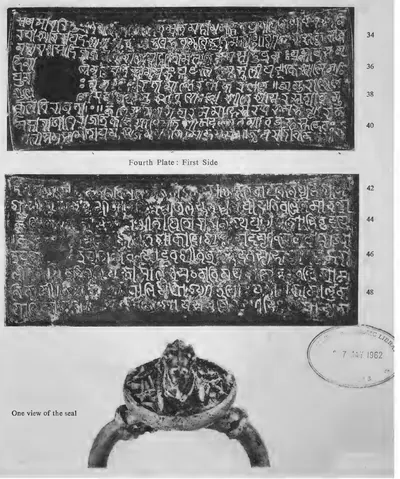
A set of copper plates found in the Puri district, dated Saka 1234, about 1312, records a grant by a king named Purushottama.1011 In it, the grant was announced inside the palace at Puri to “Vira-Sri-Bhanudeva Rauta”, who is not called king.1213 Banerji concluded that Purushottama was a usurper who kept Bhanudeva II “virtually a prisoner” in his palace.13 He thought that the usurpation did not last beyond 1312.13
Banerji also noted a Srikurmam record of 6 August 1321.13 In it Gharadamaji Sri-Rama-Senapati, called a protector of Kalinga and a minister of Bhanudeva, made a gift.134
Where the sources disagree
- His dates. Robert Sewell’s table (1932) gives 1305–06 to 1322–23 or 1324–25.2 Rangacharya thought he came to the throne in 1304.8 Banerji placed his death in 1328.13
- The war with Ghiyasuddin. Chakravarti connected it with Ulugh Khan’s capture of Rajahmundry.3 Banerji placed it in the sultan’s Bengal campaign of 1324.3
- Purushottama. Chakravarti took Saka 1231, the date of a Srikurmam record, to be Bhanudeva II’s third year.11 Banerji read the record as dated in the third year of a new king, Jagannathadeva, and argued for a usurpation.1113
Footnotes
-
R. D. Banerji, History of Orissa from the Earliest Times to the British Period, Vol. I (1930), p. 275 (archive.org (opens in a new tab)). ↩ ↩2 ↩3 ↩4 ↩5 ↩6
-
Robert Sewell, The Historical Inscriptions of Southern India (1932), p. 358, genealogical table of the Eastern Gangas (archive.org (opens in a new tab)). Paraphrased. ↩ ↩2
-
Banerji, History of Orissa, Vol. I (1930), p. 276 (archive.org (opens in a new tab)). ↩ ↩2 ↩3 ↩4 ↩5 ↩6 ↩7 ↩8 ↩9
-
Banerji, History of Orissa, Vol. I (1930), p. 281 (archive.org (opens in a new tab)). ↩ ↩2
-
Banerji, History of Orissa, Vol. I (1930), p. 288, genealogical table of the Eastern Gangas (archive.org (opens in a new tab)). ↩
-
E. Hultzsch, “Four Pillar Inscriptions of Eastern Chalukya Chiefs at Srikurmam”, Epigraphia Indica V (1898–99), p. 32 (archive.org (opens in a new tab)). ↩ ↩2 ↩3 ↩4
-
Rangacharya, Topographical List, Vol. III (1919), p. 1682, Vizagapatam No. 155 (archive.org (opens in a new tab)). ↩ ↩2
-
Rangacharya, Topographical List, Vol. III (1919), p. 1683 (archive.org (opens in a new tab)). ↩ ↩2 ↩3 ↩4
-
V. Rangacharya, A Topographical List of the Inscriptions of the Madras Presidency, Vol. I (1919), p. 688, Ganjam No. 180 (archive.org (opens in a new tab)). ↩
-
Banerji, History of Orissa, Vol. I (1930), p. 277 (archive.org (opens in a new tab)). ↩
-
Banerji, History of Orissa, Vol. I (1930), p. 279 (archive.org (opens in a new tab)). ↩ ↩2 ↩3
-
Banerji, History of Orissa, Vol. I (1930), p. 278 (archive.org (opens in a new tab)). ↩
-
Banerji, History of Orissa, Vol. I (1930), p. 280 (archive.org (opens in a new tab)). ↩ ↩2 ↩3 ↩4 ↩5 ↩6 ↩7
Related
Dynasties
References
Notes (0)
Sources (5)
Spotted an error on this page? Tell us
Last updated: