Bodhan
Town in the Nizamabad district of Telangana, 16 miles west of Nizamabad, the Bodana or Bhaudhanya-nagara of the inscriptions. A Kannada inscription of 1056, in the reign of the Chalukya king Somesvara I, records the renovation of its temple of Indranarayana. It says that the Rashtrakuta king Indravallabha had built that temple. Inscriptions in its ruined fort wall show that it was a Jain centre in the 11th and 12th centuries.
In 1909 the Imperial Gazetteer described Bodhan as the headquarters of the taluk of the same name in the Nizamabad district of Hyderabad State.1 It lay sixteen miles west of Nizamabad town and had a population of 6,438.1 The gazetteer noted a Jama Masjid, a temple of Narsingaswami, and three large irrigation tanks on the east, north and south of the town.1
The temple of Indranarayana
A Kannada inscription at Bodhan is dated in the Saka year 978 (29 May 1056), in the reign of the Western Chalukya king Somesvara I.2 It records that the king’s officer Pergade Jogapayya renovated the temple of Indranarayana.2 The inscription says that the Rashtrakuta king Indravallabha had built the temple in the capital Bodana, and that it had fallen into ruin.2
Jogapayya installed an image of Vishnu and set up a Garuda pillar.2 He gave house-sites, oil mills and a flower garden for the temple’s services.2 See the Bodhan inscription of 1056.
P. B. Desai summarised the record in 1961.2 He cautioned that the word rajadhani (capital) used of Bodana need not mean that it was ever a capital of the Rashtrakuta empire.2 Records of this collection use the word for the chief town of a region.2 The record does not say which Rashtrakuta king Indra was meant.2
A Jain centre
The editors of Epigraphia Telanganica (2023) summarise Indian Archaeology 1961–62. They list the same record with four others found in the ruined fort wall. Three of these record the deaths of Jain preceptors (teachers) by samadhi or sannyasa (ritual death and renunciation).3 They show that Bhaudhanya-nagara was a Jain centre in the 11th and 12th centuries.3
Podana and the Chalukyas of Vemulavada
Two records tell a story about Podana: the Vemulavada inscription of Arikesari II and the Parbhani plates of his grandson. Both say that Vinayaditya-Yuddhamalla, the founder of the Chalukyas of Vemulavada, had his elephants bathed in a tank, or tanks, filled with oil at Podana. Pampa tells the same story but makes it five hundred elephants and several tanks.45
N. Venkataramanayya described Podana as an ancient town in the Nizamabad district.6 He thought it was probably Yuddhamalla’s capital, to which he returned after serving the Rashtrakuta Dantidurga in the north.6
The editors of The Early History of the Deccan (1960) also identified Podana with Bodhan, and they suggested that Yuddhamalla received a fief (land grant) near it as a reward for his services to Dantidurga.78 They also suggested that it marked a stage in the family’s move east to Vemulavada.78
The “tomb of Pampa”
A memorial pillar stood on the mud fort wall at Bodhan, and it was locally said to be the tomb of the poet Pampa. A short Sanskrit inscription on it records that the Jaina monk Subhanandi, a disciple of Devendra Siddhanta, attained samadhi and went to the world of the gods. It does not mention Pampa. Sitarama Jagirdar published the inscription in Epigraphia Andhrica II (1974).910 He dated the letters to the middle of the 10th century.910 He argued that Subhanandi was the name Pampa took as a monk, since the Adipurana gives Pampa another name, Subha.910
Footnotes
-
Imperial Gazetteer of India, Provincial Series: Hyderabad State (1909), p. 132 (archive.org (opens in a new tab)). ↩ ↩2 ↩3
-
P. B. Desai (introduction), Kannada Inscriptions of Andhra Pradesh (Andhra Pradesh Government Archaeological Series 3, 1961), p. 20, No. 54 (archive.org (opens in a new tab)). Paraphrased. ↩ ↩2 ↩3 ↩4 ↩5 ↩6 ↩7 ↩8 ↩9
-
Gajjala Vasanta Lakshmi (ed.), Epigraphia Telanganica I: Pre-Kakatiya Telangana (2023), p. 83, Rashtrakuta No. 23, summarising Indian Archaeology 1961–62, p. 80. Cite-only; paraphrased. ↩ ↩2
-
N. Venkataramanayya, The Chalukyas of L(V)emulavada (1953), p. 14 (archive.org (opens in a new tab)). Paraphrased. ↩
-
Venkataramanayya, Chalukyas of L(V)emulavada (1953), p. 92 (archive.org (opens in a new tab)). Paraphrased. ↩
-
Venkataramanayya, Chalukyas of L(V)emulavada (1953), p. 18 (archive.org (opens in a new tab)). Paraphrased. ↩ ↩2
-
K. A. Nilakanta Sastri and N. Venkataramanayya, “The Chalukyas of Vemulavada”, appendix C to “The Eastern Chalukyas”, in G. Yazdani (ed.), The Early History of the Deccan, Parts VII–XI (1960), p. 507. Cite-only; paraphrased. ↩ ↩2
-
Nilakanta Sastri and Venkataramanayya, “The Chalukyas of Vemulavada” (1960), p. 508. Cite-only; paraphrased. ↩ ↩2
-
Gajjala Vasanta Lakshmi (ed.), Epigraphia Telanganica I: Pre-Kakatiya Telangana (2023), p. 403, reprinting Sitarama Jagirdar, “Pampa’s Samadhi”, Epigraphia Andhrica II (1974), pp. 31–35. Cite-only; paraphrased. ↩ ↩2 ↩3
-
Epigraphia Telanganica I (2023), p. 404, reprinting Jagirdar (1974). Cite-only; paraphrased. ↩ ↩2 ↩3
Photos
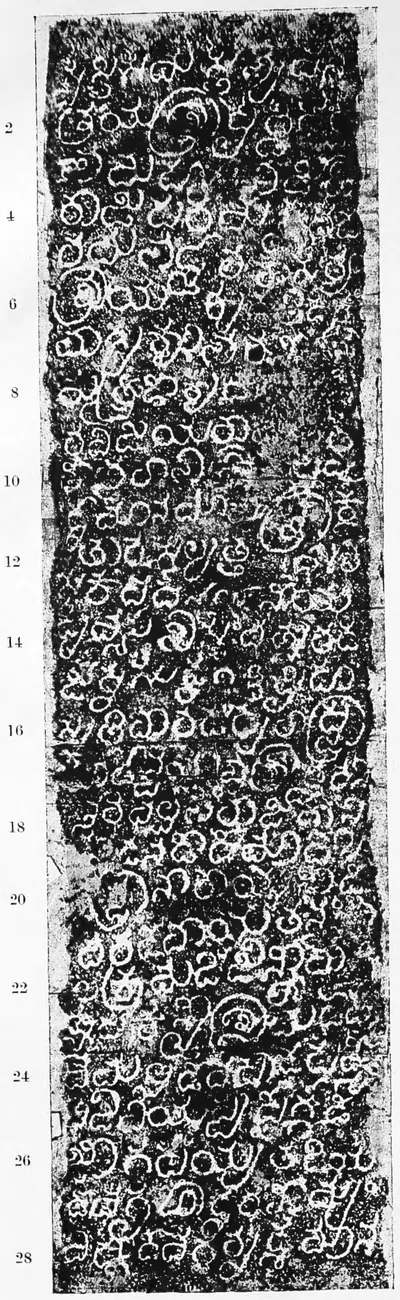 "Bodhan Stone Inscription", Plate I, first face, lines 1-28 (Hyderabad Archaeological Series No. 7, 1925)Inscription rubbing · 1925
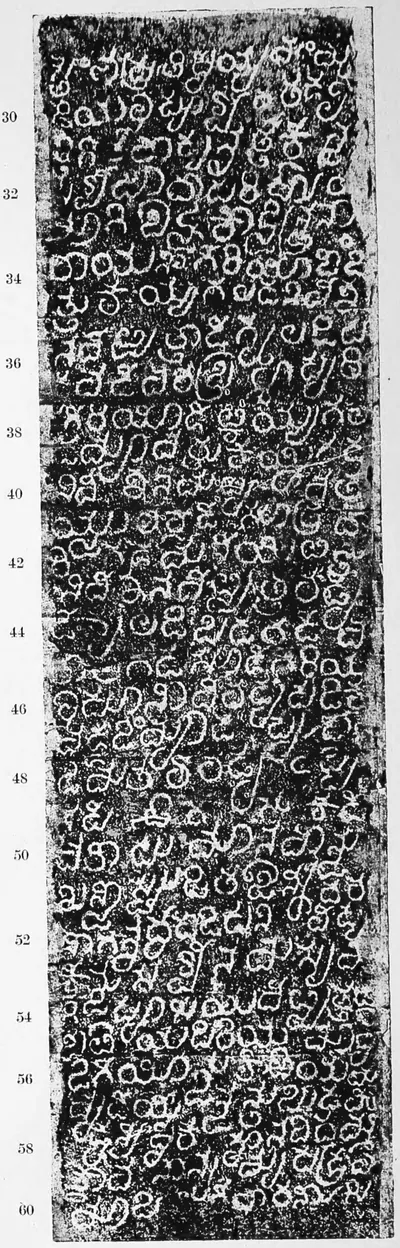 "Bodhan Stone Inscription", Plate I, second face, lines 29-60 (Hyderabad Archaeological Series No. 7, 1925)Inscription rubbing · 1925
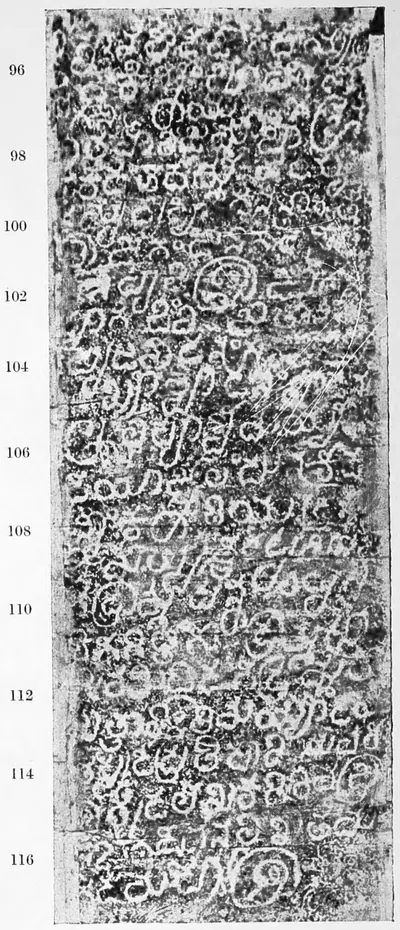 "Bodhan Stone Inscription", Plate II, fourth face, lines 95-117 (Hyderabad Archaeological Series No. 7, 1925)Inscription rubbing · 1925
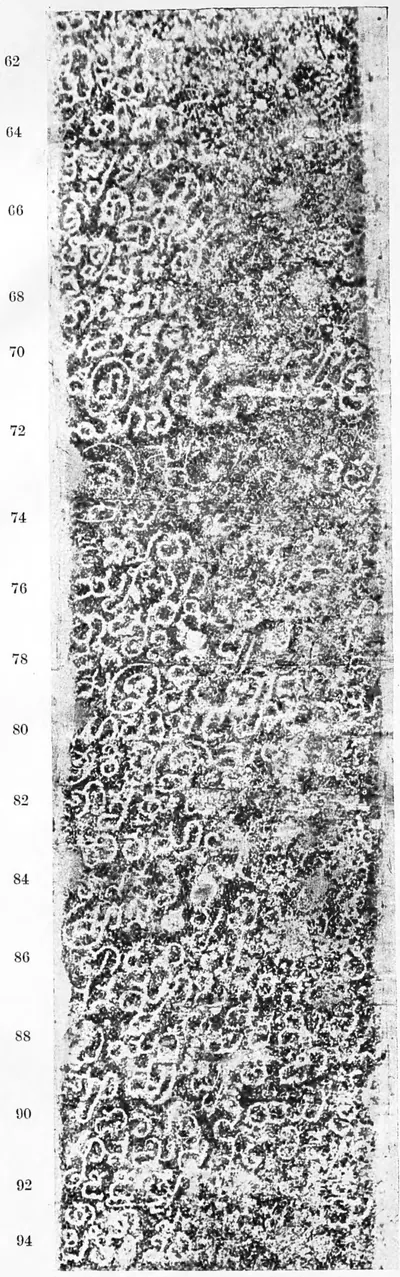 "Bodhan Stone Inscription", Plate II, third face, lines 61-94 (Hyderabad Archaeological Series No. 7, 1925)Inscription rubbing · 1925
References
Notes (0)
Sources (5)
Spotted an error on this page? Tell us
Last updated: