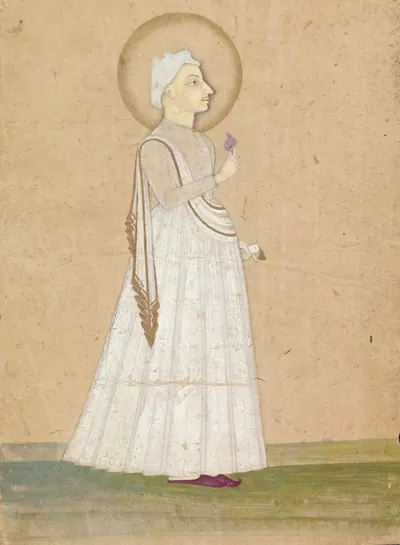
Madhavrao I
Peshwa (chief minister) of the Marathas from 1761 to his death in November 1772, and the son of Balaji Baji Rao. As a young man he fought beside his uncle Raghunath Rao against Nizam Ali at Rakshasbhuvan on the Godavari in 1763. In his wars with Haidar Ali of Mysore he took Sira in 1767, and the Mysore commander Mir Sahib then received Gurramkonda from the Marathas. His uncle Trimbak Rao took Gurramkonda by siege in 1771. The treaty of June 1772 left it with the Marathas until Tipu took it back in 1773–74.
Madhavrao was the second son of the Peshwa (chief minister) Balaji Baji Rao.12 He was invested as Peshwa after his father’s death in 1761, when the Marathas had just been defeated at Panipat.12 His uncle Raghunath Rao acted at first as regent.12 In the Telugu country he is met in the wars with the Nizam and with Haidar Ali over the forts of the Mysore and Kadapa (then Cuddapah) uplands. See the Marathas in the Telugu country.
Against Nizam Ali, 1761–1763
After the peace of 1761–62 with Nizam Ali Khan, Grant Duff says, “the young Peishwa … was sent into the southern territory for the collection of revenue”.3 When he asked for a share in the government, his uncle Raghunath Rao took up arms with Mughal help.45 Madhavrao at once decided to put himself in his uncle’s power.45 He saw this as “the only means of preventing a complete division in the state”, and he was placed in confinement.45
In the war of 1763 he was still in confinement.67 Even so, he gave his uncle “the full support of his influence and counsel”.67 The battle was fought on the Godavari at “Rakisbone” (Rakshasbhuvan).67 There, Grant Duff writes, “the young Peishwa particularly distinguished himself”.67 He showed personal energy, and he sent wise support to his uncle and to different points of the attack.67 Afterwards he “openly reproached” the Bhonsle raja Janoji for deserting the Nizam for a bribe.8
Sira and Gurramkonda, 1767
In January 1767 Madhavrao crossed the Krishna.9 Before the end of March he took Sira, Hoskote and Madhugiri from Haidar Ali.9 He also took more than thirty lakhs of tribute.9
According to Wilks, Madhavrao reached Rayadurg early in February and followed the dry bed of the Hagari to Sira.1011 The commander of Sira was Haidar’s brother-in-law Mir Sahib.1011 Madhavrao offered him terms of surrender, “which was gladly accepted”.1011 By accepting, Wilks says, Mir Sahib “betrayed his trust”.1011 He “gave up the fort and district of Sera; and received in return, as a Mahratta dependency, the fort and district of Goorumconda”.1011
Grant Duff notes that the Poona accounts do not mention this exchange.9 Gribble’s Cuddapah manual says that Mir Sahib soon afterwards gave Gurramkonda up to Haidar.12 See Gurramkonda.
The war of 1770–1772
In his last war with Haidar the Peshwa fell ill and returned to Poona, leaving his uncle Trimbak Rao with the army. Trimbak Rao’s first task, Wilks says, “was the attack of Goorumconda”.131415 The fort was held by Mir Sahib’s nephew Sayyid Sahib.131415 It “sustained a siege of two months, and then capitulated”, through the guarantee of Morari Rao of Gooty.131415
In Grant Duff’s account, the treaty of June 1772 let the Marathas keep Shahji’s old districts “besides Mudgerry and Gurumconda”.16 The treaty also gave them a payment of thirty-six lakhs and a yearly tribute of fourteen.16 Wilks gives thirty lakhs.17 Gribble’s Cuddapah manual dates the treaty to April 1772.18 It says the treaty secured “the whole of the Mahratta conquests in Cuddapah” to the Marathas.18
Death
Madhavrao’s illness was pronounced incurable in March 1772.16 Gribble says that he died in November 1772, and that Haidar “immediately seized the opportunity” to win back his losses.18 By February 1774 Tipu had retaken Sira, Madhugiri and Gurramkonda.1819 His younger brother Narayan Rao was invested as Peshwa early in December.2
Gribble’s Cuddapah manual also names a “Madoo Row, the Mahratta General”.20 This general appointed a new poligar (local chief) at Punganur in 1755 and reduced his tribute in 1771.20 The first date falls before Madhavrao became Peshwa.20 See Punganur.
Footnotes
-
James Grant Duff, A History of the Mahrattas, Vol. II (1826), contents to ch. VI, p. ix (archive.org (opens in a new tab)). ↩ ↩2 ↩3
-
Grant Duff, History of the Mahrattas, Vol. II (1826), pp. 242–243 (archive.org (opens in a new tab)). ↩ ↩2 ↩3 ↩4
-
Grant Duff, History of the Mahrattas, Vol. II (1826), p. 166 (archive.org (opens in a new tab)). ↩
-
Grant Duff, History of the Mahrattas, Vol. II (1826), p. 168 (archive.org (opens in a new tab)). ↩ ↩2 ↩3
-
Grant Duff, History of the Mahrattas, Vol. II (1826), p. 169 (archive.org (opens in a new tab)). ↩ ↩2 ↩3
-
Grant Duff, History of the Mahrattas, Vol. II (1826), p. 172 (archive.org (opens in a new tab)). ↩ ↩2 ↩3 ↩4 ↩5
-
Grant Duff, History of the Mahrattas, Vol. II (1826), p. 175 (archive.org (opens in a new tab)). ↩ ↩2 ↩3 ↩4 ↩5
-
Grant Duff, History of the Mahrattas, Vol. II (1826), p. 176 (archive.org (opens in a new tab)). ↩
-
Grant Duff, History of the Mahrattas, Vol. II (1826), p. 195 and note (archive.org (opens in a new tab)). ↩ ↩2 ↩3 ↩4
-
Mark Wilks, Historical Sketches of the South of India, Vol. II (1817), p. 10 (archive.org (opens in a new tab)). ↩ ↩2 ↩3 ↩4 ↩5
-
Wilks, Historical Sketches, Vol. II (1817), p. 11 (archive.org (opens in a new tab)). ↩ ↩2 ↩3 ↩4 ↩5
-
Gribble, Cuddapah (1875), p. 96 (archive.org (opens in a new tab)). ↩
-
Wilks, Historical Sketches, Vol. II (1817), p. 137 (archive.org (opens in a new tab)). ↩ ↩2 ↩3
-
Wilks, Historical Sketches, Vol. II (1817), p. 138 (archive.org (opens in a new tab)). ↩ ↩2 ↩3
-
Grant Duff, History of the Mahrattas, Vol. II (1826), p. 214 (archive.org (opens in a new tab)). ↩ ↩2 ↩3
-
Grant Duff, History of the Mahrattas, Vol. II (1826), p. 217 (archive.org (opens in a new tab)). ↩ ↩2 ↩3
-
Wilks, Historical Sketches, Vol. II (1817), p. 151 (archive.org (opens in a new tab)). ↩
-
Gribble, Cuddapah (1875), p. 97 (archive.org (opens in a new tab)). ↩ ↩2 ↩3 ↩4
-
Wilks, Historical Sketches, Vol. II (1817), p. 159 (archive.org (opens in a new tab)). ↩
-
J. D. B. Gribble, A Manual of the District of Cuddapah (1875), p. 90 (archive.org (opens in a new tab)). ↩ ↩2 ↩3
Photos
References
Notes (0)
Sources (4)
Spotted an error on this page? Tell us
Last updated: