Vasishthiputra Chamtamula
First known king of the Ikshvakus of Vijayapuri (Nagarjunakonda). His descendants' inscriptions remember him as a performer of the horse sacrifice and other Vedic rites, while the women of his family founded the Buddhist monuments of the Krishna valley. His reign ended before about 255; D. C. Sircar had dated it to about 223–240.
Known only through his family
Vasishthiputra Chamtamula (in Prakrit, Vasithiputa Siri-Chamtamula) is the earliest king of the Ikshvakus of the lower Krishna valley whose name survives.1 He is the father of King Virapurushadatta and the grandfather of King Ehuvula Chamtamula.1 He is known from the inscriptions of their reigns found at Nagarjunakonda.1 When D. C. Sircar wrote in 1939, no inscription dated in Chamtamula’s own reign had been found.2
His name is written both Chamtamula and Chatamula.1 J. Ph. Vogel, who edited the inscriptions, thought the anusvara (the nasal sign) had simply been left out in some places.1 Sten Konow took the name to be a Prakrit form of a Sanskrit Santamula.2 L. D. Barnett suggested to Sircar that it came from an unknown Dravidian word.2
His metronymic (name taken from the mother) Vasithiputa, “son of a Vasishtha mother”, follows a custom of the earlier Satavahana kings.3 His grandson was named after him.3 Vogel took this as an example of the custom of naming a child after its grandfather.3
On a memorial pillar of his great-grandson’s reign, he, his son and his grandson all bear the title svami.4 The excavators connected this title with the Kshatrapas of western India.5
Sacrificer and donor
The inscriptions of his descendants repeat a standard eulogy (praise) of Chamtamula. It calls him the offerer of the Vedic sacrifices agnihotra, agnishtoma, vajapeya and ashvamedha (the horse sacrifice).67 It also calls him “the giver of crores of gold, hundred thousands of kine, and hundred thousands of ploughs (of land)”.67 Vogel concluded that he was a follower of Brahmanism.73
Another phrase in the eulogy describes him as favoured by Mahasena, lord of the Virupakhas.73 Vogel read this to mean that he worshipped the war god Skanda.73 Vogel also judged the passage “entirely conventional”, and the historical information in the inscriptions “very meagre”.73
A Sanskrit inscription of his grandson’s 16th year adds the bahusuvarnaka sacrifice to the list.8 It also says that he won the glory of victory in battles by his own valour.8
Sircar gave the sacrifices a political meaning. The vajapeya and the ashvamedha were rites that only a paramount king could perform.91011 So, Sircar argued, Chamtamula could not have been a subordinate of a Satavahana emperor.91011 His horse sacrifice may mark a successful break with Satavahana overlordship.91011 Sircar placed that break in the Krishna–Guntur region in about the third decade of the 3rd century.91011
Lead coins found in the 1955–56 season carried worn legends, read tentatively as Siri Chata(mula) and Siri Virapu(rushadata).1213 Later seasons gave more lead coins bearing the names of Chamtamula and Virapurushadatta.1213
Family
Two of Chamtamula’s sisters are named in the inscriptions. Chamtisiri married Kamdasiri of the Pukiya family, who held the titles mahasenapati (great commander) and mahatalavara. She was the chief founder of the Great Stupa and its buildings at Nagarjunakonda; see Chamtisiri. Two daughters of his other sister, Hammasiri, became queens of his son.7
His daughter Adavi-Chamtisiri married Khamdavisakhamnaka of the Dhanaka family, a mahasenapati and mahadandanayaka.14 She gave a pillar to the Great Stupa.14 Virapurushadatta’s own mother is not named in the records.1516 Sircar’s genealogy calls her simply Madhari (Mathari), from her son’s metronymic Madhariputa.1516
A Brahmanical king in a Buddhist landscape
The contrast between the king and the women of his house is the most discussed feature of these records. Hirananda Sastri’s summary of the inscriptions is quoted in the Archaeological Survey’s report for 1927–28.17 It noted that Chamtisiri appears as “an ardent devotee of Buddhism”, while her brother is called a follower of Brahmanism and a performer of Vedic sacrifices.17 Sastri took this as a sign of religious tolerance.17
Sircar read the evidence differently.18 He argued that Buddhism had suffered under Chamtamula.18 In his view a new period of Buddhist building began only when Virapurushadatta came to the throne.18
The memorial pillar
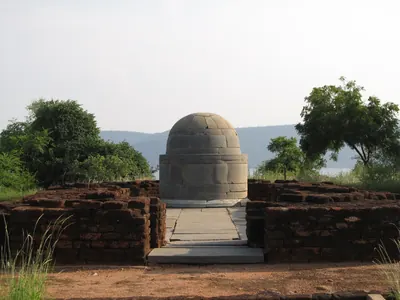
Excavations at Nagarjunakonda uncovered a carved pillar near Stupa 9, which Vogel took to be a memorial to the king. The stupa (relic mound) stood by itself near a fortified hill on the south-western side of the valley.19
The inscription records that the pillar was set up by the sisters, mothers and consorts of King Vasithiputa Siri-Chamtamula, who is described as dead.1920 Their names, about thirty in all, fill the last seven lines.1920
Vogel suggested that the pillar might stand on the place where the king was cremated.19 A stout royal figure appears in three of its five carved panels, and a rider on a royal elephant in a fourth.19 Vogel suggested that this figure might be Chamtamula himself.19
Hirananda Sastri read the panels differently.2122 In his view the royal figure under the umbrella was the reigning king, Virapurushadatta, shown with his queens setting up the pillar.2122 He presented this as a conjecture (a guess).2122
Vogel dated the inscription to the 20th year of Virapurushadatta.2023 D. C. Sircar edited it again in Epigraphia Indica XXXV from new impressions taken in 1960.2425 He found Vogel’s reading of the date to be wrong.2425 Where Vogel had read “twentieth”, Sircar read the name of the year Vijaya in Jupiter’s sixty-year cycle.2425
Sircar equated this year with 273–74.2425 He considered the inscription the earliest known use of the cyclic year in Indian inscriptions.2425 He thought the pillar had been raised many years after Chamtamula’s death.26
From two punctuation marks, Sircar suggested that the list of women fell into three groups.26 These were thirteen sisters, eleven mothers (his mother and stepmothers) and five queens.26 Two further women, whom Vogel had called subhatarikas, he read as abhyantarikas.26 These were either close companions or guards of the women’s quarters.26
Date
Like nearly all Ikshvaku records, the inscriptions that name Chamtamula are dated only in years of reign.723 So his reign can be placed only roughly.723 Sircar’s genealogical table of 1939 dates it to about 223–240.15 In 1959 Sircar placed Virapurushadatta about the middle of the 3rd century, citing that table.27
After Sircar dated the memorial pillar to 273–74, he gave Virapurushadatta’s reign as about 255–75.28 If the Abhiras and Pallavas ended Ikshvaku rule together, he placed it within about 265–335.28 Either way, Chamtamula’s reign ended before then.28 Other early editors dated the dynasty more loosely, between the 2nd and 4th centuries; see Ikshvakus: Evidence and disagreements.
Footnotes
-
J. Ph. Vogel, Prakrit Inscriptions from a Buddhist Site at Nagarjunikonda, Epigraphia Indica XX (1933), p. 3 and note 2 (archive.org (opens in a new tab)). ↩ ↩2 ↩3 ↩4 ↩5
-
D. C. Sircar, The Successors of the Satavahanas in Lower Deccan (1939), p. 17 and note 1 (archive.org (opens in a new tab)). ↩ ↩2 ↩3
-
Vogel, Prakrit Inscriptions from Nagarjunikonda (1933), p. 6 (archive.org (opens in a new tab)). ↩ ↩2 ↩3 ↩4 ↩5 ↩6 ↩7
-
Sircar and Krishnan, “Two Inscriptions from Nagarjunikonda” (1963), p. 22, text of the inscription of Rudapurisadata (archive.org (opens in a new tab)). ↩
-
Indian Archaeology 1955–56: A Review (1956), p. 24 (archive.org (opens in a new tab)). ↩
-
Vogel, Prakrit Inscriptions from Nagarjunikonda (1933), p. 17, translation of the pillar inscription of Chamtisiri (archive.org (opens in a new tab)). ↩ ↩2
-
Vogel, Prakrit Inscriptions from Nagarjunikonda (1933), p. 4 (archive.org (opens in a new tab)). ↩ ↩2 ↩3 ↩4 ↩5 ↩6 ↩7 ↩8 ↩9
-
D. C. Sircar and K. G. Krishnan, “Two Inscriptions from Nagarjunikonda”, Epigraphia Indica XXXIV (1961–62, publ. 1963), p. 18 (archive.org (opens in a new tab)). ↩ ↩2
-
Sircar, Successors of the Satavahanas (1939), pp. 17–18 (archive.org (opens in a new tab)). ↩ ↩2 ↩3 ↩4
-
Sircar, Successors of the Satavahanas (1939), p. 18 (archive.org (opens in a new tab)). ↩ ↩2 ↩3 ↩4
-
Sircar, Successors of the Satavahanas (1939), p. 4 (archive.org (opens in a new tab)). ↩ ↩2 ↩3 ↩4
-
A. Ghosh (ed.), Indian Archaeology 1955–56: A Review (1956), p. 26 (archive.org (opens in a new tab)). ↩ ↩2
-
A. Ghosh (ed.), Indian Archaeology 1956–57: A Review (1957), p. 38 (archive.org (opens in a new tab)). ↩ ↩2
-
Vogel, Prakrit Inscriptions from Nagarjunikonda (1933), p. 5 (archive.org (opens in a new tab)). ↩ ↩2
-
Sircar, Successors of the Satavahanas (1939), p. 16, genealogical table (archive.org (opens in a new tab)). ↩ ↩2 ↩3
-
Sircar, Successors of the Satavahanas (1939), p. 20 (archive.org (opens in a new tab)). ↩ ↩2
-
A. H. Longhurst, “Excavations at Nagarjunikonda”, Annual Report of the Archaeological Survey of India 1927–28 (1931), p. 118 (archive.org (opens in a new tab)). ↩ ↩2 ↩3
-
Sircar, Successors of the Satavahanas (1939), p. 38 (archive.org (opens in a new tab)). ↩ ↩2 ↩3
-
J. Ph. Vogel, Additional Prakrit Inscriptions from Nagarjunikonda, Epigraphia Indica XXI (1931–32), p. 63 (archive.org (opens in a new tab)). ↩ ↩2 ↩3 ↩4 ↩5 ↩6
-
Vogel, Additional Prakrit Inscriptions from Nagarjunikonda (1931–32), p. 64, translation of inscription L (archive.org (opens in a new tab)). ↩ ↩2 ↩3
-
Hirananda Sastri, “Nagarjunikonda Inscriptions”, Annual Report of the Archaeological Survey of India 1929–30 (1935), p. 165 (archive.org (opens in a new tab)). ↩ ↩2 ↩3
-
Hirananda Sastri, “Nagarjunikonda Inscriptions”, ASI Annual Report 1929–30 (1935), p. 166 (archive.org (opens in a new tab)). ↩ ↩2 ↩3
-
Vogel, Additional Prakrit Inscriptions from Nagarjunikonda (1931–32), p. 65 (archive.org (opens in a new tab)). ↩ ↩2 ↩3
-
D. C. Sircar, “More Inscriptions from Nagarjunikonda”, Epigraphia Indica XXXV (1963–64), p. 1 (archive.org (opens in a new tab)). ↩ ↩2 ↩3 ↩4 ↩5
-
Sircar, “More Inscriptions from Nagarjunikonda”, p. 2 (archive.org (opens in a new tab)). ↩ ↩2 ↩3 ↩4 ↩5
-
Sircar, “More Inscriptions from Nagarjunikonda”, p. 3 (archive.org (opens in a new tab)). ↩ ↩2 ↩3 ↩4 ↩5
-
D. C. Sircar, “Two Inscriptions from Guntur District”, Epigraphia Indica XXXII (1959), p. 83 and note 5 (archive.org (opens in a new tab)). ↩
-
Sircar, “More Inscriptions from Nagarjunikonda”, p. 6, with the correction in “Additions and Corrections” (archive.org (opens in a new tab)). ↩ ↩2 ↩3
Related
Dynasties
References
Notes (0)
Sources (10)
Spotted an error on this page? Tell us
Last updated: