Chamtisiri
Ikshvaku princess, sister of King Chamtamula and aunt and later mother-in-law of King Virapurushadatta. She was the chief donor of the Buddhist monuments of Vijayapuri (Nagarjunakonda). She gave the pillars of the Great Stupa, an apsidal shrine and a pillared hall beside it, all to the Aparamahavinaseliya school, in the 3rd century CE.
Chamtisiri was a princess of the Ikshvaku royal house.1 She was the main founder of the Buddhist monuments of Vijayapuri, the capital in the valley at Nagarjunakonda.1
Her name is written both Chamtisiri and Chatisiri, and once Chamtisirinika.12 J. Ph. Vogel, who edited her inscriptions, thought careless engravers had often left out the nasal sign.12 Sten Konow suggested that the first part of the name might be Sanskrit Kshanti or have some other origin.3 Sircar tentatively suggested a Sanskrit form Santisri.4
Family
Her inscriptions call her the uterine sister of King Vasishthiputra Chamtamula (his sister by the same mother) and the paternal aunt of his son, King Virapurushadatta.1 She married Vasithiputa Kamdasiri of the Pukiya family, who held the titles mahasenapati (great commander) and mahatalavara.1 So she bore the title mahatalavari herself.1 She was the mother of Khamdasagaramnaka.1
In the records of the king’s 6th year she is his aunt, but in a record of his 18th year he is her son-in-law.1 Vogel concluded that Virapurushadatta had married her daughter, his cousin, between those years.1
Another pillar was given by the unnamed wife of a Pukiya noble called Mahakamdasiri, mother of the mahasenapati Vinhusiri.5 Vogel suggested that, if Mahakamdasiri and Kamdasiri were the same man, this lady was Chamtisiri’s co-wife.5 Sircar thought Mahakamdasiri more likely an elder brother of her husband.6
Her usual inscription praises her gifts.7 It says that she acted “out of compassion for Sramanas, Brahmins, and those that are miserable, poor and destitute”.7 She “is wont to bestow on them a matchless and ceaseless flow of Velamic gifts”.7 It calls her “the great mistress of munificence”.7 Hirananda Sastri, summing up the first finds, described her as “a liberal lady whose charity extended to all classes”.8
The Great Stupa, year 6
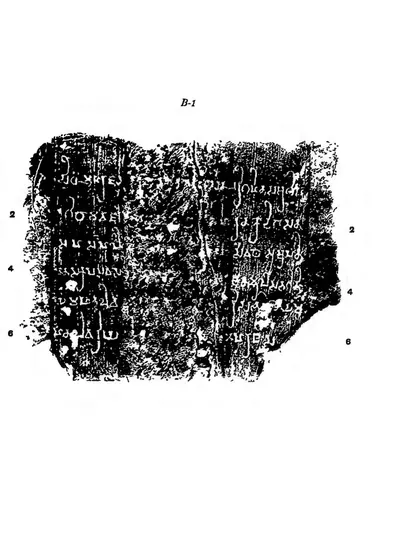
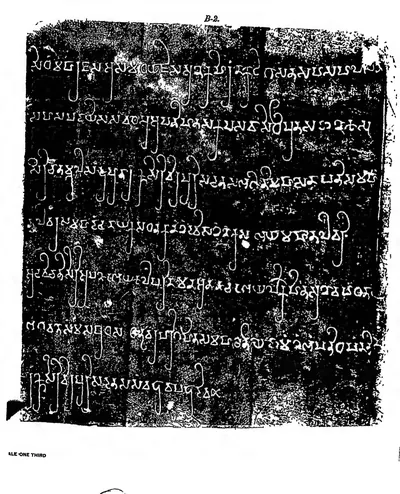
Seventeen inscribed pillars were recovered from the Great Stupa (Mahachetiya).1910 Nine of them repeat her gift of a pillar, including all three found on its main eastern side.1910 They are dated in the 6th year of Virapurushadatta, the 6th fortnight of the rainy season, the 10th day.1910
She made the gifts for welfare and happiness in both worlds, for her own Nirvana, and for the welfare of the whole world.7 She was mindful of the past, present and future members of both the families she belonged to.7
Vogel read one pillar as stating that she built the Great Chaitya.1 The verb there is plural.1 He explained it either by several ladies of her name taking part, or as a plural of majesty (the plural a ruler uses for himself).1 Another pillar of the same day says that the stupa was being raised by the mahatalavaris Chamtisirinika of the Pukiya family.11 Inscriptions of Chamtisiri gives the texts.
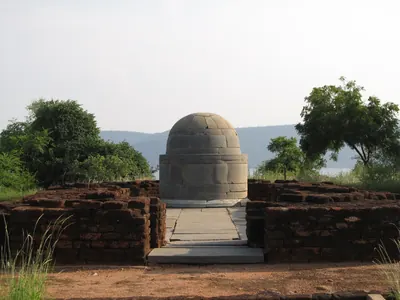
Whether she founded the stupa or rebuilt it is disputed. Vogel regarded her as its founder.1 A. H. Longhurst, who excavated it, wrote that she founded it, or perhaps rebuilt it.1213 In his 1927–28 report he suggested that the original stupa might go back to about 200 BCE.1213 In his memoir he argued that her work was a rebuilding of the outer part of an older monument.14
The shrine and the pillared hall, years 15 and 18
About twenty yards east of the Great Stupa stood an apsidal (round-ended) shrine with a small stupa in the apse.151617 M. Hamid Kuraishi measured it at about 53 feet long and 22 feet wide.151617
A Prakrit inscription in two long lines lies on its stone floor.11819 It records that Chamtisiri built a chetiya-ghara (shrine) and a stone hall surrounded by a cloister at the foot of the Mahachetiya.11819 She built them for the masters of the Aparamahavinaseliya school.11819 She did it for the long life and victory of her son-in-law King Virapurushadatta, for her own welfare, and for the good of the great community of monks.11819
The inscription is dated in the king’s 18th year, the 6th fortnight of winter, the 5th day.19 Hirananda Sastri understood the building to include rooms for pilgrims from distant countries.20
Beside the shrine Longhurst found the broken pillars of a large stone-paved hall.2122 Their broken inscriptions again name Chamtisiri, and one fragment gives the 15th year of Virapurushadatta.2122 Vogel identified this hall with the stone hall mentioned in her floor inscription three years later.2122 No trace of the cloister was found.2122
Portrait?
Two small gold medallions with raised heads, one of a woman and one of a man, were found in Stupa 6.2324 Longhurst suggested that the woman might be Chamtisiri, but the medallions carry no inscription.2324
Footnotes
-
J. Ph. Vogel, Prakrit Inscriptions from a Buddhist Site at Nagarjunikonda, Epigraphia Indica XX (1933), p. 4 and notes (archive.org (opens in a new tab)). ↩ ↩2 ↩3 ↩4 ↩5 ↩6 ↩7 ↩8 ↩9 ↩10 ↩11 ↩12 ↩13 ↩14 ↩15 ↩16 ↩17 ↩18 ↩19 ↩20 ↩21
-
Vogel, Prakrit Inscriptions from Nagarjunikonda (1933), p. 11 (archive.org (opens in a new tab)). ↩ ↩2
-
Vogel, Prakrit Inscriptions from Nagarjunikonda (1933), p. 26, postscript by Sten Konow (archive.org (opens in a new tab)). ↩
-
D. C. Sircar, The Successors of the Satavahanas in Lower Deccan (1939), p. 18 (archive.org (opens in a new tab)). ↩
-
Vogel, Prakrit Inscriptions from Nagarjunikonda (1933), p. 5 (archive.org (opens in a new tab)). ↩ ↩2
-
Sircar, Successors of the Satavahanas (1939), p. 27 (archive.org (opens in a new tab)). ↩
-
Vogel, Prakrit Inscriptions from Nagarjunikonda (1933), p. 17, translation of pillar inscription C 3 (archive.org (opens in a new tab)). ↩ ↩2 ↩3 ↩4 ↩5 ↩6
-
Longhurst, “Excavations at Nagarjunikonda”, ASI Annual Report 1927–28 (1931), p. 118 (archive.org (opens in a new tab)). ↩
-
Vogel, Prakrit Inscriptions from Nagarjunikonda (1933), p. 13, list of inscriptions (archive.org (opens in a new tab)). ↩ ↩2 ↩3
-
Vogel, Prakrit Inscriptions from Nagarjunikonda (1933), p. 14 (archive.org (opens in a new tab)). ↩ ↩2 ↩3
-
Vogel, Prakrit Inscriptions from Nagarjunikonda (1933), p. 19, translation of pillar inscription B 5 (archive.org (opens in a new tab)). ↩
-
A. H. Longhurst, The Buddhist Antiquities of Nagarjunakonda (1938), p. 4 (archive.org (opens in a new tab)). ↩ ↩2
-
A. H. Longhurst, “Excavations at Nagarjunikonda”, Annual Report of the Archaeological Survey of India 1927–28 (1931), p. 115 (archive.org (opens in a new tab)). ↩ ↩2
-
Longhurst, Buddhist Antiquities of Nagarjunakonda (1938), p. 17 (archive.org (opens in a new tab)). ↩
-
M. Hamid Kuraishi, “Trial Excavations at Alluru, Gummadidurru and Nagarjunikonda”, Annual Report of the Archaeological Survey of India 1926–27 (1930), p. 158 (archive.org (opens in a new tab)). ↩ ↩2
-
Longhurst, Buddhist Antiquities of Nagarjunakonda (1938), p. 8 (archive.org (opens in a new tab)). ↩ ↩2
-
Longhurst, Buddhist Antiquities of Nagarjunakonda (1938), p. 9 (archive.org (opens in a new tab)). ↩ ↩2
-
Vogel, Prakrit Inscriptions from Nagarjunikonda (1933), p. 21, translation of inscription E (archive.org (opens in a new tab)). ↩ ↩2 ↩3 ↩4
-
Vogel, Prakrit Inscriptions from Nagarjunikonda (1933), p. 22 (archive.org (opens in a new tab)). ↩ ↩2 ↩3 ↩4 ↩5
-
Longhurst, “Excavations at Nagarjunikonda”, ASI Annual Report 1927–28 (1931), p. 119 (archive.org (opens in a new tab)). ↩
-
J. Ph. Vogel, “Additional Prakrit Inscriptions from Nagarjunikonda”, Epigraphia Indica XXI (1931–32), p. 64 (archive.org (opens in a new tab)). ↩ ↩2 ↩3 ↩4
-
Vogel, “Additional Prakrit Inscriptions” (1931–32), p. 65 (archive.org (opens in a new tab)). ↩ ↩2 ↩3 ↩4
-
A. H. Longhurst, “Excavations at Nagarjunikonda”, Annual Report of the Archaeological Survey of India 1929–30 (1935), pp. 147–148 (archive.org (opens in a new tab)). ↩ ↩2
-
Longhurst, Buddhist Antiquities of Nagarjunakonda (1938), pp. 21–22 (archive.org (opens in a new tab)). ↩ ↩2
Photos
Related
Dynasties
References
Notes (0)
Sources (7)
Spotted an error on this page? Tell us
Last updated: