Vijayaditya (Chalukya of Badami)
Vijayaditya was a king of the Chalukyas of Badami from 696 to about 733, the son of Vinayaditya. As crown prince he asked his father for a grant of a village on the north bank of the Krishna. As king he had a Shaiva teacher, Isanacharya, build an enclosure wall at Alampur. The Alampur slab of 713 is written in two scripts, one of them an early northern script that G. S. Gai counted among the earliest in South India.
Download
Vijayaditya was a king of the Chalukyas of Badami, who reigned from 696 to about 733.12 His records at Alampur, on the Tungabhadra in today’s Telangana, show his care for its temples.345 One of them is among the earliest records in South India written in a northern script.5
Who he was
Vijayaditya was the son of Vinayaditya, and he followed his father in 696.1 His records give him the titles Satyasraya and Samastabhuvanasraya, “asylum of the universe”.1 By 692 he was already crown prince.6 He helped his father in a campaign in the north.6
His enemies once led him into an ambush and took him prisoner.6 But, Fleet writes, he escaped by his own efforts and made his power firm over all his lands.6 He built the great Shiva temple now called Sangamesvara at Pattadakal.6 Robert Sewell wrote that he kept friendly relations with the Rashtrakuta king Indra II, and gave him a Chalukya princess in marriage.7 Their son was Dantidurga, who later overthrew the Chalukyas.7 See Dantidurga.
A grant on the Krishna
As a prince, Vijayaditya asked his father for a gift to some Brahmans.8 So in 692 Vinayaditya gave them a village on the north bank of the Krishna.8 This grant came from the Kurnool district.8 J. F. Fleet took the Vijayaditya named in it to be the king’s son.8
The Alampur enclosure
At Alampur, a damaged inscription of Vijayaditya’s reign is dated Saka 626 (704; Saka is an Indian way of counting years).4 It gives the family tree of the Badami kings from Pulakesin I.4 It says that an enclosure was built at the king’s wish and dedicated to the teacher Isanacharya.4 The Corpus of Inscriptions in the Telangana Districts (1973), as summarised in Epigraphia Telanganica, thought that Isanacharya might be a head of the Kalamukha sect of Shaiva monks.9
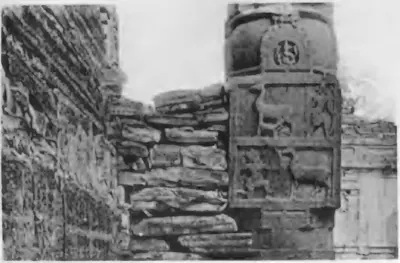
A second slab is set into the fort wall at Alampur, near the steps down to the river.3 G. S. Gai copied it in 1959 and published it in Epigraphia Indica.3 It records that, at Vijayaditya’s command, Isanacharya built an enclosure.5 Gai dated it to Friday, 13 May 713, in the king’s eighteenth year.5 He noted that the fort itself surrounds the temples called Navalingesvara, of which the Bala Brahmesvara is the most important.5
Two scripts on one slab
The 713 slab gives the same text twice.3 One version is in early Telugu-Kannada letters, and the other is in Siddhamatrika, an early northern script.3 Gai wrote that this carried back the use of the northern script in South India by at least forty years.5 The summary of the 1959–60 epigraphy report suggests that Isanacharya was probably a northerner, and that the second version was written for him.10
Another pillar inscription of Vijayaditya’s time stands in the Bala Brahmesvara temple.10 It praises his father Vinayaditya’s victory over the lord of northern India.10 See the temples of Alampur.
Where the sources disagree
- The date of the enclosure slab. Gai read Saka 636, the eighteenth year, as 713.5 The summary of the 1959–60 epigraphy report gives the same two versions as Saka 635 and 636, which it equates with 714–715.10
- The record of 704. The 1961 list reads its date as Saka 626 and gives the regnal year with a query, as “[18?]”.4 Gai counted Saka 619 as the king’s first year, so the eighteenth year fell in 713.5
Footnotes
-
Fleet, “Dynasties of the Kanarese Districts” (1896), p. 370 (archive.org (opens in a new tab)). ↩ ↩2 ↩3
-
Sewell, Historical Inscriptions (1932), p. 28 (archive.org (opens in a new tab)). Paraphrased. ↩
-
Epigraphia Telanganica I (2023), p. 47, reprinting G. S. Gai, “Alampur Inscription of Chalukya Vijayaditya, Saka 635 and 636”, Epigraphia Indica XXXV, pp. 121–124. Cite-only; paraphrased. ↩ ↩2 ↩3 ↩4 ↩5
-
Kannada Inscriptions of Andhra Pradesh (Andhra Pradesh Government Archaeological Series 3, 1961), p. 38, No. 107 (archive.org (opens in a new tab)). Paraphrased. ↩ ↩2 ↩3 ↩4 ↩5
-
Epigraphia Telanganica I (2023), p. 48, reprinting Gai, Epigraphia Indica XXXV. Cite-only; paraphrased. ↩ ↩2 ↩3 ↩4 ↩5 ↩6 ↩7 ↩8
-
Fleet, “Dynasties of the Kanarese Districts” (1896), p. 371 (archive.org (opens in a new tab)). ↩ ↩2 ↩3 ↩4 ↩5
-
Robert Sewell, The Historical Inscriptions of Southern India (1932), pp. 26–27 (archive.org (opens in a new tab)). Paraphrased. ↩ ↩2
-
J. F. Fleet, “Dynasties of the Kanarese Districts”, Gazetteer of the Bombay Presidency I, pt. II (1896), p. 369 (archive.org (opens in a new tab)). ↩ ↩2 ↩3 ↩4
-
Gajjala Vasanta Lakshmi (ed.), Epigraphia Telanganica I: Pre-Kakatiya Telangana (2023), p. 45, summarising the Corpus of Inscriptions in the Telangana Districts VI (1973), pp. 3–4. Cite-only; paraphrased. ↩
-
Epigraphia Telanganica I (2023), p. 49, summarising the Annual Report on Indian Epigraphy for 1959-60, pp. 21 and 58, and Inscriptions of Andhra Pradesh, Mahabubnagar District I (2003), pp. 15–16. Cite-only; paraphrased. ↩ ↩2 ↩3 ↩4
Related
Dynasties
References
Notes (0)
Sources (4)
Spotted an error on this page? Tell us
Last updated: