Malkhed (Manyakheta)
Village in the Kalaburagi (Gulbarga) district of Karnataka, formerly in Hyderabad State. It is the ancient Manyakheta, capital of the Rashtrakuta kings from the 9th century until 973. J. F. Fleet thought that the Eastern Chalukya king of Vengi built its outer wall for Govinda III. The Eastern Chalukya Gunaga Vijayaditya III claimed to have burnt it.
Malkhed, the Manyakheta of the inscriptions, was the capital of the Rashtrakutas. The Hyderabad volume of the Imperial Gazetteer (1909) places it in the Gulbarga district.1 J. F. Fleet described it as about ninety miles south-east of Sholapur.2 He pointed out that its position made it important “with a view to resisting attacks from the east”, that is, from Vengi.2 The Arab writers of the 9th and 10th centuries called the Rashtrakuta capital Mankir.3
Founding
The Radhanpur plates of 808 relate that the lord of Vengi, the Eastern Chalukya king Vijayaditya II, was made to build an outer wall round a city for Govinda III.24 Fleet believed that this city was Malkhed.24
The Deoli grant of 940 and the Karda grant of 972 say that Amoghavarsha I made the city of Manyakheta.24 Fleet read this as meaning that Amoghavarsha completed its fortification and made it the capital of the dynasty.24
In 1901 Fleet noted that the Radhanpur verse places the enclosure near the Tungabhadra, some eighty-five or ninety miles south of Malkhed.5 But he still thought Malkhed the most likely place.5 See the Radhanpur plates.
Burnt and plundered
The Eastern Chalukya king Gunaga Vijayaditya III claimed to have frightened Krishna II and “completely burnt his city”.6 D. R. Bhandarkar found a Rashtrakuta admission of this in the Cambay plates of 930.7 They say that in Krishna II’s reign his enemies abandoned “Khetaka”, which Bhandarkar took to mean Manyakheta.7
Later kings, among them Govinda IV, Krishna III and Kakka II, are described in their grants as settled at Manyakheta as their capital.8910 Khottiga’s only known date is in 971.11 In his reign the city was plundered, either by the Paramara king Siyaka-Harsha of Malwa or by his successor Munja.11
The Chalukyas of Kalyani overthrew the Rashtrakutas in 973.12 Fleet thought that they may at first have ruled from Malkhed, before Somesvara I made Kalyani their capital.12
Footnotes
-
Imperial Gazetteer of India, Provincial Series: Hyderabad State (1909), p. 10 (archive.org (opens in a new tab)). ↩
-
Fleet, “Dynasties of the Kanarese Districts” (1896), p. 396 (archive.org (opens in a new tab)). ↩ ↩2 ↩3 ↩4 ↩5 ↩6
-
J. F. Fleet, “Dynasties of the Kanarese Districts”, Gazetteer of the Bombay Presidency I, pt. II (1896), p. 388 (archive.org (opens in a new tab)). ↩
-
Fleet, “Dynasties of the Kanarese Districts” (1896), p. 403 (archive.org (opens in a new tab)). ↩ ↩2 ↩3 ↩4
-
J. F. Fleet, “Three Western Ganga Records in the Mysore Government Museum at Bangalore”, Epigraphia Indica VI (1901), p. 64, note 3 (archive.org (opens in a new tab)). ↩ ↩2
-
Fleet, “Dynasties of the Kanarese Districts” (1896), p. 412 (archive.org (opens in a new tab)). ↩
-
D. R. Bhandarkar, “Cambay Plates of Govinda IV; Saka-Samvat 852”, Epigraphia Indica VII (1903), p. 29 (archive.org (opens in a new tab)). ↩ ↩2
-
Fleet, “Dynasties of the Kanarese Districts” (1896), p. 416 (archive.org (opens in a new tab)). ↩
-
Fleet, “Dynasties of the Kanarese Districts” (1896), p. 419 (archive.org (opens in a new tab)). ↩
-
Fleet, “Dynasties of the Kanarese Districts” (1896), p. 423 (archive.org (opens in a new tab)). ↩
-
Fleet, “Dynasties of the Kanarese Districts” (1896), p. 422 (archive.org (opens in a new tab)). ↩ ↩2
-
Fleet, “Dynasties of the Kanarese Districts” (1896), p. 427 (archive.org (opens in a new tab)). ↩ ↩2
Photos
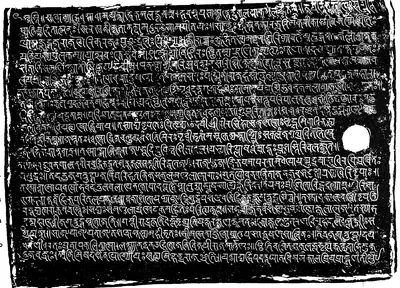 "Cambay Plates of Govinda IV.—Saka-Samvat 852." side i (Epigraphia Indica VII, plate i (between pp. 38 and 39), first page; PDF p. 53 of the archive.org scan epigraphiaindica014351mbp)Inscription rubbing · 1903
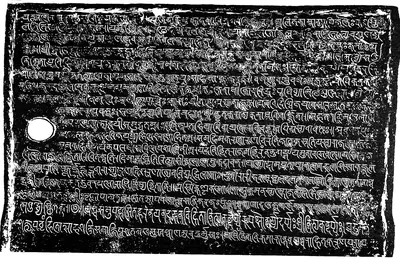 "Cambay Plates of Govinda IV.—Saka-Samvat 852." side iia (Epigraphia Indica VII, plate i (between pp. 38 and 39), second page; PDF p. 54 of the archive.org scan epigraphiaindica014351mbp)Inscription rubbing · 1903
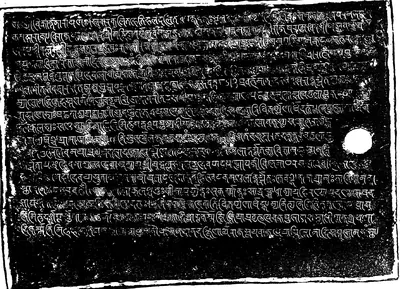 "Cambay Plates of Govinda IV.—Saka-Samvat 852." side iib (Epigraphia Indica VII, plate ii (between pp. 40 and 41), first page; PDF p. 57 of the archive.org scan epigraphiaindica014351mbp)Inscription rubbing · 1903
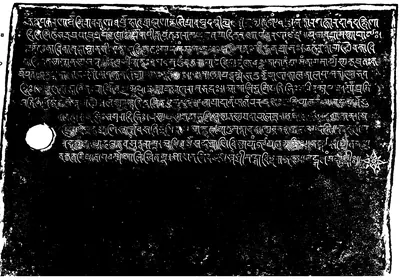 "Cambay Plates of Govinda IV.—Saka-Samvat 852." side iii (Epigraphia Indica VII, plate ii (between pp. 40 and 41), second page; PDF p. 58 of the archive.org scan epigraphiaindica014351mbp)Inscription rubbing · 1903
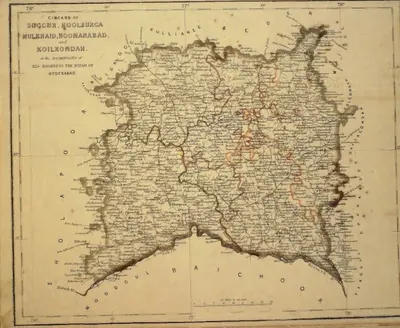 "Circars of Succur, Koolburga, Mulkhaid, Hoonanabad and Koilkondah, in the Dominions of His Highness the Nizam of Hyderabad" (map No. 5, atlas presented to the Nizam, 1865)Map · 1865
Related
Dynasties
People
Govinda III (Rashtrakuta)
c. 793–814 CE
Rashtrakuta king (about 793–814), son of Dhruva, under whom the dynasty's power reached from the Vindhyas to the Tungabhadra. His Radhanpur plates of 808 say that the lord of Vengi, the Eastern Chalukya Vijayaditya II, came at his command and built an enclosure for him like a servant. An undated inscription at Kuruvagattu in the Mahbubnagar district names him as the friend of a Chalukya prince. A shrine of the Sun at Alampur was built for the prosperity of a king Prabhutavarsha who may be Govinda III.
Amoghavarsha I
c. 814–878 CE
Rashtrakuta king (814–about 878), son of Govinda III, who reigned for more than sixty years and made Manyakheta (Malkhed) the capital of the dynasty. His records claim the homage of the king of Vengi and a victory over the Eastern Chalukyas at Vingavalli. Kannada inscriptions of his reign have been found in the Medak and Warangal districts of Telangana.
Krishna II (Rashtrakuta)
c. 878–914 CE
Rashtrakuta king (about 878–914), son of Amoghavarsha I. The Eastern Chalukya Gunaga Vijayaditya III claimed to have frightened him and burnt his city, and a Rashtrakuta grant admits that his enemies once abandoned his capital. Later Eastern Chalukya records in turn admit that his army overran Vengi until Chalukya-Bhima I won it back. A Kannada record of 907 in his reign has been found at Velmajala in Telangana.
Krishna III (Rashtrakuta)
c. 939–966 CE
Rashtrakuta king (about 939–966), the most powerful of the line, who took Kanchi and Tanjore from the Cholas. In the Telugu country he held most of the Cuddapah country through the Vaidumba chiefs, and the Nolamba chiefs of Anantapur served under him. The Eastern Chalukya pretender Badapa sought his help to drive Amma II out of Vengi. Inscriptions of his reign or of his feudatories have been found at Chennur, Mallikarjunapalli, Minambaram and Inavolu in Telangana.
References
Notes (0)
Sources (4)
Spotted an error on this page? Tell us
Last updated: