Krishna III (Rashtrakuta)
Rashtrakuta king (about 939–966), the most powerful of the line, who took Kanchi and Tanjore from the Cholas. In the Telugu country he held most of the Cuddapah country through the Vaidumba chiefs, and the Nolamba chiefs of Anantapur served under him. The Eastern Chalukya pretender Badapa sought his help to drive Amma II out of Vengi. Inscriptions of his reign or of his feudatories have been found at Chennur, Mallikarjunapalli, Minambaram and Inavolu in Telangana.
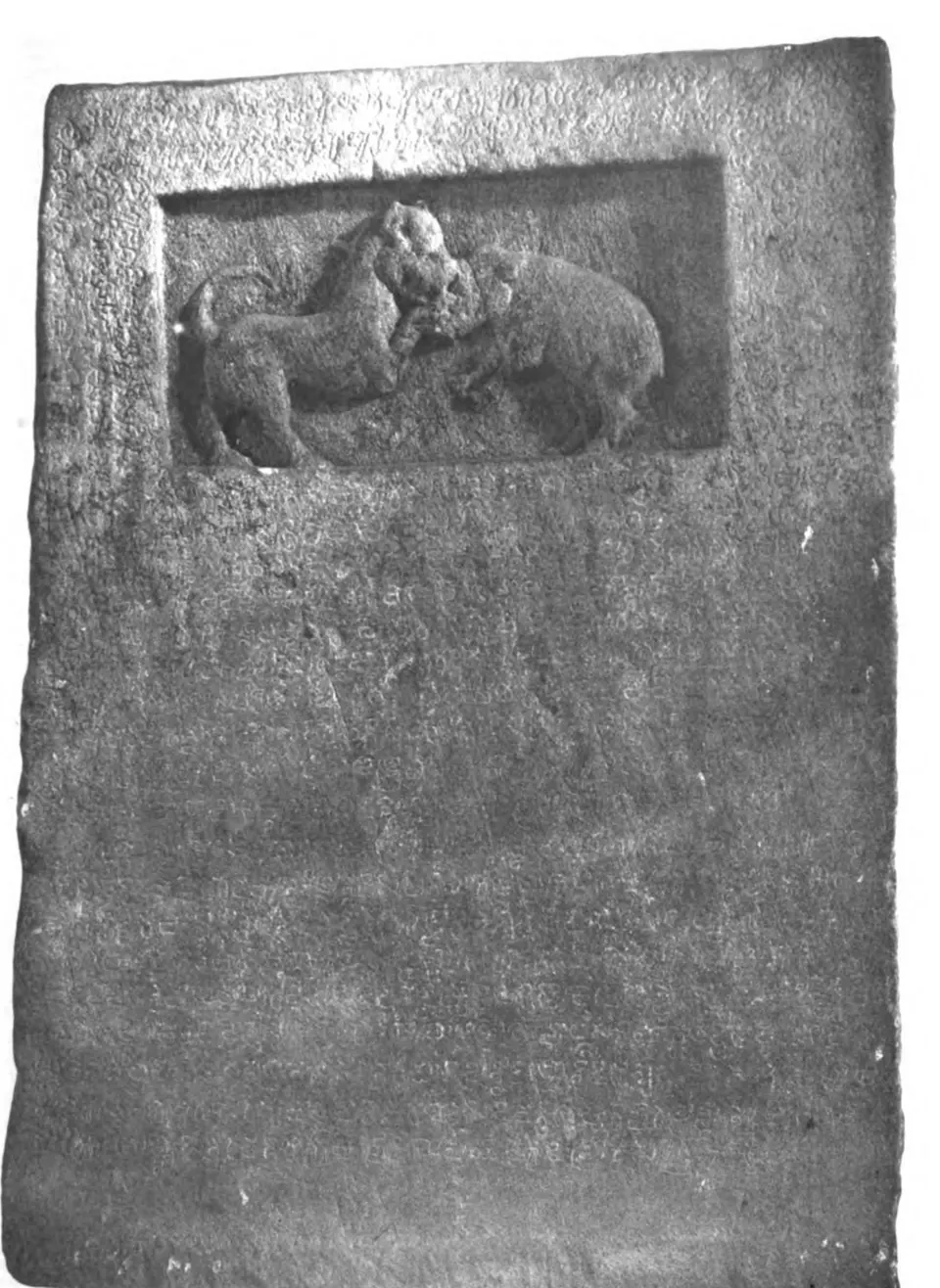
Krishna III was the last great king of the Rashtrakuta dynasty. J. F. Fleet wrote that under him the growth of the kingdom to the east and south reached its climax.1 He “penetrated even to the Chingleput District, near Madras, on the east coast, and took Conjeeveram and Tanjore” (Kanchipuram and Thanjavur).1 In the Telugu country his overlordship is recorded from Kadapa (then Cuddapah) and Anantapur to Telangana and Vengi.234
Family
Indra III had two sons, Amoghavarsha II and Govinda IV.5 Fleet thought that Govinda IV set his elder brother aside and took the throne. Govinda IV, in turn, was succeeded by his paternal uncle Vaddiga, a son of Jagattunga by his second wife Govindamba (see Krishna II).56
Krishna III was the eldest son of Amoghavarsha III (Vaddiga), and is once called his “favourite son”.6 Krishna III’s younger brother Jagattunga III died before him.78 The Deoli grant of 940 was made for Jagattunga’s spiritual benefit.78 Khottiga, another younger brother of Krishna III, succeeded him.8 Nirupama, a younger brother of Khottiga, did not reign.9
Nirupama’s son Kakka II succeeded Khottiga and was the last king of the dynasty.910 A son of Krishna III, whose name is not given, died before his father.8 Indra IV, the son of that son and so a grandson of Krishna III, was crowned by the Western Ganga prince Marasimha.10 Marasimha tried in this way to continue the dynasty after 973.10
Reign and conquests
Krishna III’s capital was Manyakheta (Malkhed). Fleet’s earliest date for him was in April 940.11 An inscription at Alur shows him reigning in May 956, and the Vellore inscription is dated in his twenty-sixth year.11
The chief event of the reign was the war with the Chola king Rajaditya.11 The Atakur inscription says that Krishna fought and killed Rajaditya at Takkola in or just before 949–50.11 It says the actual slayer was his Western Ganga feudatory Butuga, whom Krishna rewarded with the Banavasi province.11 His inscriptions at Tirukkalukunram in the Chengalpattu (then Chingleput) district call him the taker of Kanchi and Tanjore.11
An inscription of 17 February 966 at Kolagallu in the Bellary district says that Krishna died in that year, and that Khottiga succeeded him.12 Robert Sewell put his death between February 965 and February 966.13
Vengi
About 956 the Eastern Chalukya king Amma II left his kingdom for the north. A copper-plate grant of the pretender Badapa, a son of Yuddhamalla II, was noticed in the Madras epigraphy report for 1920–21.14 It says that Badapa “sought the help of the Vallabha (i.e., Rashtrakuta) Krishnaraja and driven Amma from the country”.15
The epigraphist identified the Vallabha with Krishna III.15 He inferred that Krishna had invaded the Trikalinga country, which the grant claims as part of his dominions.15 He concluded that the Eastern Chalukya country was then divided between Badapa in the east and Danarnava, who ruled in Amma’s name, in the west.15
Cuddapah and Anantapur
The Cuddapah gazetteer (1915) wrote that Krishna III “must have held the whole of Cuddapah district except the eastern portion beyond the Seshachalams”. It said he went as far south as Melpadi in the Chittoor district. It added that he exacted allegiance (demanded loyalty) from local chiefs, among them the Vaidumbas, rather than effectively conquering the south of the district.2
A temple at Palagiri in the Kamalapuram taluk was restored in 1056 by the Vaidumba chief Bhima-Maharaja.1617 The record of the restoration refers to an earlier grant made to the temple by Krishna III.1617 P. B. Desai, writing in 1958, cited an inscription from Palagiri as naming a Vaidumba Maharaja as Krishna III’s subordinate.18
In the Anantapur district, a Nolamba pillar inscription of 6 March 965 at Kambaduru was set up by the minister of Polalchora II.3 V. Rangacharya described Polalchora II as “lieutenant of the Rashtrakuta Krishna III in the conquest of Chola land”.3
Records in Telangana
- Chennur (Adilabad district). A pillar inscription in the Siva temple is dated 12 July 940, in the reign of Akalavarsha.4 It records the grant of an agrahara (Brahmin village) on the bank of the Godavari by Baddega, son of Gunagarasa of the Chalukya family.4 Baddega was a subordinate of Arikesari, who is described as a scion of the Chalukya family and a feudatory of the Rashtrakuta king.4 See the Chalukyas of Vemulavada.
- Mallikarjunapalli (Medak district). A worn inscription dated 30 August 946, in the reign of Akalavarsha (Krishna III), records a gift of wet land by the mahasamanta (great feudatory) Kommana of Panduravadi.19
- Minambaram (Mahbubnagar district). An inscription of the reign of Kannara, whom P. B. Desai thought might be Krishna III, names the Kalamukha ascetic Agastya.2021
- Inavolu (Warangal district). A 10th-century record in old Kannada names a donor who held the offices of angaraksha (bodyguard) and tantrapala in the service of the king Satyasraya.21 Its editors took this king to be Krishna III.21
Footnotes
-
J. F. Fleet, “Dynasties of the Kanarese Districts”, Gazetteer of the Bombay Presidency I, pt. II (1896), p. 383 (archive.org (opens in a new tab)). ↩ ↩2
-
C. F. Brackenbury, Madras District Gazetteers: Cuddapah, Vol. I (1915), p. 29 (archive.org (opens in a new tab)). ↩ ↩2
-
V. Rangacharya, A Topographical List of the Inscriptions of the Madras Presidency I (1919), p. 20, Anantapur district No. 127 (archive.org (opens in a new tab)). ↩ ↩2 ↩3
-
Gajjala Vasanta Lakshmi (ed.), Epigraphia Telanganica I: Pre-Kakatiya Telangana (2023), p. 80, Rashtrakuta No. 16, summarising the Annual Report on Indian Epigraphy for 1959–60, p. 46. Cite-only; paraphrased. ↩ ↩2 ↩3 ↩4
-
Fleet, “Dynasties of the Kanarese Districts” (1896), p. 416 (archive.org (opens in a new tab)). ↩ ↩2
-
Fleet, “Dynasties of the Kanarese Districts” (1896), p. 418 (archive.org (opens in a new tab)). ↩ ↩2
-
Fleet, “Dynasties of the Kanarese Districts” (1896), p. 420 (archive.org (opens in a new tab)). ↩ ↩2
-
Fleet, “Dynasties of the Kanarese Districts” (1896), p. 422 (archive.org (opens in a new tab)). ↩ ↩2 ↩3 ↩4
-
Fleet, “Dynasties of the Kanarese Districts” (1896), p. 423 (archive.org (opens in a new tab)). ↩ ↩2
-
Fleet, “Dynasties of the Kanarese Districts” (1896), p. 424 (archive.org (opens in a new tab)). ↩ ↩2 ↩3
-
Fleet, “Dynasties of the Kanarese Districts” (1896), p. 419 (archive.org (opens in a new tab)). ↩ ↩2 ↩3 ↩4 ↩5 ↩6
-
Rangacharya, Topographical List I (1919), p. 34, Bellary district No. 84 (archive.org (opens in a new tab)). ↩
-
Robert Sewell, The Historical Inscriptions of Southern India (1932), p. 50 (archive.org (opens in a new tab)). Paraphrased. ↩
-
Annual Report on South-Indian Epigraphy for 1920–21 (G.O. No. 183, Finance, 23 September 1921), p. 90 (archive.org (opens in a new tab)). ↩
-
Annual Report on South-Indian Epigraphy for 1920–21 (G.O. No. 183, Finance, 23 September 1921), p. 91 (archive.org (opens in a new tab)). ↩ ↩2 ↩3 ↩4
-
Brackenbury, Cuddapah (1915), p. 30 (archive.org (opens in a new tab)). ↩ ↩2
-
M. Venkataramayya, “Machupalle Inscription of the Time of Somideva-Maharaja”, Epigraphia Indica XXVIII (1958), p. 117 (archive.org (opens in a new tab)). Paraphrased. ↩ ↩2
-
P. B. Desai, “Madras Museum Plate of Bhuvanatrinetra”, Epigraphia Indica XXVIII (1958), p. 69 (archive.org (opens in a new tab)). Paraphrased. ↩
-
Epigraphia Telanganica I (2023), p. 81, No. 17. Cite-only; paraphrased. ↩
-
P. B. Desai (introduction), Kannada Inscriptions of Andhra Pradesh (Andhra Pradesh Government Archaeological Series 3, 1961), p. 11, No. 30 (archive.org (opens in a new tab)). Paraphrased. ↩
-
Epigraphia Telanganica I (2023), p. 82, Nos. 18 and 20. Cite-only; paraphrased. ↩ ↩2 ↩3
Photos
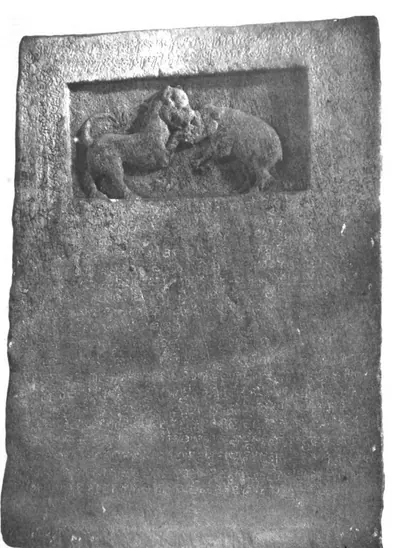 "Atakur Stone." the inscribed slab of A.D. 949–50 with the relief of a hound fighting a boar (Epigraphia Indica VI, photograph with No. 6, part C; PDF p. 77 of the archive.org scan EpigraphiaIndicaVol6)Photograph · 1901
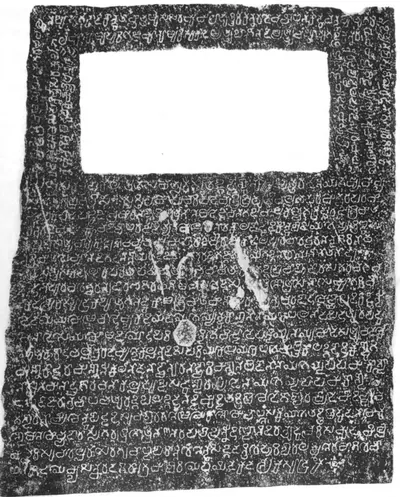 "C.—Atakur Inscription of Krishna III. and Butuga II.—A.D. 949-50." (Epigraphia Indica VI, plate with No. 6; PDF p. 83 of the archive.org scan EpigraphiaIndicaVol6)Inscription rubbing · 1901
Related
Dynasties
References
Notes (0)
Sources (8)
Spotted an error on this page? Tell us
Last updated: