Srisailam
Temple town of Siva as Mallikarjuna, on the northernmost plateau of the Nallamalai hills, above the gorge of the Krishna in the Kurnool district. The Reddi kings of Kondavidu claimed the country 'from Srisailam to the eastern sea'. Their inscriptions credit Prolaya Vema with a flight of steps from the Patalaganga to the shrine, and Anavema built a hall there in 1378. Shivaji spent about ten days at the shrine in March 1677, on his way from Hyderabad to the Karnatak.
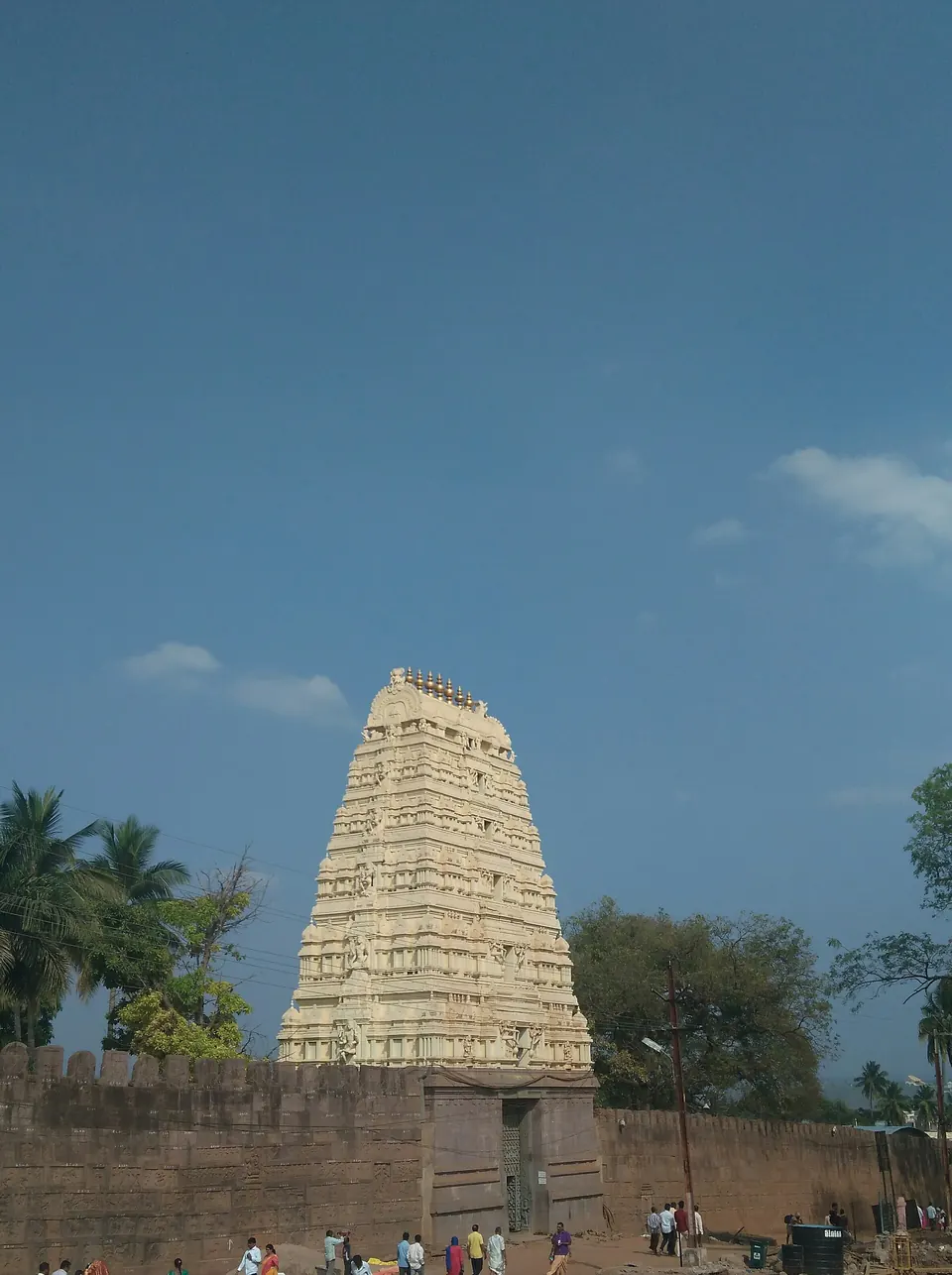
Srisailam is a famous temple of Siva, worshipped there as Mallikarjuna, in the Kurnool district.1 It stands on the northernmost plateau of the Nallamalai hills, above the gorge of the Krishna.1 The Reddi kings of Kondavidu treated it as the western edge of their country, and Shivaji visited it in 1677.234
The Imperial Gazetteer of 1908 calls Srisailam a “famous temple in the Nandikotkur taluk of Kurnool District”.1 It lies at 16°5′ N, 78°53′ E, “in the midst of malarious jungles” (forests full of malaria) “and rugged hills”.1 It is on “the northernmost plateau of the Nallamalais”, overlooking “a deep gorge through which flows the Kistna river”.1
The temple is 660 feet long and 510 feet broad.1 Its walls are “elaborately sculptured with scenes from the Ramayana and Mahabharata”.1 In the centre stands the shrine of Mallikarjuna, as Siva is called there.1 The great festival is Sivaratri, in February or March.1 The gazetteer says that ruins of old forts, houses and towns on the Srisailam plateau show “that it was inhabited by prosperous communities in olden days”.5
The Reddi kings and Srisailam
For the Reddi kings of Kondavidu, Srisailam marked the western edge of their country.2 Prolaya Vema’s grant of 1345 describes the Pungi country as stretching “from the eastern slopes of Srigiri to the eastern sea”.2
Almost every later inscription of the family remembers Prolaya Vema for a flight of steps.6789 The Vanapalli plates say that “having built (a flight of) steps on the path of the Patalaganga, king Vema converted Srisailam into a pillar (which records) his pious gifts”.67 E. Hultzsch noted that the Patalaganga was the name of the branch of the Krishna that flows past Srisailam.67
The Puvvada grant of 1346 was made in the presence of the god of Srisailam.89 The Pedapalakaluru plates of 1378 pair the Srisailam steps with a second flight at Ahobilam.89
Later tradition gave the steps to Anavema instead.1011 An inscription listed at Srisailam says that he “erected the steps to the Srisailam hill”.10 The Kurnool district manual credits him with “the causeway on Srisailam”.11 See Prolaya Vema Reddi and Anavema Reddi.
In January 1378 Anavema built a Viramantapa (heroes’ hall) at Srisailam for the merit of his uncle Annaya.12 The inscription gives a long list of his titles.12 It adds that “in this mantapa many heroes voluntarily cut off their heads and tongues”.12
A copper-plate grant of Komati Vema was found at Pinapadu.13 It was made at Srisailam on the night of Sivaratri.13 It names the god of Srigiri as witness, and the poet Srinatha as its composer.13 See Peda Komati Vema and Srinatha.
Shivaji’s pilgrimage, 1677
The Maratha king Shivaji left Hyderabad after his alliance with Abul Hasan Qutb Shah.34 In March 1677 he crossed the Krishna at the Nivritti Sangam, north-east of Kurnool.34 In Jadunath Sarkar’s account, he then made “a rapid journey 37 miles due east to Shri Shaila, lightly attended”, while his army waited for him.34
His chronicler Sabhasad, writing in 1694, says that Shivaji bathed in the Nilaganga and “compared it to Kailas”.14 Shivaji “thought of offering himself—his head—in sacrifice at the shrine”.14 But the goddess Bhavani, speaking through him, forbade it.14
Sarkar says that he spent some ten days there.15 He built a ghat (bathing steps) named Shri-Gangesha, a monastery and a dharmashala (rest house).15 He also “fed a lakh of Brahmans, and gave away large sums to them”.15 Grant Duff, using the Maratha chronicles, says he stayed twelve days at the temple.16 The Marathas called the temple “Sree Sheyl Mullik Arjoon”.16
Sarkar doubted a grant for the temple’s worship, dated April 1677, that was published as Shivaji’s.4 Its date is impossible, and he thought the grant might be forged.4 The Kurnool manual tells of the same visit from local tradition, but dates it to 1674.17 See Shivaji and the Marathas in the Telugu country.
Decline
The gazetteer says that the place “appears to have been inhabited till the fifteenth century, and was deserted after the Musalman conquest”.1 Robbers plundered it in the eighteenth century.1 By 1908 the temple buildings were “in bad order and falling to pieces”.1
Footnotes
-
Imperial Gazetteer: Madras, Vol. I (1908), p. 428 (archive.org (opens in a new tab)). ↩ ↩2 ↩3 ↩4 ↩5 ↩6 ↩7 ↩8 ↩9 ↩10 ↩11 ↩12
-
J. Ramayya, Madras Museum Plates of Vema, A.D. 1345, Epigraphia Indica VIII (1905–06), p. 10 (archive.org (opens in a new tab)). ↩ ↩2 ↩3
-
Jadunath Sarkar, Shivaji and his Times (2nd ed., 1920), p. 337 (archive.org (opens in a new tab)). ↩ ↩2 ↩3 ↩4
-
Sarkar, Shivaji and his Times (1920), p. 338 and note (archive.org (opens in a new tab)). ↩ ↩2 ↩3 ↩4 ↩5 ↩6
-
Imperial Gazetteer of India: Madras, Vol. I (1908), p. 409 (archive.org (opens in a new tab)). ↩
-
E. Hultzsch, Vanapalli Plates of Anna-Vema, Saka-Samvat 1300, Epigraphia Indica III (1894–95), p. 59 (archive.org (opens in a new tab)). ↩ ↩2 ↩3
-
Hultzsch, Vanapalli Plates of Anna-Vema (1894–95), p. 64 (archive.org (opens in a new tab)). ↩ ↩2 ↩3
-
N. Ramesan, Copper Plate Inscriptions of Andhra Pradesh Government Museum, Hyderabad, Vol. I (1962), p. 175 (archive.org (opens in a new tab)). ↩ ↩2 ↩3
-
Ramesan, Copper Plate Inscriptions, Vol. I (1962), p. 189 (archive.org (opens in a new tab)). ↩ ↩2 ↩3
-
Rangacharya, Topographical List, Vol. II (1919), p. 959, Kurnool No. 489-L (archive.org (opens in a new tab)). ↩ ↩2
-
Narahari Gopalakristnamah Chetty, A Manual of the Kurnool District (1886), p. 24 (archive.org (opens in a new tab)). ↩ ↩2
-
V. Rangacharya, A Topographical List of the Inscriptions of the Madras Presidency, Vol. II (1919), p. 954, Kurnool No. 456 (archive.org (opens in a new tab)). ↩ ↩2 ↩3
-
A. Rangaswami Saraswati and N. Lakshminarayan Rao, Three Copper-plate Inscriptions of the Reddis, Epigraphia Indica XXI (1931–32), p. 271 (archive.org (opens in a new tab)). ↩ ↩2 ↩3
-
R. P. Patwardhan and H. G. Rawlinson (eds.), Source Book of Maratha History (1928), p. 167, translating Sabhasad (archive.org (opens in a new tab)). ↩ ↩2 ↩3
-
Sarkar, Shivaji and his Times (1920), p. 339 (archive.org (opens in a new tab)). ↩ ↩2 ↩3
-
James Grant Duff, A History of the Mahrattas, Vol. I (1826), p. 278 and note (archive.org (opens in a new tab)). ↩ ↩2
-
Chetty, Kurnool District (1886), p. 29 (archive.org (opens in a new tab)). ↩
Photos
Related
People
Prolaya Vema Reddi
c. 1325–1353 CE
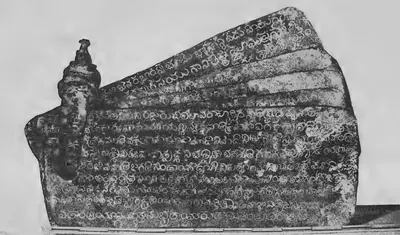
Founder of the Reddi kingdom of Addanki and Kondavidu (c. 1325–1353). He took over the country between Srisailam and the sea after the fall of the Kakatiyas. His grants of 1345 and 1346 say he restored the Brahman villages seized by the Muslim conquerors of Warangal. Later records remember him for the flights of steps at Srisailam and Ahobilam, and the poet Errapragada dedicated his Harivamsa to him.
Anavema Reddi
c. 1364–1386 CE
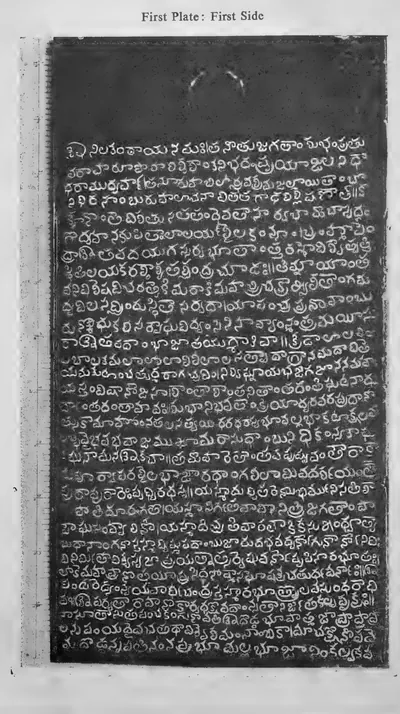
Third Reddi king (c. 1364–1386), younger son of Prolaya Vema, who ruled from Kondavidu and carried the kingdom's grants into the Godavari delta. He is known from five copper-plate grants (Pachchanitandiparru 1374, Nadupuru, Pedapalakaluru 1378, Vanapalli 1380 and others) and from records at Srisailam and Draksharama. He was surnamed Vasantaraya for his spring festival. The poet Srinatha's connection with the Reddis probably began under him.
Srinatha
c. 1365–1440 CE
Telugu poet of the late 14th and early 15th centuries, often ranked with the three translators of the Mahabharata. He served Peda Komati Vema of Kondavidu as vidyadhikarin and composed his grants and inscriptions. He then wrote for the Reddis of Rajahmundry. His Sringaranaishadham, Bhimakhandam and Kasikhandam are dedicated to Reddi kings and ministers, and they are a main source for their history.
Shivaji
c. 1627–1680 CE
Founder of the Maratha kingdom (died 1680), crowned at Raigarh in 1674. In the Telugu country he is remembered for his Karnatak expedition of 1677. He made an alliance with Abul Hasan Qutb Shah of Golconda, and the king and his ministers Madanna and Akkanna received him at Hyderabad with great ceremony. He made a pilgrimage to Srisailam, crossed the Krishna near Kurnool and sent his army south through the Cuddapah country to Jinji. On the way home he took the fort of Bellary. In 1680 Bijapur gave him its rights over the Bellary and Anantapur country.
References
Notes (0)
Sources (11)
Spotted an error on this page? Tell us
Last updated: