Shitab Khan of Warangal
Short-lived Telugu principality of the chief Shitab Khan, or Sitapati, between the fall of the Bahmani power and the rise of Golconda. He was a former officer of the Bahmanis. By his pillar inscription, he took Warangal fort from the Muslims on 21 January 1504. He held it with Khammam, Bellamkonda and other hill forts, and restored the Kakatiya family goddess and a Krishna image to their temples. The Kistna manual thought him a vassal of the Gajapatis of Orissa, with whose prince he fought at Palanchinur. Sultan Quli Qutb Shah of Golconda took his forts. The sources date the conquest of Warangal anywhere from 1512 to 1525.
Swipe sideways to see the whole chart; tap a bar for details.
Each bar is a ruling power in its region; time runs left to right. Dashed = approximate dates. Select a bar for details.
Show as a list
Nayakas, Reddis & Bahmanis 1323–1518 CE
- Telangana
- Bahmani Sultanate (c. 1347–1518 CE) · Recherla Velamas (Padmanayakas) (c. 1361–1475 CE) · Adil Shahis of Bijapur (c. 1489–1686 CE) · Gajapatis of Orissa (c. 1459–1461 CE) · Shitab Khan (Sitapati) of Warangal (c. 1504–1516 CE)
- Coastal Andhra
- Eastern Gangas of Kalinga (c. 537–1434 CE) · Gajapatis of Orissa (c. 1446–1571 CE) · Vijayanagara Empire (c. 1350–1579 CE) · Reddis of Rajahmundry (c. 1386–1448 CE) · Bahmani Sultanate (c. 1471–1489 CE)
- Rayalaseema
- Vijayanagara Empire (c. 1336–1646 CE)
Vijayanagara & the Qutb Shahis 1336–1687 CE
- Telangana
- Bahmani Sultanate (c. 1347–1518 CE) · Vijayanagara Empire (c. 1563–1565 CE) · Recherla Velamas (Padmanayakas) (c. 1361–1475 CE) · Adil Shahis of Bijapur (c. 1489–1686 CE) · Gajapatis of Orissa (c. 1459–1461 CE) · Qutb Shahis of Golconda (c. 1518–1687 CE) · Shitab Khan (Sitapati) of Warangal (c. 1504–1516 CE)
- Coastal Andhra
- Eastern Gangas of Kalinga (c. 537–1434 CE) · Gajapatis of Orissa (c. 1446–1571 CE) · Vijayanagara Empire (c. 1350–1579 CE) · Reddis of Rajahmundry (c. 1386–1448 CE) · Bahmani Sultanate (c. 1471–1489 CE) · Qutb Shahis of Golconda (c. 1524–1687 CE)
- Rayalaseema
- Vijayanagara Empire (c. 1336–1646 CE) · Adil Shahis of Bijapur (c. 1568–1686 CE) · Qutb Shahis of Golconda (c. 1579–1687 CE)
Sultanates
Bahmani Sultanate
Open page- Telangana: c. 1347–1518 CE (c. 171 years)
Western Telangana from 1347 (Kaulas taken or ceded; Bhongir taken late in Bahman Shah's reign, the province of Bidar reaching east to Bhongir); Golconda ceded under Muhammad Shah I (1362 Bilgrami; 1364-65 Haig, IG); Warangal taken in AH 828 (end of 1424 per Haig, 1422 per IG, 1425 per the Kistna Manual) and the rayas of Devarakonda and Rachakonda made tributary. Partial afterwards (Telugu chiefs regained districts under Ahmad I; Devarakonda relieved by Orissa 1459; Warangal held by the Gajapatis 1460 and by Shitab Khan from 1504). Governed for Mahmud Shah by Sultan Quli from 1495-96 until his independence (1512 per Haig; 1518 per Bilgrami, from the Golconda mosque inscription of AH 924)
- Coastal Andhra: c. 1471–1489 CE (c. 18 years)
Rajahmundry and Kondapalli (Ferishta) or Kondavidu (Haig, Burhan-i Ma'asir) taken by Malik Hasan Bahri in AH 876 (1471-72), on the invitation of a claimant to the Orissan throne (the Godavari gazetteer says Purushottama ceded the two districts); Muhammad Shah III at Rajahmundry for nearly three years after his Orissa campaign of 1478, and raided Masulipatam and Kanchi in 1481; Telingana split into the provinces of Rajahmundry and Warangal; Rajahmundry still Bahmani in 1486; the Godavari-Krishna country recovered by the Gajapati Purushottama by 1489
Rulers (18)
- Ala-ud-din Hasan Bahman Shah (1347–1358 CE)
- Muhammad Shah I (1358–1375 CE)
- Mujahid Shah (1375–1378 CE)
- Daud Shah (1378 CE)
- Muhammad Shah II (1378–1397 CE)
- Ghiyas-ud-din (1397 CE)
… and 12 more
- Shams-ud-din Daud (1397 CE)
- Firuz Shah (1397–1422 CE)
- Ahmad Shah I (1422–1435 CE)
- Ala-ud-din Ahmad Shah II (1435–1458 CE)
- Humayun Shah (1458–1461 CE)
- Nizam Shah (1461–1463 CE)
- Muhammad Shah III (1463–1482 CE)
- Mahmud Shah Bahmani (1482–1518 CE)
- Ahmad Shah (c. 1518–1521 CE)
- Ala-ud-din (c. 1521–1523 CE)
- Wali-ullah Shah (c. 1523–1525 CE)
- Kalim-ullah Shah (c. 1525–1527 CE)
Inscriptions
Sources (12)
Kingdoms and empires
Vijayanagara Empire
Open page- Rayalaseema: c. 1336–1646 CE (c. 310 years)
Founded c. 1335-36; Bukka I held Penukonda and Gooty (records of 1352 and a Gooty rock inscription) and his minister built the Bukkarayasamudram tank near Anantapur in 1364; Cuddapah in the 14th century; Kurnool wholly annexed under Krishnadeva Raya. After Talikota (1565) the kings ruled from Penukonda, which held out against Bijapur in 1577 and Golconda in 1589; the country north of Penukonda was lost after Sriranga I's capture (c. 1579-80); Venkatapati II moved to Chandragiri c. 1592; Golconda held the Cuddapah district and took Chandragiri (Chittoor) in 1646. Bijapur and Golconda took most of the region piecemeal after 1565
- Coastal Andhra: c. 1350–1579 CE (c. 229 years)
Vijayanagara officers kept Guntur (Kondavidu, Vinukonda, Bellamkonda) and the governor of Udayagiri kept Nellore after Talikota; Golconda took Kondavidu in April 1579 (Kistna Manual) or 1580 (a Guntur record of 1592 cited by Sewell), though Sewell thinks Guntur was already under Muslim rule by 1576 and the Nellore Manual says the Muslims held Nellore from 1565.
- Telangana: c. 1563–1565 CE (c. 2 years)
To end the confederate invasion of Golconda, Ibrahim Qutb Shah let Rama Raja keep the forts of Ghanpur and Panagal (Mahbubnagar) until Talikota; Ferishta places this after the Kalyani campaign of the early 1560s, the Kistna Manual dates it to 1557.
Rulers (24)
- Harihara I (Vijayanagara) (c. 1336–1355 CE)
- Bukka I (Vijayanagara) (1355–1377 CE)
- Harihara II (1377–1404 CE)
- Bukka II (1404–1406 CE)
- Deva Raya I (1406–1422 CE)
- Vijaya (Bukka III) (1422 CE)
… and 18 more
- Deva Raya II (Vijayanagara) (1422–1446 CE)
- Mallikarjuna (1446–1465 CE)
- Virupaksha (1465–1485 CE)
- Saluva Narasimha (1485–1492 CE)
- Immadi Narasimha (1492–1505 CE)
- Narasa Nayaka (c. 1505 CE)
- Vira Narasimha (1505–1509 CE)
- Krishnadeva Raya (1509–1529 CE)
- Achyuta Raya (1529–1542 CE)
- Venkata I (1542 CE)
- Sadasiva (c. 1542–1569 CE)
- Tirumala (Aravidu) (c. 1569–1572 CE)
- Sriranga I (1572–1586 CE)
- Venkatapati II (Vijayanagara) (1586–1614 CE)
- Sriranga II (1614 CE)
- Rama Deva (1614–1630 CE)
- Pedda Venkata (1630–1642 CE)
- Sriranga III (c. 1642–1670 CE)
Monuments (7)
- Penukonda fort and Gagan Mahal
- Kalahastisvara temple, Srikalahasti
- Virabhadra temple, Lepakshi
- Chandragiri fort and Raja Mahal
- Gooty fort
- Narasimha temples, Ahobilam
… and 1 more
Inscriptions (14)
- Penukonda fort inscription (1354)
- Gooty rock inscription of Bukka I
- Bitragunta grant of Sangama II (1356)
- Bukkarayasamudram tank inscription (1364)
- Tirumala inscriptions of Krishnadeva Raya and his queens (1513–1514)
- Amaravati inscription of Krishnadeva Raya (1515)
… and 8 more
- Mangalagiri and Kaza pillar inscriptions (1515–1518)
- Simhachalam inscriptions of Krishnadeva Raya (1516–1519)
- Srikalahasti inscription of Krishnadeva Raya (1516)
- Kondavidu pillar inscription of Nadindla Gopa (1520)
- Lepakshi temple inscriptions of Achyuta Raya's reign (1533–1538)
- Kanuma grant of Sadasiva (1548)
- Penukonda inscription of Channappa Nayudu (1577)
- Ahobilam inscription of Sriranga I (1584)
Sources (20)
Kingdoms and empires
Recherla Velamas (Padmanayakas)
Open page- Telangana: c. 1361–1475 CE (c. 114 years)
Anapota at Rachakonda (Rajukonda) and Mada at Devarakonda after their victories of 1361 (family chronicle); Rachakonda fortified in August 1365; Warangal, Bhongir and Rachakonda ruled by July 1369 (Inavolu inscription). The rayas of Devarakonda and Rachakonda paid tribute to Ahmad Shah Bahmani after his capture of Warangal (end of 1424); Devarakonda routed a Bahmani army with Orissan help in 1459; last dated record of the Rachakonda line 1464. End about 1475 per the list of rulers in Epigraphia Telanganica; no source dates the annexation
Rulers (7)
- Singama Nayaka (Recherla) (c. 1336–1361 CE)
- Anapota Nayaka (Recherla) (c. 1361–1384 CE)
- Mada Nayaka (Recherla) (c. 1361–1384 CE)
- Singabhupala (Recherla) (c. 1384–1399 CE)
- Peda Vedagiri (Recherla) (c. 1384–1410 CE)
- Lingama Nayaka (Recherla) (c. 1427–1475 CE)
… and 1 more
- Singama Nayaka, 'Sarvajna' (Rachakonda) (c. 1430–1475 CE)
Capitals
Monuments
Inscriptions
Sources (7)
Sultanates
Adil Shahis of Bijapur
Open page- Telangana: c. 1489–1686 CE (c. 197 years)
After the Bahmani break-up part of Mahbubnagar district went to Bijapur (the rest to Golconda) and stayed with it until Aurangzeb annexed Bijapur in 1686; the Raichur district article likewise passes Raichur (which then included the Alampur taluk and Gadwal) from the Bahmanis to the Adil Shahis.
- Rayalaseema: c. 1568–1686 CE (c. 118 years)
Partial, the western uplands only. Adoni taken by Ali Adil Shah's general Ankus Khan in 1568 after a failed siege in 1535-37; Penukonda besieged in the 1570s (dates disputed) and taken in 1652 (Mackenzie MS); Kurnool taken from Gopala Raja early in the 17th century and governed by Abdul Wahab (d. 1618) and later deputies, Siddi Jauhar holding it as his jagir about 1660; the Bellary and Anantapur uplands held through governors and tributary poligars; Bijapur's rights there passed to Shivaji in 1677-80 (Francis); Bijapur fell to Aurangzeb on 12 September 1686, but Siddi Masud held Adoni until 1688 (Sarkar) or 1687 (Bellary gazetteer)
Rulers (9)
Capitals
Monuments
Sources (11)
Kingdoms and empires
Gajapatis of Orissa
Open page- Coastal Andhra: c. 1446–1571 CE (c. 125 years)
Kapilendra (Kapilesvara, r. 1434-35 to 1469-70) took the Reddi kingdom of Rajahmundry between 1444 and 1448 and held Kondavidu by 1454 through his kinsman Ganadeva; the Bahmanis took Rajahmundry and Kondapalli or Kondavidu in 1470-71 and Purushottama had recovered the Godavari-Krishna country and the Ongole taluk by 1489; the country south of the Krishna passed to Saluva Narasimha after 1470 and, with Udayagiri, Kondavidu and Kondapalli, to Krishnadeva Raya in 1513-16; Golconda took the Godavari-Krishna doab from about 1522 and Rajahmundry in 1571-72. The northern coast (Srikurmam, Simhachalam) stayed Gajapati throughout.
- Telangana: c. 1459–1461 CE (c. 2 years)
Brief: Orissan troops relieved Devarakonda from the Bahmanis in 1459, and Kapilendra's son Hamvira and nephew Raghudeva took Warangal on 2 February 1460 (two gateway inscriptions); in 1461-62 the Orissan army and the zemindars of Telangana marched on Bidar. How long Warangal was held is not recorded
- Telangana: c. 1497–1516 CE (c. 19 years)
Partial: the uplands of Khammam and the Kondapalli-Nelakondapalli country, held by Prataparudra until Krishnadeva Raya's campaigns (Banerji; Nizam's Archaeological Department)
Rulers
- Kapilendra (Kapilesvara) (c. 1434–1470 CE)
- Purushottama (Gajapati) (c. 1470–1497 CE)
- Prataparudra (Gajapati) (c. 1497–1540 CE)
- Kalua Deva (c. 1540–1541 CE)
- Kakharua Deva (c. 1541 CE)
Inscriptions (8)
Sources (10)
Sultanates
Qutb Shahis of Golconda
Open page- Telangana: c. 1518–1687 CE (c. 169 years)
Sultan Quli governed Telingana for the Bahmanis from 1493-95 and declared independence in 1512 (Ferishta, Haig, IG Hyderabad) or 1518 (Bilgrami, from the Golconda mosque inscription of AH 924); he took the forts of the Telugu chiefs, among them Rachakonda, Devarakonda and, from Shitab Khan, Warangal and Khammam (1519-1525 per Bilgrami). Tributary to the Mughals from 1635-36 (khutba and coins in Shah Jahan's name; two lakhs of huns a year). Hyderabad taken by the Mughals in 1656 and 1685; Golconda surrendered on 21 September 1687 (Old Style) and was annexed
- Coastal Andhra: c. 1524–1687 CE (c. 163 years)
Sultan Quli took Kondapalli and fixed the Godavari as his frontier with Orissa (Ellore ceded) some time before his 1530 campaign, and a 1524 record shows him granting villages near Kondapalli and Bezwada; the Godavari gazetteer and IG Madras date the Krishna-Godavari doab to c. 1540 or 'before 1543', and the IG Madras Kistna article to after 1565.
- Rayalaseema: c. 1579–1687 CE (c. 108 years)
Partial; the sources disagree on when Golconda's hold began. IG Madras says Kurnool and Cuddapah were overrun soon after 1565. The Kurnool Manual dates the campaigns that took Gurramkonda (1579) and Gandikota, Nandyal and Musalimadugu (c. 1590). The Cuddapah gazetteer says Golconda only turned to Cuddapah in the early 17th century and never really conquered it. Chandragiri fell to Golconda in 1646.
Rulers (8)
Capitals
Monuments (13)
Inscriptions (7)
- Epitaph of Sultan Quli, Golconda (1543)
- Makka Darwaza inscription, Golconda (1559)
- Jami Masjid inscription, Hyderabad
- Epitaph of Muhammad Quli Qutb Shah, Golconda (1612)
- Ma Saheba tank inscriptions (1625)
- Musa Burj inscription, Golconda fort (1666–67)
… and 1 more
Sources (23)
Kingdoms and empires
Shitab Khan (Sitapati) of Warangal
Open page- Telangana: c. 1504–1516 CE (c. 12 years)
Partial (Warangal, Khammam and other hill forts, with Bellamkonda south of the Krishna; probably Nalgonda). A former Bahmani officer, Shitab Khan or Sitapati, took Warangal fort from the Muslims on 21 January 1504 by his pillar inscription, and held it until Sultan Quli Qutb Shah defeated him and his Gajapati allies; the Kistna manual calls him apparently a vassal of Orissa. The end is uncertain: Sastri allows him six or seven years (to 1512), the Hyderabad archaeological report of 1925-26 dates the loss of Warangal to 1513-1516, the Kistna manual places the war after 1516, and Bilgrami gives 1519-1525
Rulers
Capitals
Monuments
Inscriptions
Sources (6)
Kingdoms and empires
Eastern Gangas of Kalinga
Open page- Coastal Andhra: c. 537–1434 CE (c. 897 years)
Partial: only the far north coast (the old Ganjam and Vizagapatam districts, now Srikakulam-Vizianagaram- Visakhapatnam), capital Kalinganagara (Mukhalingam). Earliest dated grant: Jirjingi, near Tekkali, Ganga year 39 (c. 537 on Mirashi's epoch of 498; Fleet put the early grants in the 7th century and Sewell used an epoch of 877-78; the Imperial Gazetteer, the 7th century). Later line in power from the end of the 9th century (Vizagapatam gazetteer): Vajrahasta III crowned 1038; Anantavarman Chodaganga 1078-1146, with records at Mukhalingam, Srikurmam, Simhachalam and Visakhapatnam. South of the Godavari only records and raids (Draksharama 1128-1274; Bendapudi). Ended 1434, when the minister Kapilesvara founded the Gajapati line
Rulers (15)
- Vajrahasta III (Eastern Ganga) (1038–1070 CE)
- Rajaraja I (Eastern Ganga) (1070–1078 CE)
- Anantavarman Chodaganga (c. 1078–1146 CE)
- Madhu-Kamarnava (c. 1146–1152 CE)
- Raghava (c. 1152–1166 CE)
- Rajaraja II (c. 1166–1192 CE)
… and 9 more
- Aniyanka-Bhima (c. 1192–1202 CE)
- Anangabhima III (c. 1219–1253 CE)
- Narasimha I (Eastern Ganga) (c. 1253–1256 CE)
- Bhanudeva I (c. 1256–1275 CE)
- Narasimha II (c. 1275–1306 CE)
- Bhanudeva II (c. 1306–1323 CE)
- Narasimha III (c. 1323–1346 CE)
- Bhanudeva III (c. 1346–1378 CE)
- Narasimha IV (c. 1378–1397 CE)
Capitals
Monuments
Inscriptions (8)
Sources (10)
Kingdoms and empires
Reddis of Rajahmundry
Open page- Coastal Andhra: c. 1386–1448 CE (c. 62 years)
Partial: the Godavari delta and the coast north to Simhachalam, capital Rajahmundry. Kataya Vema, minister of Kumaragiri, received "the eastern country" by 1386 (Ramayya; Sewell c. 1380); after his death (c. 1414-16) Allada Reddi, then Allada's sons Allaya Vema and Virabhadra (records 1423-1437, a record of 1444). Godavari gazetteer: family in the Draksharama inscriptions until 1447; a Gajapati record of 1448 at Penugonda marks the end (Somasekhara Sarma); Kapilesvara's minister ruling at Rajahmundry in 1458
Rulers
- Kataya Vema (c. 1386–1415 CE)
- Allada Reddi (c. 1416–1420 CE)
- Allaya Vema and Virabhadra (c. 1423–1448 CE)
Capitals
Inscriptions
Sources (6)
Family tree
The rulers and the relatives who explain the succession. Every line rests on a cited statement on a person page; the sources are listed below the tree. Select a card to open that page.
- parent and child
- marriage
- adoption
- the sources disagree (see below)
- order of succession
Generation 1
- NagaLeader of the Bhoga family; grandfather of Shitab Khan
Generation 2
- GaurambaMother of Shitab KhanWife of Mana (Manaya)
- Mana (Manaya)Archer and duellist; father of Shitab KhanSon of NagaHusband of Gauramba
Generation 3
- DevambikaSenior wife of Shitab KhanWife of Shitab Khan (Sitapati)
- 1Shitab Khan (Sitapati)c. 1504–1516 CESon of Mana (Manaya) and GaurambaHusband of DevambikaHusband of Anumamba
- AnumambaSecond wife of Shitab KhanWife of Shitab Khan (Sitapati)
Generation 4
- Avadhuta KhanElder son of DevambikaSon of Shitab Khan (Sitapati) and Devambika
- PurantakaYounger son of Devambika; praised as a warriorSon of Shitab Khan (Sitapati) and Devambika
- Amara, Bhogi, RamaSons of Anumamba; Amara was killed in battleSons of Shitab Khan (Sitapati) and Anumamba
Sources for every line of the tree
- Naga → Mana (Manaya) (parent and child)
- His inscription says that Shitab Khan was the son of Mana, or Manaya, a famous archer, and of his wife Gauramba. →
- Sastri, Shitab Khan of Warangal (1932), p. 15 (archive.org (opens in a new tab)).
- Sastri, Shitab Khan of Warangal (1932), p. 20, translation of verse 1 and lines 5–6 (archive.org (opens in a new tab)).
- Sastri, Shitab Khan of Warangal (1932), p. 21, translation of verses 5–8 (archive.org (opens in a new tab)).
- His inscription says that Shitab Khan was the son of Mana, or Manaya, a famous archer, and of his wife Gauramba. →
- Mana (Manaya) · Gauramba (marriage)
- His inscription says that Shitab Khan was the son of Mana, or Manaya, a famous archer, and of his wife Gauramba. →
- Sastri, Shitab Khan of Warangal (1932), p. 15 (archive.org (opens in a new tab)).
- Sastri, Shitab Khan of Warangal (1932), p. 20, translation of verse 1 and lines 5–6 (archive.org (opens in a new tab)).
- Sastri, Shitab Khan of Warangal (1932), p. 21, translation of verses 5–8 (archive.org (opens in a new tab)).
- His inscription says that Shitab Khan was the son of Mana, or Manaya, a famous archer, and of his wife Gauramba. →
- Mana (Manaya) and Gauramba → Shitab Khan (Sitapati) (parent and child)
- His inscription says that Shitab Khan was the son of Mana, or Manaya, a famous archer, and of his wife Gauramba. →
- Sastri, Shitab Khan of Warangal (1932), p. 15 (archive.org (opens in a new tab)).
- Sastri, Shitab Khan of Warangal (1932), p. 20, translation of verse 1 and lines 5–6 (archive.org (opens in a new tab)).
- Sastri, Shitab Khan of Warangal (1932), p. 21, translation of verses 5–8 (archive.org (opens in a new tab)).
- His inscription says that Shitab Khan was the son of Mana, or Manaya, a famous archer, and of his wife Gauramba. →
- Shitab Khan (Sitapati) · Devambika (marriage)
- By his senior wife, Devambika, he had two sons, Avadhuta Khan and Purantaka. →
- Sastri, Shitab Khan of Warangal (1932), p. 13 (archive.org (opens in a new tab)).
- Sastri, Shitab Khan of Warangal (1932), p. 23, translation of verses 23–27 (archive.org (opens in a new tab)).
- By his senior wife, Devambika, he had two sons, Avadhuta Khan and Purantaka. →
- Shitab Khan (Sitapati) · Anumamba (marriage)
- By his senior wife, Devambika, he had two sons, Avadhuta Khan and Purantaka. →
- Sastri, Shitab Khan of Warangal (1932), p. 13 (archive.org (opens in a new tab)).
- Sastri, Shitab Khan of Warangal (1932), p. 23, translation of verses 23–27 (archive.org (opens in a new tab)).
- By his senior wife, Devambika, he had two sons, Avadhuta Khan and Purantaka. →
- Shitab Khan (Sitapati) and Devambika → Avadhuta Khan and Purantaka (parent and child)
- By his senior wife, Devambika, he had two sons, Avadhuta Khan and Purantaka. →
- Sastri, Shitab Khan of Warangal (1932), p. 13 (archive.org (opens in a new tab)).
- Sastri, Shitab Khan of Warangal (1932), p. 23, translation of verses 23–27 (archive.org (opens in a new tab)).
- By his senior wife, Devambika, he had two sons, Avadhuta Khan and Purantaka. →
- Shitab Khan (Sitapati) and Anumamba → Amara, Bhogi, Rama (parent and child)
- By his senior wife, Devambika, he had two sons, Avadhuta Khan and Purantaka. →
- Sastri, Shitab Khan of Warangal (1932), p. 13 (archive.org (opens in a new tab)).
- Sastri, Shitab Khan of Warangal (1932), p. 23, translation of verses 23–27 (archive.org (opens in a new tab)).
- By his senior wife, Devambika, he had two sons, Avadhuta Khan and Purantaka. →
A line from one parent only means that the cited sources name no other parent.
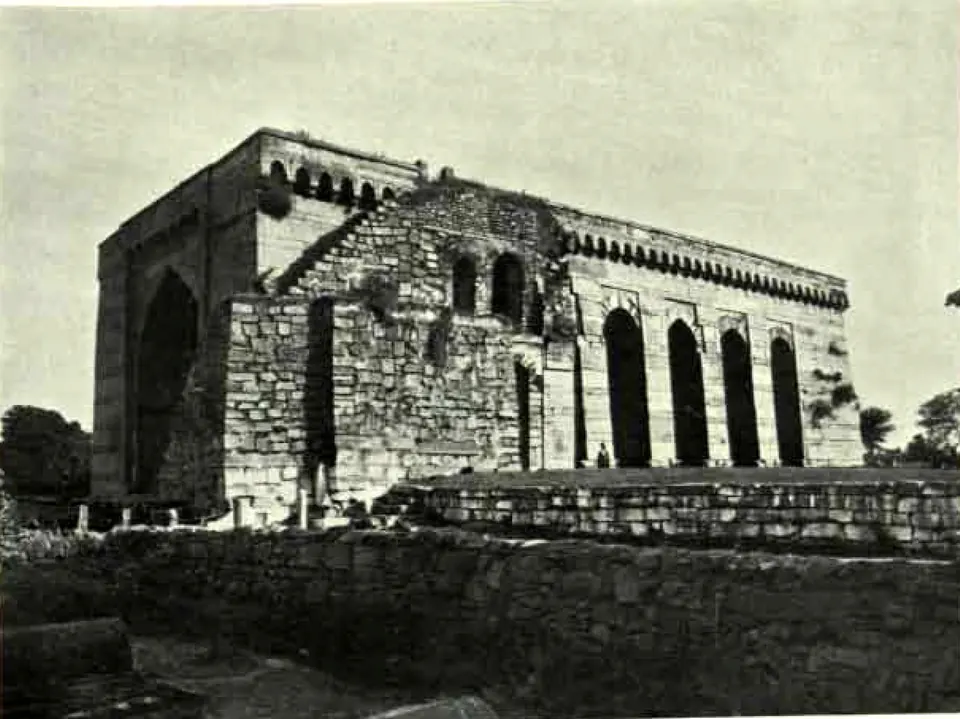
Between the decline of the Bahmani sultanate and the rise of Golconda, a Telugu chief, Shitab Khan, held the old Kakatiya capital of Warangal for some years. The Golconda chronicle calls him Sitapati, the Raja of Khammam. Hirananda Sastri edited his inscription for the Nizam’s government in 1932.1 He wrote that Shitab Khan “was the governor of Warangal under the Baihmanids originally”.1 He added that “he succeeded in carving out for himself an independent principality which probably comprised Khammameth, Warangal and Nalgonda”.1 See Shitab Khan (Sitapati), the Bahmanis and the Qutb Shahis.
The sources
The main source is the Sanskrit and Telugu inscription on a red sandstone pillar in front of the Sambhuni-gudi in Warangal fort.23 Sastri published it with a translation and plates.23 He also gathered the Persian chronicles, the Telugu kaifiyats (village histories) of the Mackenzie collection and two Telugu poems.23
The History of Sultan Quli Qutb Shah, in Briggs’s translation of 1829, tells of the war with Sitapati.4 The Kistna district manual (1883) retells it.5 Sastri warned that the kaifiyats “have mixed up matters”.6 They “did not distinguish the Shitab Khan of the reign of Humayun, the Cruel, from the Shitab Khan of the time of Ibrahim Qutb Shah”.6
Robert Sewell’s Historical Inscriptions of Southern India (1932) lists the Warangal record among those of 1503.7 It notes E. Hultzsch’s comment that the chief praised in it seems to have been a Hindu, though he bore a Muslim title.7 See the inscription.
Origins
The Burhan-i Ma’asir names a Shitab Khan among the amirs (nobles) of the Bahmani Sultan Humayun Shah who “fled for his life”.826 The Sultan had tortured these men’s women in public.826 Sastri dated the episode to about 1461, and took this amir for the later chief of Warangal.26
According to his inscription, Shitab Khan took Warangal from the Muslims on the fifth day of the bright fortnight of Magha in Saka 1425 (Saka is an Indian way of counting years).9 Sastri reckoned this date as 21 January 1504.9 The Burhan-i Ma’asir also says that in 1497 Sultan Quli “added to his former possessions the towns of Warangal and Kovilkonda with their dependencies”.9 Sastri concluded that Shitab Khan “must have wrested it in the year 1504 A.C. from Quli Qutb Shah … when he had not yet proclaimed his independence”.9
The Hyderabad archaeological report for 1925–26 calls him “the Governor of Warangal under the Baihmanids at the close of the 15th century”.1011 It says that he later allied himself with the “Warangal Kings”.1011 See Humayun Shah and Sultan Quli.
Territory
The Golconda chronicle says: “This Raja possessed the strong forts of Cummamett, Belumconda, Wurungole, and others”.4 From this Sastri inferred that “he must have governed the tracts between Warangal and Guntur on both sides of the Krishna river”.2
His inscription says that he took “the important and impregnable hill forts of Rajadri and others”.12 Sastri identified Rajadri with Rajakonda.13 The Kistna manual says that “Bellamkonda was at this time held by a Raja named Sitapati who also held Varangal and Kammamet and who seems to have been a vassal of Orissa”.5 See Khammam and Rachakonda.
Government and army
The chronicle credits him with “twelve thousand infantry, noted as good marksmen”.4 Their fire “withstood several charges of the Mahomedan cavalry” before they broke.4
The Telugu poem Chitra-Bharatamu is dedicated to his minister Inumulapalli Peddanna.14 It calls the minister “expert in managing the kingdom of the great king (Chitapa Khana)”.14 It says that one of the minister’s brothers commanded a fort and “was a great foe of the Musalmans”.14 This brother received from Shitab Khan the royal honours of the chauri (fly-whisk), palanquin and white umbrella.14
The Telugu Raya-vachakamu tells of the time when Krishnadeva Raya invaded the Gajapati country.3 It says that “Chitapa-Khana (Shitab Khan), with sixty thousand archers” held the passes against him for a time.3 See Krishnadeva Raya.
Religion and the Kakatiya past
His inscription presents him as a Hindu restorer of the Kakatiya city.1516 It calls Warangal “the beautiful city of Ekasilapuri, which was formerly ruled by a number of virtuous kings belonging to the family of Kakati”.1516 It says that he put back on its throne the image of Krishna as Panchalaraya, “removed from his place by the strength of the wicked”.1516 He also reinstalled the goddess who “was the Lakshmi of the throne of the Kakati kingdom”.1516
Sastri read the respectful mention of the Kakatiyas as a sign “that some scion of that ancient house was alive”.1 He thought this descendant was “possibly, recognised to be the de jure owner of Warangal”, that is, its lawful owner.1
A kaifiyat says the opposite.617 It says that he pulled down Kakatiya temples, including the thousand-pillared temple, to finish the stone fort.617 Sastri thought this might be explained if the temples were already ruined.617 See the Kakatiyas and Warangal Fort.
Buildings and works
A great hall in Warangal fort, near the western gateway of the central temple, bears his name.110 The Hyderabad Archaeological Department repaired it and called it “the audience-hall of Shitab Khan”.110 It thought the hall “seems to have been constructed about that time”, the turn of the fifteenth and sixteenth centuries.110
The Chitra-Bharatamu praises him for building “Pakala and other lakes which can be compared with oceans”.14 A tradition credits him with repairing the breaches in the dam of the Pakhal lake.1418 At the centre of the dam the Imperial Gazetteer (1909) noted “the ruins of a small pavilion known as the chabutra of Shitab Khan”.18 See Shitab Khan’s hall and Pakhal.
The Gajapatis and the end
According to the chronicle, Sultan Quli took Bellamkonda by storm and beat Sitapati in the field.41920 Sitapati then called on the neighbouring rajas, “such as those of Condapilly, Indraconda, Warapully, and Etgeer”, to form a league at Khammam.41920 When that too was broken, he “fled, and took protection with Ramchundur Dew”.41920 Sultan Quli stormed Khammam, “then one of the strongest forts in Tulingana”.41920 He spared only “the females of the family of Seetaputty, who were reserved for the King’s seraglio” (harem).41920
Sitapati told Ramachandra, “the son of Gujputty, who held his court at Condapilly”, that Sultan Quli would next invade his country.202122 The Gajapati prince gathered a vast army, in which Sitapati commanded on the left with Hari Chandra.202122 This army was routed near “Palunchinoor”.202122 After that a treaty made the Godavari the boundary between Golconda and Orissa.202122
Sastri quotes a Persian manuscript about the fall of the fort.23 It says that when “such a strong fort was conquered” the victors seized “the treasure and jewellery which Shitab Khan and his villainous forebears had amassed”.23 It says that his temples were destroyed and mosques built in their place.23 See Kondapalli and the Gajapatis.
Where the sources disagree
- The date of his fall. Sastri thought that Sultan Quli took Warangal after defeating Ala-ud-din Imad Shah in 1512, giving Shitab Khan “not … more than six or seven years”.9 The Hyderabad report for 1925–26 says that Sultan Quli “took possession of Warangal between 1513 and 1516”.11 The Kistna manual places the war after the peace of 1516 between Krishnadeva Raya and the Gajapati.245 Bilgrami says that Sultan Quli was busy defeating Shitab Khan between 1519 and 1525.25 Sewell compared the chronicle with Vijayanagara and Portuguese sources.26 He thought that its campaigns covered “a period of at least twenty-one years” from 1512 and could not be dated in detail.26
- His religion. From the inscription, Sastri held that “Shitab Khan was a Hindu and not a Musalman”, and the Persian writers call him an infidel.179 Glimpses of the Nizam’s Dominions called him “the first Mahomedan conqueror of Warangal”.179 A kaifiyat makes him a destroyer of Hindu temples.179
- Whose officer. Sastri and the 1925–26 report make him a former Bahmani governor.910 Bilgrami makes “Shitab Khan one of the officers of Ibrahim”, who took Warangal for Golconda after Talikota.27 The kaifiyats give him a career in the service of the Gajapati Mukundadeva at Rajahmundry.286 Sastri gave that career to a later Shitab Khan.286
- Two Shitab Khans. The chronicle of Ibrahim Qutb Shah has a “Seetaputty” holding Pentapoor and Rajapudi and helping to defend Rajahmundry in 1571–72.29 Sastri argued that the amir of about 1461 would by then have been “about 130 or 135 years” old.6 So, he said, this must be “a different Shitab Khan”.6
Footnotes
-
Hirananda Sastri, Shitab Khan of Warangal (Hyderabad Archaeological Series No. 9, 1932), p. 2 (archive.org (opens in a new tab)). ↩ ↩2 ↩3 ↩4 ↩5 ↩6 ↩7 ↩8
-
Sastri, Shitab Khan of Warangal (1932), p. 3 (archive.org (opens in a new tab)). ↩ ↩2 ↩3 ↩4 ↩5 ↩6 ↩7
-
Sastri, Shitab Khan of Warangal (1932), p. 12 (archive.org (opens in a new tab)). ↩ ↩2 ↩3 ↩4 ↩5
-
John Briggs (tr.), History of the Rise of the Mahomedan Power in India, Vol. III (1829), p. 360, “History of the Kootb Shahy Dynasty” (archive.org (opens in a new tab)). ↩ ↩2 ↩3 ↩4 ↩5 ↩6 ↩7 ↩8 ↩9
-
Gordon Mackenzie, A Manual of the Kistna District (1883), p. 25 (archive.org (opens in a new tab)). ↩ ↩2 ↩3
-
Sastri, Shitab Khan of Warangal (1932), p. 9 (archive.org (opens in a new tab)). ↩ ↩2 ↩3 ↩4 ↩5 ↩6 ↩7 ↩8 ↩9 ↩10 ↩11 ↩12
-
Robert Sewell, The Historical Inscriptions of Southern India (1932), p. 234, A.D. 1503, No. 108 of 1902 (archive.org (opens in a new tab)). ↩ ↩2
-
J. S. King, The History of the Bahmani Dynasty, founded on the Burhan-i Ma’asir (1900), p. 88 (archive.org (opens in a new tab)). ↩ ↩2
-
Sastri, Shitab Khan of Warangal (1932), p. 15 (archive.org (opens in a new tab)). ↩ ↩2 ↩3 ↩4 ↩5 ↩6 ↩7 ↩8 ↩9
-
Annual Report of the Archaeological Department of H.E.H. the Nizam’s Dominions, 1925–26 (1928), p. 11 (archive.org (opens in a new tab)). ↩ ↩2 ↩3 ↩4 ↩5 ↩6
-
Hyderabad Archaeological Report, 1925–26 (1928), p. 12 (archive.org (opens in a new tab)). ↩ ↩2 ↩3
-
Sastri, Shitab Khan of Warangal (1932), p. 22, translation of verse 19 (archive.org (opens in a new tab)). ↩
-
Sastri, Shitab Khan of Warangal (1932), p. 13 (archive.org (opens in a new tab)). ↩
-
Sastri, Shitab Khan of Warangal (1932), p. 11 (archive.org (opens in a new tab)). ↩ ↩2 ↩3 ↩4 ↩5 ↩6
-
Sastri, Shitab Khan of Warangal (1932), p. 23, translation of verse 27 (archive.org (opens in a new tab)). ↩ ↩2 ↩3 ↩4
-
Sastri, Shitab Khan of Warangal (1932), p. 24, translation of verses 33–34 (archive.org (opens in a new tab)). ↩ ↩2 ↩3 ↩4
-
Sastri, Shitab Khan of Warangal (1932), p. 10 (archive.org (opens in a new tab)). ↩ ↩2 ↩3 ↩4 ↩5 ↩6
-
Imperial Gazetteer of India, Provincial Series: Hyderabad State (1909), p. 91 (archive.org (opens in a new tab)). ↩ ↩2
-
Briggs, Rise of the Mahomedan Power, Vol. III (1829), p. 361 (archive.org (opens in a new tab)). ↩ ↩2 ↩3 ↩4 ↩5
-
Briggs, Rise of the Mahomedan Power, Vol. III (1829), p. 362 (archive.org (opens in a new tab)). ↩ ↩2 ↩3 ↩4 ↩5 ↩6 ↩7 ↩8 ↩9
-
Briggs, Rise of the Mahomedan Power, Vol. III (1829), p. 363 (archive.org (opens in a new tab)). ↩ ↩2 ↩3 ↩4
-
Briggs, Rise of the Mahomedan Power, Vol. III (1829), p. 364 (archive.org (opens in a new tab)). ↩ ↩2 ↩3 ↩4
-
Sastri, Shitab Khan of Warangal (1932), p. 14 (archive.org (opens in a new tab)). ↩ ↩2 ↩3
-
Mackenzie, Kistna District (1883), p. 24 (archive.org (opens in a new tab)). ↩
-
Syed Ali Asgar Bilgrami, Landmarks of the Deccan (1927), p. 195 (archive.org (opens in a new tab)). ↩
-
Robert Sewell, A Forgotten Empire (Vijayanagar) (1900), p. 135 (archive.org (opens in a new tab)). ↩ ↩2
-
Bilgrami, Landmarks of the Deccan (1927), p. 125 (archive.org (opens in a new tab)). ↩
-
Sastri, Shitab Khan of Warangal (1932), p. 7 (archive.org (opens in a new tab)). ↩ ↩2
-
Sastri, Shitab Khan of Warangal (1932), p. 8, quoting the chronicle of Ibrahim Qutb Shah (archive.org (opens in a new tab)). ↩
Photos
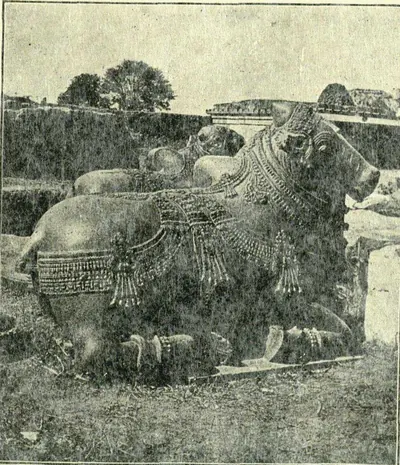 "Carved Stone Bulls in front of the Sambhuni-gudi Temple" (Sastri 1932, Pl. I (b))Book plate · 1932
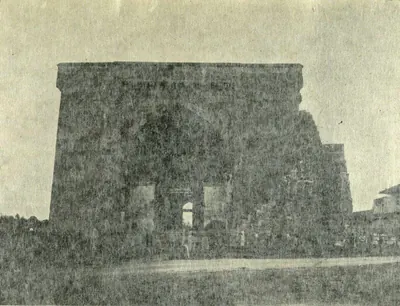 "Shitab Khan's Hall: Front View" (Sastri 1932, Pl. II (a))Book plate · 1932
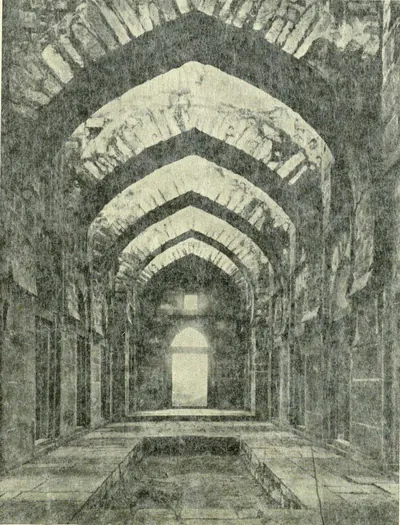 "Shitab Khan's Hall: Interior" (Sastri 1932, Pl. II (b))Book plate · 1932
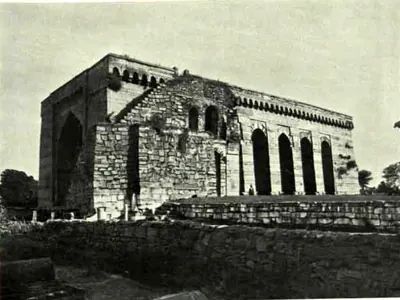 Shitab Khan's Hall: view from N.-W., Warangal Fort (Hyderabad Arch. Report 1925-26, Pl. XV (b))Historic photograph · 1928
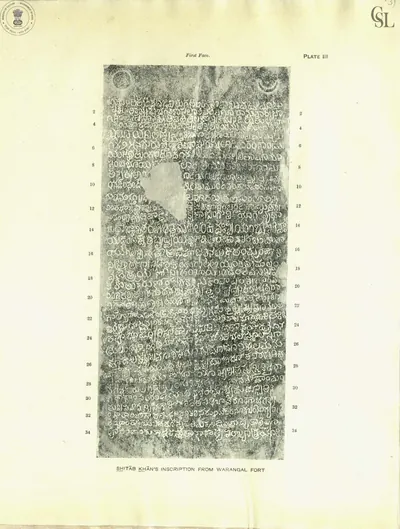 Shitab Khan's inscription from Warangal Fort: first face (Sastri 1932, Pl. III)Inscription rubbing · 1932
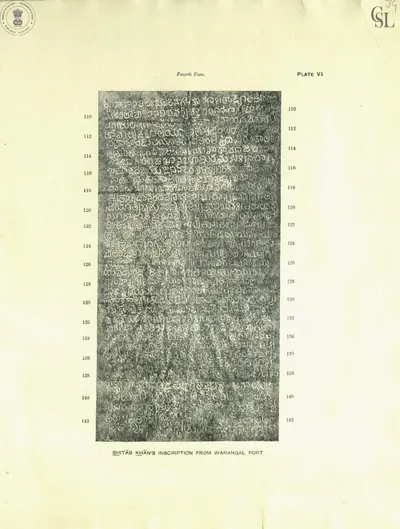 Shitab Khan's inscription from Warangal Fort: fourth face (Sastri 1932, Pl. VI)Inscription rubbing · 1932
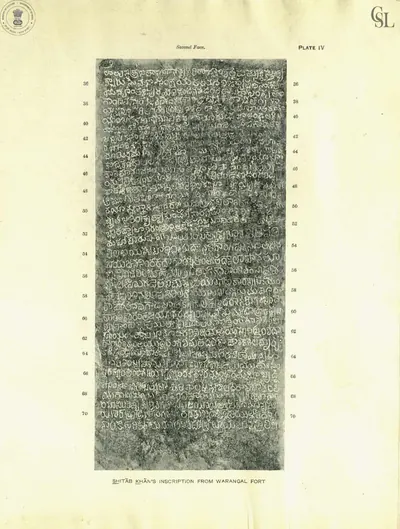 Shitab Khan's inscription from Warangal Fort: second face (Sastri 1932, Pl. IV)Inscription rubbing · 1932
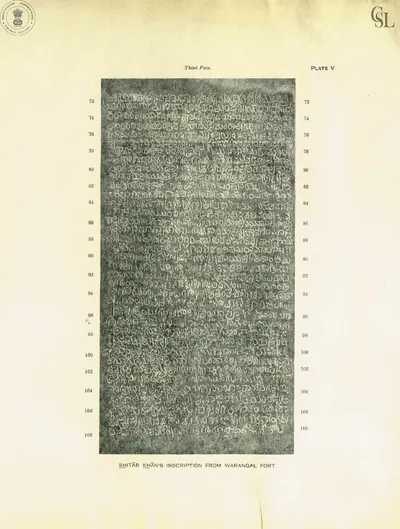 Shitab Khan's inscription from Warangal Fort: third face (Sastri 1932, Pl. V)Inscription rubbing · 1932
Related
People
Monuments
Inscriptions
References
Notes (0)
Sources (9)
Spotted an error on this page? Tell us
Last updated: