Dhruva (Rashtrakuta)
Dhruva, called Dharavarsha and Kalivallabha, was the Rashtrakuta king who took the throne from his elder brother Govinda II about 780 and reigned until about 793. Records of his first year at Alampur, now in Jogulamba Gadwal district, tell how a feudatory named Balavarmarasa built a great gateway and arranged a feast for a thousand people. An undated inscription at Kuruvagattu, in the Mahbubnagar country, names the friend of his son Govinda III.
Download
Dhruva was a king of the Rashtrakutas, who reigned from about 780 to 793.12 He took the throne from his elder brother, Govinda II.3 Inscriptions of his first year at Alampur, on the Tungabhadra in today’s Telangana, show that the Rashtrakutas now held the old Chalukya temple town.12
Who he was
Dhruva was the younger son of Krishna I.3 His titles included Dharavarsha, “the heavy rainer”, Kalivallabha and Nirupama, “the unequalled one”.3 The early records say that he won the throne “by jumping over his elder brother”.3 Robert Sewell read the Paithan grant of 794 to say that Govinda II was deposed and Dhruva seized his throne.4
J. F. Fleet lists his wars outside the Telugu country.3 He imprisoned a Ganga king, took elephants from a Pallava king, and drove the king Vatsaraja into the deserts of Marwar.3 He made his son Govinda III crown prince by investing him with a necklace.5 See Govinda III.
The gateway at Alampur
One Kannada inscription at Alampur is dated in the first year of a king named Dharavarsha.1 Its editor in 1961 thought that this “might be” Dhruva, and dated his first year to about 780.1 It describes the arrangements made by a man named Balavarmarasa for the temple festivals at Alampur.1
The Mahbubnagar volume of Inscriptions of Andhra Pradesh (2003), as summarised in Epigraphia Telanganica, describes a record of the same first year.2 It is on the south wall of the Brahmesvara temple, near its western entrance.2 In the volume’s reading, Balavarmarasa was probably a feudatory, and he built the western mahadvara (great gateway) of the temple.2
The same record lists the gifts made for the Mahanavami festival.2 Thirty leading men of the village gave rice, ghee and other food to feed a thousand people.2 The gaundas (oil-pressers) gave oil, and the flower-sellers gave flowers to decorate the hall.2 Three sculptors, Ayyanachari, Sridharavoja and Punnioja, also made gifts.2
Another record of the same first year is on a pilaster of the great gateway of the Mahadeva temple.2 It records gifts to the goddess Durga-bhattaraki while Balavarmarasa governed Alampur.2 A man named Somadibhatta was then head of the matha (monastery).2 The summary of Indian Archaeology 1959–60 says that it gave the goddess three hundred and sixty mattars of land.6
Kuruvagattu
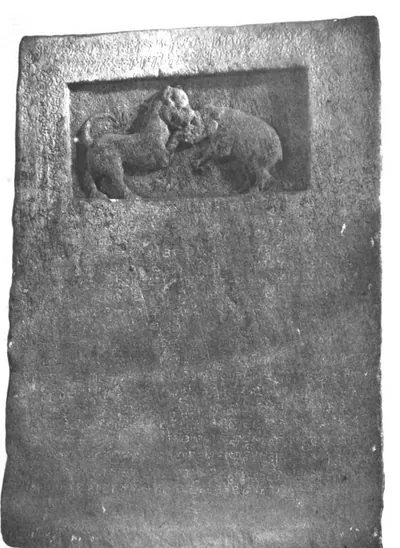
An undated inscription at Kuruvagattu, in the Mahbubnagar district, praises a Chalukya warrior, the son of Vinayaditya.7 It calls him the friend of Govinda-vallabha, son of Kali-vallabha of the Rashtrakuta family.7 P. B. Desai pointed out that Kalivallabha was a title of Dhruva, whose son was Govinda III.7 See the Kuruvagattu inscription.
Where the sources disagree
- Who was Dharavarsha? The 1961 list says only that he “might be” Dhruva.1 The 2003 Mahbubnagar volume names him Dharavarsha Dhruva without doubt.2
- His reign. About 780 to 792 in the 1961 list, and 780 to 793 in the 2003 volume.12
- The Kuruvagattu warrior’s father. Desai’s 1961 list does not say who this Vinayaditya was.7 The summary in Epigraphia Telanganica identifies him with the founder of the Chalukya family of Vemulavada.8
Footnotes
-
Kannada Inscriptions of Andhra Pradesh (1961), p. 36, No. 99 (archive.org (opens in a new tab)). Paraphrased except for the short phrase quoted. ↩ ↩2 ↩3 ↩4 ↩5 ↩6 ↩7
-
Epigraphia Telanganica I (2023), p. 76, Rashtrakuta Nos. 3–4, summarising Inscriptions of Andhra Pradesh, Mahabubnagar District I (2003), pp. 21–22, and the Annual Report on Indian Epigraphy for 1959-60, p. 59. Cite-only; paraphrased. ↩ ↩2 ↩3 ↩4 ↩5 ↩6 ↩7 ↩8 ↩9 ↩10 ↩11 ↩12 ↩13 ↩14
-
J. F. Fleet, “Dynasties of the Kanarese Districts”, Gazetteer of the Bombay Presidency I, pt. II (1896), p. 393 (archive.org (opens in a new tab)). ↩ ↩2 ↩3 ↩4 ↩5 ↩6
-
Robert Sewell, The Historical Inscriptions of Southern India (1932), p. 32 (archive.org (opens in a new tab)). Paraphrased. ↩
-
Fleet, “Dynasties of the Kanarese Districts” (1896), p. 394 (archive.org (opens in a new tab)). ↩
-
Gajjala Vasanta Lakshmi (ed.), Epigraphia Telanganica I: Pre-Kakatiya Telangana (2023), p. 46, summarising Indian Archaeology 1959-60: A Review, p. 54. Cite-only; paraphrased. ↩
-
P. B. Desai (introduction), Kannada Inscriptions of Andhra Pradesh (Andhra Pradesh Government Archaeological Series 3, 1961), p. 11, No. 29 (archive.org (opens in a new tab)). Paraphrased except for the short phrase quoted. ↩ ↩2 ↩3 ↩4
-
Epigraphia Telanganica I (2023), p. 77, No. 6, summarising Inscriptions of Andhra Pradesh, Mahabubnagar District I (2003), pp. 24–25. Cite-only; paraphrased. ↩
Related
Dynasties
References
Notes (0)
Sources (4)
Spotted an error on this page? Tell us
Last updated: