Govinda II (Rashtrakuta)
Govinda II was the elder son of the Rashtrakuta king Krishna I and reigned briefly in the 770s, until his younger brother Dhruva pushed him aside. As crown prince in 770 he led an army into Vengi, and he issued the Alas plates from a camp where the Musi joins the Krishna, on the edge of the Telugu country. The plates say that the king of Vengi gave up his treasury, his forces and his country. Later, according to Fleet, Govinda called on the king of Vengi to help him keep his throne.
Download
Govinda II was the elder son of the Rashtrakuta king Krishna I.1 As crown prince he led an army into Vengi, the kingdom of the Eastern Chalukyas, in 770.2 His grant from that campaign shows that the two houses were already at war in 770.3 He reigned only a few years before his younger brother Dhruva pushed him aside.14
The camp on the Krishna
In 770 Govinda issued a grant, now called the Alas plates.5 It was made in the reign of his father, while Govinda was yuvaraja (crown prince).5 In D. R. Bhandarkar’s translation, it was issued from “the victorious army that invaded the Vengi-mandala”.2 This was “when the lord of Vengi was humbled by the cession of (his) treasury, (his) forces, and his own country”.2
The camp was “at the confluence of the Krishnaverna and the Musi”.2 Bhandarkar noted that the Musi joins the Krishna on the edge of the old Kistna district.3 Robert Sewell placed the camp on the borders of the Palnad taluk, south of the Krishna.6 He took the king of Vengi to be Vishnuvardhana IV.6 He thought the defeat was real, but that the Rashtrakutas did not take over the country.6 See Vishnuvardhana IV.
Bhandarkar drew a wider lesson from the grant.3 It showed, he wrote, that the war between the two dynasties “had sprung up … long before the time of Govinda III”.3
A short reign
By 779 Govinda II was on the throne.7 The Dhulia plates of that year, issued by his nephew Karka, name him as the reigning king, with the title Prabhutavarsha.7 Sewell wrote that this settled the doubt whether Govinda II ever came to the throne.7
Dhruva then took the kingdom.1 The early records say that Dhruva won the throne “by jumping over his elder brother”.1 A grant of 940 tells it more gently: Govinda grew careless through pleasure and left the kingdom to his brother.1
The Paithan grant of Govinda III names the kings of Malava, Kanchi, Vengi and the Ganga country in Govinda II’s story.14 J. F. Fleet read it to say that Govinda called these hostile kings to his help against Dhruva.1 Sewell read it to say that Govinda fought them, the king of Vengi among them.4
Alampur
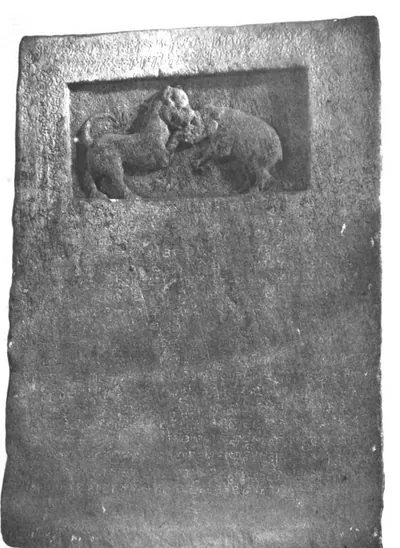
A damaged inscription at Alampur records that a man named Srimara built a shrine of the Sun in the Uttaresvara temple.8 He built it for the welfare of a king called Prabhutavarsha.8 The Mahbubnagar volume of Inscriptions of Andhra Pradesh (2003), as summarised in Epigraphia Telanganica, assigns the record to Govinda II.9 It takes the record as a sign that Rashtrakuta power had reached the region.9
Where the sources disagree
- Did he reign? Fleet (1896) thought it most likely that Govinda II never succeeded to the throne.1 Sewell (1932) took the Dhulia plates of 779 to prove that he did.7
- The kings in the Paithan grant. Govinda’s helpers against Dhruva (Fleet), or his enemies (Sewell).14
- The Alas plates. Fleet judged in 1903 that the plates are not the original record, because of their poor letters and uneven lines.10 But he thought them based on “something genuine”, and accepted that Govinda was crown prince in 770.10
- The Alampur Prabhutavarsha. Govinda II (the 2003 Mahbubnagar volume), or probably Govinda III (P. B. Desai’s list of 1961).98
Footnotes
-
J. F. Fleet, “Dynasties of the Kanarese Districts”, Gazetteer of the Bombay Presidency I, pt. II (1896), p. 393 (archive.org (opens in a new tab)). ↩ ↩2 ↩3 ↩4 ↩5 ↩6 ↩7 ↩8 ↩9
-
Bhandarkar, “Alas Plates” (1901), p. 213, translation (archive.org (opens in a new tab)). ↩ ↩2 ↩3 ↩4
-
Bhandarkar, “Alas Plates” (1901), p. 209 (archive.org (opens in a new tab)). ↩ ↩2 ↩3 ↩4
-
Sewell, Historical Inscriptions (1932), p. 32 (archive.org (opens in a new tab)). Paraphrased. ↩ ↩2 ↩3 ↩4
-
D. R. Bhandarkar, “Alas Plates of the Yuvaraja Govinda II; Saka-Samvat 692”, Epigraphia Indica VI (1901), p. 208 (archive.org (opens in a new tab)). ↩ ↩2
-
Robert Sewell, The Historical Inscriptions of Southern India (1932), p. 30 (archive.org (opens in a new tab)). Paraphrased. ↩ ↩2 ↩3
-
Sewell, Historical Inscriptions (1932), p. 31 (archive.org (opens in a new tab)). Paraphrased. ↩ ↩2 ↩3 ↩4
-
Kannada Inscriptions of Andhra Pradesh (Andhra Pradesh Government Archaeological Series 3, 1961), p. 35, No. 93 (archive.org (opens in a new tab)). Paraphrased. ↩ ↩2 ↩3
-
Gajjala Vasanta Lakshmi (ed.), Epigraphia Telanganica I: Pre-Kakatiya Telangana (2023), p. 75, Rashtrakuta No. 1, summarising Inscriptions of Andhra Pradesh, Mahabubnagar District I (2003), pp. 20–21. Cite-only; paraphrased. ↩ ↩2 ↩3
-
J. F. Fleet, “Some Rashtrakuta Records”, Epigraphia Indica VII (1903), p. 231 (archive.org (opens in a new tab)). ↩ ↩2
Photos
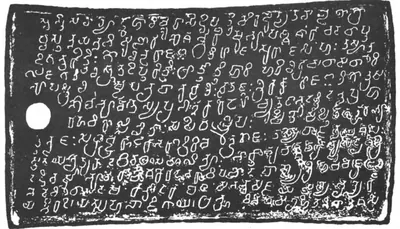 "Alas Plates of the Yuvaraja Govinda II.—Saka-Samvat 692." side i (Epigraphia Indica VI, plate with No. 18; PDF p. 265 of the archive.org scan EpigraphiaIndicaVol6)Inscription rubbing · 1901
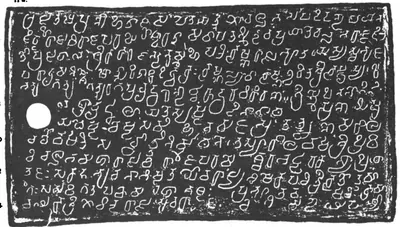 "Alas Plates of the Yuvaraja Govinda II.—Saka-Samvat 692." side iia (Epigraphia Indica VI, plate with No. 18; PDF p. 265 of the archive.org scan EpigraphiaIndicaVol6)Inscription rubbing · 1901
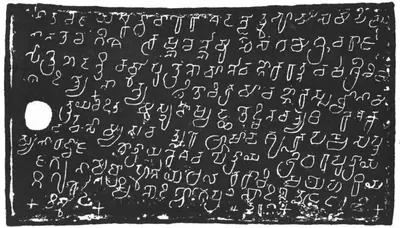 "Alas Plates of the Yuvaraja Govinda II.—Saka-Samvat 692." side iib (Epigraphia Indica VI, plate with No. 18; PDF p. 266 of the archive.org scan EpigraphiaIndicaVol6)Inscription rubbing · 1901
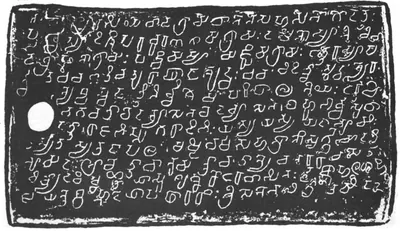 "Alas Plates of the Yuvaraja Govinda II.—Saka-Samvat 692." side iii (Epigraphia Indica VI, plate with No. 18; PDF p. 266 of the archive.org scan EpigraphiaIndicaVol6)Inscription rubbing · 1901
Related
Dynasties
References
Notes (0)
Sources (6)
Spotted an error on this page? Tell us
Last updated: