Dost Ali Khan
Dost Ali Khan was Nawab of the Carnatic, ruling from Arcot from 1732 to 1740, a nephew of Saadatullah Khan. His Nawabship included the Nellore district, and a farman of 1733, said to come from the emperor Muhammad Shah, confirmed him in his uncle's place. In 1740 a Maratha army came south through Kurnool and Kadapa. Dost Ali tried to stop it at Damalcheruvu, in the Chandragiri taluk, but he was outflanked and killed there with his son Hussain Ali.
Download
Dost Ali Khan was Nawab of the Carnatic, ruling from Arcot from 1732 to 1740.12 His Nawabship included the Nellore district.3 He was killed in 1740 at Damalcheruvu, in the Chandragiri taluk near Chandragiri, fighting a Maratha army.4 See the Nawabs of Arcot.
Who he was
Dost Ali was a nephew of Saadatullah Khan, who had no children of his own.5 Saadatullah adopted his brother’s two sons and made the elder, Dost Ali, Nawab of Arcot.5 When Saadatullah died in 1732, Dost Ali succeeded him.1 Mark Wilks wrote that he did so without the sanction of Nizam-ul-Mulk, the viceroy of the south.1 Dost Ali gave one of his daughters in marriage to Hussain Dost Khan, better known as Chanda Sahib.1
Muhammad Burhanuddin (1905) prints a farman (royal order) of 13 January 1733, said to come from the emperor Muhammad Shah.5 It tells Dost Ali that he is now “in the room of the late Nabob”, and to keep his uncle’s good rules.5 See Muhammad Shah.
The North Arcot manual (1895) praises the rule of the two Nawabs for its “moderation and beneficence”.6 It says that many of the irrigation works of the country were ascribed to them.6
The Maratha invasion of 1740
In 1740 a Maratha army under Raghoji Bhonsle invaded the Carnatic.4 In May it defeated the Nawab of Kurnool and then the Nawab of Kadapa.7 The Cuddapah gazetteer thought that it came down from the plateau by the descent from Piler to Damalcheruvu.78 Dost Ali sent word to his son Safdar Ali to hurry to his help.4 He then marched out with about 4,000 horse and 6,000 foot.4
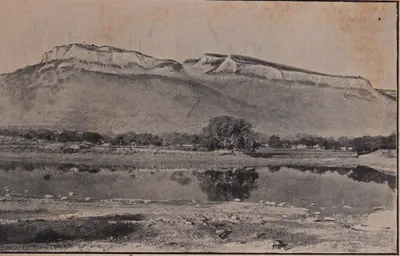
He chose Damalcheruvu, in the Chandragiri taluk, to make a stand.4 There hills close in the valley below the Kallur pass, and an earthwork crossed it.4 Wilks wrote that Dost Ali held the gorge of the pass because he believed, wrongly, that it was the only pass through the hills.2
The Marathas won over one of the Nawab’s Hindu officers, some say the Pulicherla poligar (local chief).4 He let them pass to the rear of the defences by night, so the Nawab’s guns were useless.4 After a long fight Dost Ali and his son Hussain Ali were killed, and his diwan (chief minister) was taken prisoner.42 The district records of 1804 mention a mound called the Bhimigutta, “the memorial of a great battle”, which the manual thought was probably this one.49
Where the sources disagree
- Who brought the Marathas. Wilks, following the Navayat family, wrote that Safdar Ali and the diwan secretly invited them, to destroy Chanda Sahib.10 He noted that Robert Orme said Nizam-ul-Mulk incited the invasion.10 The North Arcot manual says both: that the Nizam encouraged the Marathas, and that the son and the diwan had invited them.4
- The start of his rule. Wilks dates his succession to 1732.1 The Nellore manual’s list gives him the years 1733 to 1740.3
- The Nizam’s consent. Wilks says he succeeded without the Nizam’s sanction.1 Burhanuddin says that he was first appointed without it, but then by the Nizam’s direction.5
Footnotes
-
Mark Wilks, Historical Sketches of the South of India, Vol. I (1810), p. 248 (archive.org (opens in a new tab)). ↩ ↩2 ↩3 ↩4 ↩5 ↩6
-
Wilks, Historical Sketches, Vol. I (1810), p. 252 (archive.org (opens in a new tab)). ↩ ↩2 ↩3
-
John A. C. Boswell, A Manual of the Nellore District (1873), p. 444 (archive.org (opens in a new tab)). ↩ ↩2
-
Stuart, North Arcot, Vol. I (1895), p. 49 (archive.org (opens in a new tab)). ↩ ↩2 ↩3 ↩4 ↩5 ↩6 ↩7 ↩8 ↩9 ↩10 ↩11
-
Muhammad Burhanuddin Siddiqui, The Carnatic & Kurnool, their Last Muhammedan Rulers (1905), p. 23 (archive.org (opens in a new tab)). Paraphrased except for the short phrase quoted. ↩ ↩2 ↩3 ↩4 ↩5
-
Arthur F. Cox, revised by Harold A. Stuart, Madras District Manuals: North Arcot, Vol. I (1895), p. 48 (archive.org (opens in a new tab)). Paraphrased except for the short phrase quoted. ↩ ↩2
-
C. F. Brackenbury, Madras District Gazetteers: Cuddapah, Vol. I (1915), p. 41 (archive.org (opens in a new tab)). ↩ ↩2
-
Brackenbury, Cuddapah, Vol. I (1915), p. 42 (archive.org (opens in a new tab)). ↩
-
Stuart, North Arcot, Vol. I (1895), p. 50 (archive.org (opens in a new tab)). ↩
-
Wilks, Historical Sketches, Vol. I (1810), p. 251 and note (archive.org (opens in a new tab)). ↩ ↩2
Related
Dynasties
References
Notes (0)
Sources (5)
Spotted an error on this page? Tell us
Last updated: