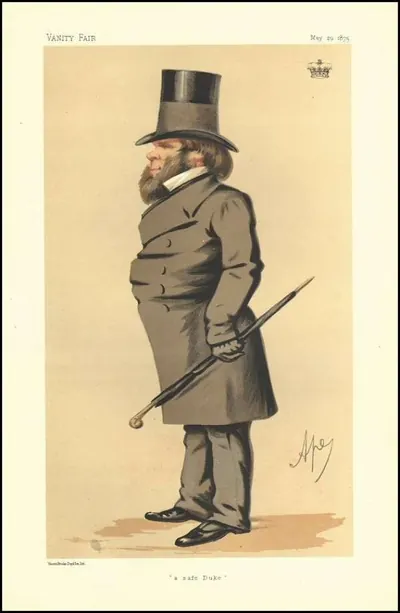
Duke of Buckingham and Chandos
The third Duke of Buckingham and Chandos was Governor of Madras from 1875 to 1880, the years of the great famine of 1876–78 in the Deccan districts and Nellore. The coastal canal finished as a famine relief work was renamed the Buckingham Canal after him. In 1876 he went to see the Krishna and Godavari works, his government admitted that the company running the Kurnool–Kadapa canal had been unfairly treated, and in 1880 he ordered the whole Amaravati stupa site dug out, which the archaeologist Burgess regretted.
Download
The Duke of Buckingham and Chandos governed Madras through the great famine of 1876–78. It struck the Deccan districts of the Presidency and Nellore, and millions died.1 A canal finished as a famine relief work was named after him.2 See British Crown (Madras Presidency) and Famines and floods.
Governor of Madras
Maclean’s chronology records that the Duke took office on 23 November 1875.3 His list of Governors shows him in office until 20 December 1880.4
The great famine
On 12 October 1876 famine was reported in Bellary, Kadapa (then Cuddapah) and Nellore.3 The Imperial Gazetteer says the famine “lasted twenty-two months”.1 It affected fourteen of the Presidency’s twenty-one districts.1 It “is calculated to have caused the death of 3½ millions of people”.1 In one week of September 1877, more than 2¼ million people were on relief.1
Cotton’s biography quotes the Duke as stating that “two-thirds of the Presidency were suffering from the high price of food”.5 In the Bellary country, the gazetteer says, the government ordered a proper system of task-work, for the first time in any famine.6 It also suggested moving workers to Nellore to dig the Buckingham Canal.6 That plan failed: only 12,000 people from Bellary and Anantapur could be persuaded to go so far.6 See Bellary and Nellore.
The Buckingham Canal
A salt-water canal along the coast had been begun earlier as the East Coast Canal.2 In the great famine it was decided to complete it as a relief work, at a cost of over 29 lakhs of rupees.2 It was then renamed after the Duke of Buckingham and Chandos, “then Governor of Madras”.2 It ran from Pedda Ganjam in Guntur south towards Madras, and linked the Krishna canals with the city.27 See Guntur.
The Krishna and Godavari works
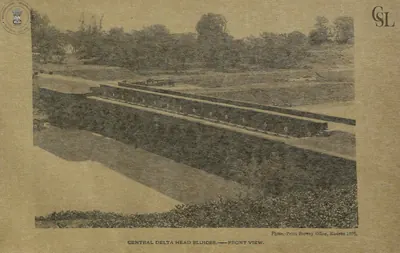
In 1876 Arthur Cotton wrote to a friend: “Do you see that the Duke of Buckingham has gone up to see Kistna and Godavari”.8 Cotton was glad to hear that the Duke was overruling his Council.8 He hoped it meant the Duke was “going really to govern”.8 See Krishna anicut.
The Kurnool–Kadapa canal belonged to a private company, and it had not paid.9 Giving evidence before a committee, Cotton blamed bad management, and named the Duke as his authority.9 A minute of the Duke’s government admitted that the company had “real cause of complaint”.10 The Deputy Collector of Kurnool had in effect stopped the ryots from asking the canal officers for water.10 See Kurnool.
Amaravati
In February 1880 the Duke told the Collector to finish digging out the whole site of the Amaravati stupa at once.11 James Burgess called this “unfortunate”.11 No trained help was given, not even a Public Works engineer, and the sculptures suffered.11 Burgess says his plate of the site in 1882, after the Duke’s excavation, shows very few stones still in place.12 See Amaravati stupa.
Footnotes
-
Imperial Gazetteer of India: Madras, Vol. I (1908), p. 80 (archive.org (opens in a new tab)). ↩ ↩2 ↩3 ↩4 ↩5
-
Imperial Gazetteer of India: Madras, Vol. I (1908), p. 181, s.v. Buckingham Canal (archive.org (opens in a new tab)). ↩ ↩2 ↩3 ↩4 ↩5
-
C. D. Maclean (ed.), Manual of the Administration of the Madras Presidency, Vol. II (1885), p. 267, chronological annals, 1864–1884 (archive.org (opens in a new tab)). ↩ ↩2
-
Maclean (ed.), Manual of the Administration, Vol. II (1885), p. 270, list of Governors of Fort St. George (archive.org (opens in a new tab)). ↩
-
Lady Hope, General Sir Arthur Cotton (1900), p. 411 (archive.org (opens in a new tab)). ↩
-
W. Francis, Madras District Gazetteers: Bellary (1904), p. 132 (archive.org (opens in a new tab)). ↩ ↩2 ↩3
-
Imperial Gazetteer of India: Madras, Vol. I (1908), p. 182, s.v. Buckingham Canal (archive.org (opens in a new tab)). ↩
-
Lady Hope, General Sir Arthur Cotton (1900), p. 459, letter of Arthur Cotton, 1876 (archive.org (opens in a new tab)). ↩ ↩2 ↩3
-
Lady Hope, General Sir Arthur Cotton, R.E., K.C.S.I.: His Life and Work (1900), pp. 285–286 (archive.org (opens in a new tab)). ↩ ↩2
-
Lady Hope, General Sir Arthur Cotton (1900), p. 286 (archive.org (opens in a new tab)). ↩ ↩2
-
James Burgess, The Buddhist Stupas of Amaravati and Jaggayyapeta (1887), p. 19 (archive.org (opens in a new tab)). ↩ ↩2 ↩3
-
Burgess, Amaravati and Jaggayyapeta (1887), p. 22 (archive.org (opens in a new tab)). ↩
Photos
Related
Dynasties
References
Notes (0)
Sources (5)
Spotted an error on this page? Tell us
Last updated: