Pandaranga
Army commander of the Eastern Chalukya king Gunaga Vijayaditya III in the second half of the 9th century, praised in the Telugu verse inscription at Addanki. Later grants credit him with burning Kiranapura, the home of the Rashtrakuta Krishna II and his ally Sankila. He was the executor of his king's grants, and his descendants held the office of Katakaraja under the later kings.
Pandaranga was the commander of the army of Gunaga Vijayaditya III, who ruled the Eastern Chalukya kingdom of Vengi from about 844 to 888. He is known from a Telugu verse inscription at Addanki and from the grants of his king and of later kings.12
The Addanki inscription
The stone inscription at Addanki says that Pandaranga was made commander of the army in the first year of the king’s reign. It credits him with taking twelve kottams (districts) of the Boyas, raising the banners of the kings of Vengi-nadu and laying bare the fort of Katte.1
K. V. Lakshmana Rao, its editor, read part of the verse as saying that Pandaranga won back hill-forts in the Vengi country from foreign kings, perhaps the Rashtrakutas.3 The opening of the record is a Telugu poem in the taruvoja metre, which Lakshmana Rao took to be among the earliest Telugu verse known.1 See Addanki inscription of Pandaranga.
Other records near Ongole
Robert Sewell noted three inscriptions of the period near Ongole that mention Pandaranga. One says that he conquered the Venginadu, his own king’s home country. Sewell explained this by another record, which says that the Rashtrakuta army had then overrun the Vengi country.4 So, in Sewell’s view, Pandaranga must have driven the Rashtrakuta forces out.4
There are two inscriptions at Dharmavaram, in the Addanki division of the Ongole taluk.5 One of them names Gunakenalla (Vijayaditya III), Pandaranga and the burning of Kiranapura.5
Kiranapura
Two grants of the dynasty say that Vijayaditya III himself burnt Kiranapura, the city of the Rashtrakuta Krishna II and his ally Sankila. E. Hultzsch edited the Maliyapundi grant of Amma II in 1908.2 This grant says that Pandaranga really did the deed.2
In 1914 the Madras epigraphist reported a grant of Chalukya-Bhima I.6 He accepted the Maliyapundi account, and described Kiranapura as the home of Krishna II and Sankila, burnt by Gunaka’s general Pandaranga.6
The officer who carried out the king’s grants
The executor (ajnapti) of one grant of Vijayaditya III was Pandaranga. This was the grant that gave the village of Trandaparu to Vinayadisarman.7 F. Kielhorn edited it in 1899, and noted that the same name occurs again in a grant of Chalukya-Bhima I, which mentions a grandson of his.7 That grandson, Kadeyaraja, was the executor of Bhima I’s Bezvada plates.8
His descendants
The Maliyapundi grant sets out Pandaranga’s family:25
- Niravadyadhavala was the son of Pandaranga and was appointed Katakaraja.25
- Niravadyadhavala’s son was the Katakadhipati Vijayaditya.25
- Vijayaditya’s son was Durgaraja.25
Durgaraja founded the Jain temple called Katakabharana-Jinalaya to the south of Dharmapuri (Dharmavaram, in the Addanki division of the Ongole taluk).25 At his request Amma II gave the temple the village of Maliyapundi.25
Hultzsch rendered the title Katakaraja or Katakadhipati as “superintendent of the royal camp”.5 He thought the title belonged only to the Eastern Chalukya court.5 The names Katakaraja, Katakesa and Katakadhisa appear as executors of grants of Amma I and Amma II.5 J. F. Fleet had taken them to be titles.5 Hultzsch showed that in each case they refer to one of Pandaranga’s three descendants.5
Footnotes
-
K. V. Lakshmana Rao, “The Addanki Stone Inscription of Pandaranga”, Epigraphia Indica XIX (1928), p. 273 (archive.org (opens in a new tab)). ↩ ↩2 ↩3
-
E. Hultzsch, “Maliyapundi Grant of Ammaraja II”, Epigraphia Indica IX (1907–08), p. 49 (archive.org (opens in a new tab)). ↩ ↩2 ↩3 ↩4 ↩5 ↩6 ↩7 ↩8 ↩9
-
Lakshmana Rao, “Addanki Stone Inscription” (1928), p. 274 (archive.org (opens in a new tab)). ↩
-
Robert Sewell and S. Krishnaswami Aiyangar, The Historical Inscriptions of Southern India (1932), p. 35 (archive.org (opens in a new tab)). ↩ ↩2
-
Hultzsch, “Maliyapundi Grant of Ammaraja II” (1908), p. 50 (archive.org (opens in a new tab)). ↩ ↩2 ↩3 ↩4 ↩5 ↩6 ↩7 ↩8 ↩9 ↩10 ↩11 ↩12 ↩13
-
Annual Report on Epigraphy, Madras, for 1913–14 (1914), Part II, para. 6, p. 85 (archive.org (opens in a new tab)). ↩ ↩2
-
F. Kielhorn, “Six Eastern Chalukya Copper-plate Inscriptions”, B, Epigraphia Indica V (1898–99), p. 123 (archive.org (opens in a new tab)). ↩ ↩2
-
Kielhorn, “Six Eastern Chalukya Copper-plate Inscriptions”, C (1899), p. 128 (archive.org (opens in a new tab)). ↩
Photos
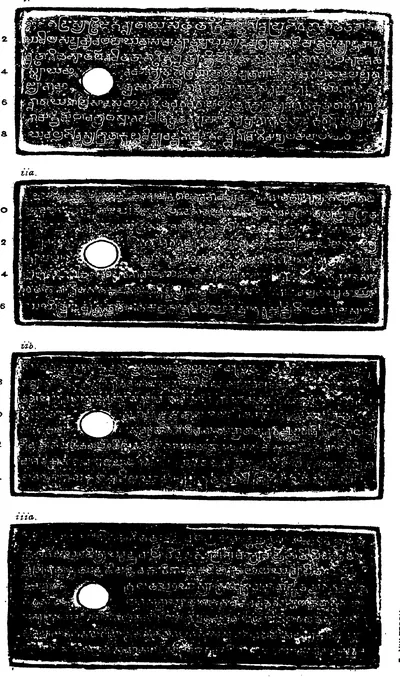 "Maliyapundi grant of Ammaraja II.", plates i, ii a, ii b and iii a (Epigraphia Indica IX, plate between pp. 52 and 53 (PDF p. 75))Inscription rubbing · 1908
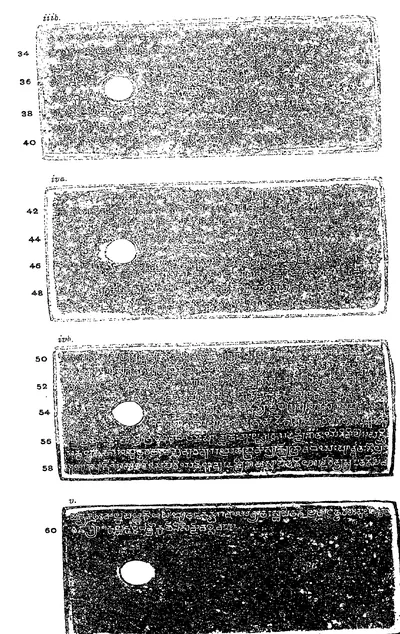 "Maliyapundi grant of Ammaraja II.", plates iii b, iv a, iv b and v (Epigraphia Indica IX, plate between pp. 52 and 53 (PDF p. 76))Inscription rubbing · 1908
References
Notes (0)
Sources (5)
Spotted an error on this page? Tell us
Last updated: