Vagaraja (Chalukya of Vemulavada)
Vagaraja was a Vemulavada Chalukya chief, the elder son of Arikesari II. He was ruling in 959, when the Jaina scholar Somadeva Suri finished his Yasastilaka at Gangadhara, a town that prospered under him. He served the Rashtrakuta king Krishna III, who was then camped at Melpati. N. Venkataramanayya thought he died without a son and was followed by his nephew Arikesari III. The Early History of the Deccan (1960) counts his younger brother Bhadradeva as king instead.
Download
Vagaraja was a chief of the Chalukyas of Vemulavada in the middle of the 10th century.1 Venkataramanayya’s account of him rests on the closing note of a Sanskrit book finished in his town.21 That book is the Yasastilaka of the Jaina scholar Somadeva Suri.3
Family
Vagaraja was the elder son of Arikesari II, the patron of the Kannada poet Pampa.31 The closing note of the Yasastilaka calls him the “first son” of Sri Arikesarin.3 Arikesari II had a second son, Bhadradeva or Baddega, by his queen Lokambika. Venkataramanayya called Bhadradeva Vagaraja’s younger half-brother.14
The Yasastilaka
In the printed text of 1903, the closing note of the Yasastilaka says that the poem was finished in Saka 881, the year Siddharthin.3 Venkataramanayya worked this out as 959.2 At that time “Sri Krishnarajadeva” was ruling from his camp at Melpati, after subduing the Pandya, Simhala, Chola and Chera kings.3 The poem was finished at Gangadhara, a town that prospered under Sri Vagaraja.3
R. G. Bhandarkar, writing in 1896, took the overlord to be the Rashtrakuta king Krishna III.5 Peter Peterson, who first described the manuscript, wrote that it was composed “at the court of one of his feudatories, the eldest son of a Chalukya prince named Arikesari”.6
Service under Krishna III
N. Venkataramanayya wrote that Vagaraja was a feudatory of Krishna III.1 He went with that king on his southern campaign to Melpadi in the Chittoor district.21 He thought that Somadeva, a Jaina from north India, came to Vemulavada in Vagaraja’s time.7 Nothing more is known of what Vagaraja did.14
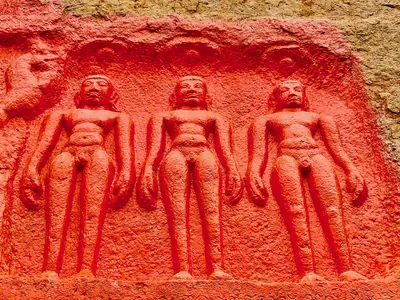
No source read for this page says where Gangadhara was. A village called Gangadharam lies near the Bommala Gutta at Kurikyal, where Pampa’s brother Jinavallabha left an inscription.89 Venkataramanayya noted Jaina sculptures in its fields, but he did not connect it with the closing note.89
The end of his line
Venkataramanayya thought that Vagaraja died without a son.4 His half-brother Bhadradeva seems to have died before him.4 So the next chief was Bhadradeva’s son, Arikesari III, whose Parbhani plates are dated 966.4
Where the sources disagree
- Who ruled after Arikesari II. Venkataramanayya held that Vagaraja succeeded his father.1 The Early History of the Deccan (1960) names the last rulers as Bhadradeva II and Arikesari III. It calls the prince of the Yasastilaka “Badyaga”.10
- Where he was in 959. Venkataramanayya wrote that Vagaraja was camped at Melpadi with Krishna III.21 The printed closing note places Krishna at Melpati, but says that the poem was finished at Gangadhara, under Vagaraja.3
Footnotes
-
Venkataramanayya, Chalukyas of L(V)emulavada (1953), p. 41 (archive.org (opens in a new tab)). Paraphrased. ↩ ↩2 ↩3 ↩4 ↩5 ↩6 ↩7 ↩8 ↩9
-
N. Venkataramanayya, The Chalukyas of L(V)emulavada (1953), p. 9 (archive.org (opens in a new tab)). Paraphrased. ↩ ↩2 ↩3 ↩4
-
Somadeva Suri, Yasastilaka, ed. Pandit Sivadatta and Kasinath Pandurang Parab, Part II (Kavyamala 70, 1903), p. 419, closing colophon (archive.org (opens in a new tab)). Translated for this page. ↩ ↩2 ↩3 ↩4 ↩5 ↩6 ↩7
-
Venkataramanayya, Chalukyas of L(V)emulavada (1953), p. 42 (archive.org (opens in a new tab)). Paraphrased. ↩ ↩2 ↩3 ↩4 ↩5
-
R. G. Bhandarkar, “Early History of the Dekkan”, Gazetteer of the Bombay Presidency I, pt. II (1896), p. 207 (archive.org (opens in a new tab)). ↩
-
B. Lewis Rice (ed.), The Pampa Bharata or Vikramarjuna Vijaya of Pampa (1898), introduction, p. 4, quoting P. Peterson’s report on Sanskrit manuscripts in the Bombay Circle (archive.org (opens in a new tab)). ↩
-
Venkataramanayya, Chalukyas of L(V)emulavada (1953), p. 46 (archive.org (opens in a new tab)). Paraphrased. ↩
-
Gajjala Vasanta Lakshmi (ed.), Epigraphia Telanganica I: Pre-Kakatiya Telangana (2023), p. 394, reprinting N. Venkataramanayya, “The Kurkiyala Inscription of Jinavallabha”, Epigraphia Andhrica II (1974). Cite-only; paraphrased. ↩ ↩2
-
Epigraphia Telanganica I (2023), p. 399, reprinting Venkataramanayya (1974). Cite-only; paraphrased. ↩ ↩2
-
K. A. Nilakanta Sastri and N. Venkataramanayya, “The Chalukyas of Vemulavada”, appendix C to “The Eastern Chalukyas”, in G. Yazdani (ed.), The Early History of the Deccan, Parts VII–XI (1960), p. 511. Cite-only; paraphrased. ↩
Related
Dynasties
References
Notes (0)
Sources (6)
Spotted an error on this page? Tell us
Last updated: