Venkata I (Vijayanagara)
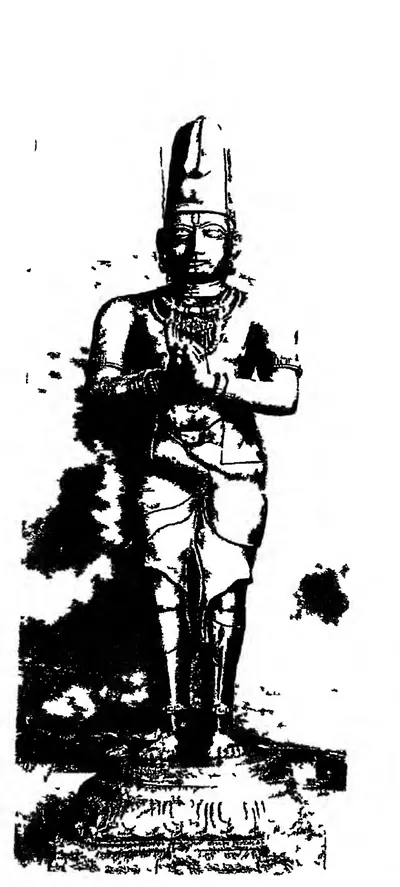
Venkata I, also called Chinna Venkatadri, was the young son of Achyuta Raya and Queen Varadamba. He followed his father on the throne of Vijayanagara at the end of 1541 and reigned only a few months. His uncle Salakam Timma ruled as regent, quarrelled with the nobles and, according to Correa, had the boy king murdered with other members of the royal family. Rama Raya and his brothers then overthrew Timma and crowned Venkata's cousin Sadasiva in 1542. An inscription at Markapur records the regent's crime.
Download
Venkata I was king of Vijayanagara for a few months after his father Achyuta Raya died at the end of 1541.12 He was only a boy, and his uncle Salakam Timma ruled for him as regent.3 H. Heras, writing in 1927, says that the regent had him murdered.2 The murder led to a civil war, and from it the Aravidu brothers rose to power.45 See Vijayanagara and Achyuta Raya.
Crown prince
Venkata was the son of Achyuta Raya and his queen Varadamba, also called Varadadevi Ammal.13 The Sanskrit poem Varadambikaparinayam was written by Tirumalamba, a woman poet admired at Achyuta’s court.6 It says that the child was born by the favour of the god of Venkatadri, that is, Tirupati.7 So he was named Chinna Venkatadri.7 When his father saw the prince’s character, he made him Yuvaraja (crown prince).7
Krishnaswami Aiyangar wrote that, according to the Achyutarayabhyudayam, the boy was made crown prince at his father’s coronation.8 Two records in the Vitthala temple at Vijayanagar name him as Achyuta’s heir.1 Heras calls him Venkata I, though earlier writers had called him only Venkatadri.91 In Heras’s count, the later king Venkatapati, until then called Venkata I, becomes Venkata II.9
The regent
Achyuta died towards the end of 1541, and Venkata followed him.101 Heras says that the new king was not yet of age.3 The Portuguese writer Correa calls him a child.3 So his uncle Salakam Timma Raju, a brother-in-law of the late king, became regent.3 The Varadambikaparinayam makes Queen Varadamba a younger sister of two of Achyuta’s ministers, both named Tirumala.7
The nobles, and two queens of Krishnadeva Raya, wanted the young king free of the regent.11 They wished Rama Raya and his brother Tirumala, close relatives of the royal family, to run the government.11 Salakam Timma would not share power, and he tried to imprison his opponents.11 Rama Raya and his brothers fled from the capital, to Gooty according to one poem, and to Penukonda according to others.11 See Aliya Rama Raya.
Heras points out that the nobles rebelled against the regent, not against the young king.11 Later grants praise Venkata as “the treasury of wisdom” and “famous for valour”.1112 They say he died young “owing to the ill-fortune of the people”.12
Murder
Heras says that Salakam Timma ruled harshly, and wasted the royal treasure.12 Queen Varadamba asked Ibrahim Adil Shah of Bijapur to save the kingdom for her son.12 The sultan set out, but Salakam Timma paid him to turn back.12
Venkata’s reign did not last long.2 An inscription of his cousin Sadasiva dates from July 1542, so Heras thought that Venkata reigned no more than half a year.2 Correa says that Salakam Timma had the king murdered, with two of his uncles and one of his cousins.2 Heras thought one of the uncles was most likely Ranga, the father of Sadasiva, and that Sadasiva himself escaped.2
A damaged inscription in the Chennakesava temple at Markapur says that Timma “sinned against his lord”.2 The same inscription says that Rama Raya later subdued “Timma … and the whole of the Salakam family” at Vijayanagar.135
What followed
Salakam Timma then took the throne himself.14 When the nobles turned against him, he called in Ibrahim Adil Shah once more.14 Rama Raya and his brothers gathered an army from the forts of Penukonda, Adoni, Gooty, Gandikota and Kurnool.4 Salakam Timma’s officers deserted him, and Rama Raya entered the capital.13 Ferishta says the regent killed himself in the palace.5 Rama Raya then fetched Venkata’s cousin Sadasiva from the fort of Gooty and crowned him.15 See Sadasiva Raya.
Where the sources disagree
- How he died. Correa says that Salakam Timma had him murdered.2 Ferishta says that his uncle strangled him.2 The Burhan-i Ma’asir says only that he was imprisoned and the regent took the throne.2 S. Krishnaswami Aiyangar (1928) says that “the mad Tirumala” killed him.16
- Who the regent was. Correa makes him the husband of a sister of Achyuta.3 The Basatin-us-Salatin calls him the son of the king’s daughter.3 The Varadambikaparinayam makes Achyuta’s queen the sister of two ministers named Tirumala.7
Footnotes
-
Heras, The Aravidu Dynasty, Vol. I (1927), p. 3 and note (archive.org (opens in a new tab)). ↩ ↩2 ↩3 ↩4 ↩5
-
Heras, The Aravidu Dynasty, Vol. I (1927), p. 7 and notes (archive.org (opens in a new tab)). ↩ ↩2 ↩3 ↩4 ↩5 ↩6 ↩7 ↩8 ↩9 ↩10
-
Heras, The Aravidu Dynasty, Vol. I (1927), p. 4 and notes (archive.org (opens in a new tab)). ↩ ↩2 ↩3 ↩4 ↩5 ↩6 ↩7
-
Heras, The Aravidu Dynasty, Vol. I (1927), p. 9 (archive.org (opens in a new tab)). ↩ ↩2
-
Heras, The Aravidu Dynasty, Vol. I (1927), p. 11 (archive.org (opens in a new tab)). ↩ ↩2 ↩3
-
Krishnaswami Aiyangar, Sources of Vijayanagar History (1919), p. 170, extract 55, the Varadambikaparinayam of Tirumalamba (archive.org (opens in a new tab)). ↩
-
Krishnaswami Aiyangar, Sources of Vijayanagar History (1919), p. 172, extract 55, the Varadambikaparinayam of Tirumalamba, and note (archive.org (opens in a new tab)). ↩ ↩2 ↩3 ↩4 ↩5
-
S. Krishnaswami Aiyangar (ed.), Sources of Vijayanagar History (1919), introduction, p. 12 (archive.org (opens in a new tab)). ↩
-
H. Heras, The Aravidu Dynasty of Vijayanagara, Vol. I (1927), introduction, p. xv (archive.org (opens in a new tab)). ↩ ↩2
-
Heras, The Aravidu Dynasty, Vol. I (1927), p. 2 (archive.org (opens in a new tab)). ↩
-
Heras, The Aravidu Dynasty, Vol. I (1927), p. 5 (archive.org (opens in a new tab)). ↩ ↩2 ↩3 ↩4 ↩5 ↩6
-
Heras, The Aravidu Dynasty, Vol. I (1927), p. 6 (archive.org (opens in a new tab)). ↩ ↩2 ↩3 ↩4 ↩5
-
Heras, The Aravidu Dynasty, Vol. I (1927), p. 10 (archive.org (opens in a new tab)). ↩ ↩2
-
Heras, The Aravidu Dynasty, Vol. I (1927), p. 8 (archive.org (opens in a new tab)). ↩ ↩2
-
Heras, The Aravidu Dynasty, Vol. I (1927), p. 13 (archive.org (opens in a new tab)). ↩
-
S. Krishnaswami Aiyangar, “Hindu States in Southern India”, in Wolseley Haig (ed.), The Cambridge History of India, Vol. III (1928), p. 498 (archive.org (opens in a new tab)). ↩
Related
Dynasties
References
Notes (0)
Sources (3)
Spotted an error on this page? Tell us
Last updated: