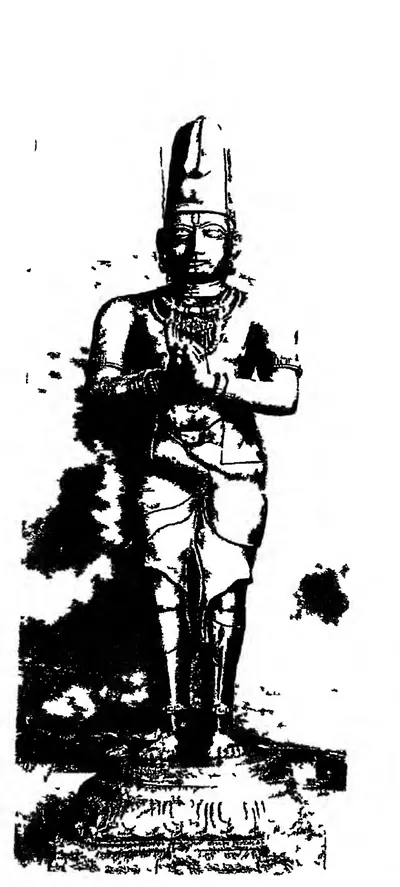
Sadasiva Raya
Sadasiva was the last king of Vijayanagara's Tuluva dynasty, from 1542 to about 1569. He was a nephew of Krishnadeva Raya and Achyuta Raya, and Rama Raya crowned him as a boy after overthrowing the regent Salakam Timma. Rama Raya ruled in his name, and from about 1550, Heras says, kept him a prisoner, showing him to the people once a year. After the battle of 1565 Tirumala carried him off to Penukonda and kept him in the same way. He was murdered about 1569, by Tirumala or one of Tirumala's sons.
Download
Sadasiva was the last king of Vijayanagara’s Tuluva dynasty. He reigned from 1542 to about 1569, but for nearly all that time others ruled in his name.12 Aliya Rama Raya put him on the throne as a boy and governed for him, and Sewell wrote that Sadasiva was “virtually a prisoner in the hands of Rama Raya”.34 After the defeat of 1565, Rama Raya’s brother Tirumala kept him the same way.5 See Vijayanagara and Aliya Rama Raya.
Family
Heras wrote that several inscriptions of Sadasiva’s time call him the son of Ranga and Timmamba.36 Ranga was a brother of Achyuta Raya, born of the same mother, Obambika.6 So Sadasiva was a nephew of both Achyuta and Krishnadeva Raya.67 His father Ranga was probably killed by the regent Salakam Timma, in Heras’s view.6 See Venkata I and Achyuta Raya.
Crowned as a boy
The poem Svaramelakalanidhi calls Sadasiva “helpless” at this time.6 An anonymous chronicler of Golconda says the heir was “a child in arms”.6 Heras thought most likely the statement of the Portuguese writer Couto, who says that Sadasiva was a little over thirteen when he was crowned.6 Another Portuguese writer, Correa, says he was about sixteen.6
After he defeated Salakam Timma, Rama Raya went to fetch Sadasiva from the fort of Gooty, where the prince was hiding.3 Correa says that Sadasiva was first crowned at Tirupati, where the Brahmans gave him “a hundred bulls loaded with gold pieces”.8 Then he was crowned again at Vijayanagar.8 His earliest known inscription is dated 27 July 1542.1
His inscriptions give him the full imperial title “Virapratapa Kathari Saluva Vira-Sadasiva-rayadeva”.7 One grant of 1558 says that the tears of joy shed at his coronation flooded the earth.7
Three stages of Rama Raya’s rule
Heras studied Sadasiva’s grants and saw three stages in Rama Raya’s rule.9
In the first stage, Rama Raya was only the regent.9 An inscription of 1547–48 at Podili, in the Nellore district, says that Sadasiva ruled Vijayanagar “under the orders” of Rama Raya, “who bears the burden of the kingdom”.9 In 1549, by Sadasiva’s order, Rama Raya issued an edict for the barbers of Udayagiri.9 The young king lived mostly at the capital.9
In the second stage, Rama Raya put the king in prison, probably when he was old enough to rule.10 Couto says the prison was a strong tower with iron doors and guards, though the king was treated as a king.10 Heras dates this stage from about 1550 to 1562 or 1563.1011 The king was shown to his people only once a year.11
In the third stage, from about 1563, Rama Raya took the title of king himself.12 Even the yearly showing of Sadasiva stopped. But the three Aravidu brothers still went once a year to his palace prison to do him homage.12
S. Krishnaswami Aiyangar described this government as “the de facto rule of the three brothers”.13 The wars and alliances of these years were Rama Raya’s, and they ended in the battle of January 1565.14 See Aliya Rama Raya.
After 1565
When the army broke in 1565, Tirumala fled to Penukonda.15 With him went King Sadasiva, the royal family, and treasure carried on 550 elephants.15 Heras thought Sadasiva then stayed in the palace at Tirupati, or in the fort of Chandragiri.5 The traveller Cesare Federici says that Tirumala “had in prison the lawful king”.5
Some records still name Sadasiva as king, with Tirumala acting under his orders.1617 One such grant gave the barbers of Battepadu in Udayagiri freedom from taxes.16 Others, made in Tirumala’s own name, do not mention Sadasiva at all.16 In 1568, the Krishnapuram plates show Sadasiva at Srirangam, on the bank of the Kaveri.1819 There, at Tirumala’s request, he gave villages to the god Venkatesa, before envoys of his southern chiefs and of the Nayaka of Madurai.19 See Tirumala.
Death
Sadasiva’s last inscriptions date from 1568 to 1570, but Heras thought the news of his death had not yet reached distant parts of the empire.192 Federici says that Tirumala’s son “had put to death the lawful King”.2 Heras trusted Federici, who was in India at the time, and concluded that one of Tirumala’s sons killed Sadasiva.220 He thought it might have been Venkata, the future king Venkatapati, if Venkata was the king’s jailer at Chandragiri.20 See Venkatapati II.
Heras added that Sadasiva seems to have had a son, Vitthala Raya, whose fate is not known.220
Where the sources disagree
- His father. Couto calls him a son of Krishnadeva Raya, and an inscription at Hassan calls him a son of Achyuta.3 Several inscriptions of his own reign call him the son of Ranga.36
- His age when crowned. Couto says a little over thirteen, and Correa about sixteen.6
- Who killed him, and when. Sewell (1900) wrote that “in 1568 (so it is said) Tirumala murdered his sovereign”.21 Federici says it was Tirumala’s son.2 Heras thought Tirumala at least shared the guilt, but that one of his sons did the deed, about 1569.220
Footnotes
-
Heras, The Aravidu Dynasty, Vol. I (1927), p. 17 (archive.org (opens in a new tab)). ↩ ↩2
-
Heras, The Aravidu Dynasty, Vol. I (1927), p. 245 (archive.org (opens in a new tab)). ↩ ↩2 ↩3 ↩4 ↩5 ↩6 ↩7
-
H. Heras, The Aravidu Dynasty of Vijayanagara, Vol. I (1927), p. 13 and notes (archive.org (opens in a new tab)). ↩ ↩2 ↩3 ↩4 ↩5
-
Robert Sewell, A Forgotten Empire (Vijayanagar) (1900), p. 109 (archive.org (opens in a new tab)). ↩
-
Heras, The Aravidu Dynasty, Vol. I (1927), p. 233 (archive.org (opens in a new tab)). ↩ ↩2 ↩3
-
Heras, The Aravidu Dynasty, Vol. I (1927), p. 14 and notes (archive.org (opens in a new tab)). ↩ ↩2 ↩3 ↩4 ↩5 ↩6 ↩7 ↩8 ↩9 ↩10
-
Heras, The Aravidu Dynasty, Vol. I (1927), p. 16 (archive.org (opens in a new tab)). ↩ ↩2 ↩3
-
Heras, The Aravidu Dynasty, Vol. I (1927), p. 15 (archive.org (opens in a new tab)). ↩ ↩2
-
Heras, The Aravidu Dynasty, Vol. I (1927), p. 28 (archive.org (opens in a new tab)). ↩ ↩2 ↩3 ↩4 ↩5
-
Heras, The Aravidu Dynasty, Vol. I (1927), p. 31 and notes (archive.org (opens in a new tab)). ↩ ↩2 ↩3
-
Heras, The Aravidu Dynasty, Vol. I (1927), p. 32 (archive.org (opens in a new tab)). ↩ ↩2
-
Heras, The Aravidu Dynasty, Vol. I (1927), p. 37 (archive.org (opens in a new tab)). ↩ ↩2
-
S. Krishnaswami Aiyangar, “Hindu States in Southern India”, in Wolseley Haig (ed.), The Cambridge History of India, Vol. III (1928), p. 498 (archive.org (opens in a new tab)). ↩
-
Krishnaswami Aiyangar, in Cambridge History of India, Vol. III (1928), p. 499 (archive.org (opens in a new tab)). ↩
-
Sewell, A Forgotten Empire (1900), p. 206 (archive.org (opens in a new tab)). ↩ ↩2
-
Heras, The Aravidu Dynasty, Vol. I (1927), p. 234 (archive.org (opens in a new tab)). ↩ ↩2 ↩3
-
Heras, The Aravidu Dynasty, Vol. I (1927), p. 235 (archive.org (opens in a new tab)). ↩
-
Heras, The Aravidu Dynasty, Vol. I (1927), p. 243 (archive.org (opens in a new tab)). ↩
-
Heras, The Aravidu Dynasty, Vol. I (1927), p. 244 and notes (archive.org (opens in a new tab)). ↩ ↩2 ↩3
-
Heras, The Aravidu Dynasty, Vol. I (1927), p. 246 and note (archive.org (opens in a new tab)). ↩ ↩2 ↩3 ↩4
-
Sewell, A Forgotten Empire (1900), p. 212 (archive.org (opens in a new tab)). ↩
Related
Dynasties
References
Notes (0)
Sources (3)
Spotted an error on this page? Tell us
Last updated: