Amoghavarsha III (Rashtrakuta)
Amoghavarsha III, whose own name was Vaddiga or Baddega, was the Rashtrakuta king who replaced his nephew Govinda IV in the 930s. N. Venkataramanayya wrote that Arikesari II of Vemulavada invited him to Vemulavada, and that together they drove Govinda out. Pampa says that Arikesari gave Baddega universal sovereignty. A damaged record at Khajipet near Hanamkonda was assigned to his reign by P. B. Desai, but a later editor dated it to 872.
Download
Amoghavarsha III was a king of the Rashtrakutas in the 930s.12 His own name appears as Vaddiga or Baddega.1 He came to the throne through a revolt of the Chalukya chiefs of the Telugu country, helped by Arikesari II of Vemulavada.345 His son was the great king Krishna III.1
Who he was
Vaddiga was a son of the prince Jagattunga, who never reigned, by his second wife Govindamba.61 So he was the uncle of Govinda IV.1 He married Kundakadevi, a daughter of a king named Yuvaraja.1 Fleet, following Alexander Cunningham, took this Yuvaraja to be the Kalachuri king Yuvaraja I.1 J. F. Fleet knew no records that could be assigned to his reign with certainty.1
From exile to the throne
K. A. Nilakanta Sastri and N. Venkataramanayya (1960) wrote that Govinda IV banished Baddega and his son Kannara.7 The two went to the court of the Haihaya king Yuvarajadeva I at Tripuri.3 From there they stirred up the Chalukya chiefs of Vemulavada and Mudigonda to revolt.3
Venkataramanayya told the next step in his book on Vemulavada.4 Arikesari II of Vemulavada had just defeated an army that Govinda sent against him.4 He expected a larger attack, so he invited Baddega to Vemulavada to join him.4 Baddega came with his son Krishna, and probably with his son-in-law Butuga.4 With the rebels they defeated Govinda and drove him out of the kingdom.5 Baddega then took the title Amoghavarsha III and the throne.5
The poet Pampa, Arikesari’s court poet, tells it in one line.8 In K. B. Pathak’s translation, Arikesari “gave universal sovereignty to Baddegadeva, who came placing confidence in him”.8 The Deoli grant of 940 says that the feudatory chiefs asked him to take the throne, to keep up the greatness of the Rattas.1
A troubled reign
Venkataramanayya wrote that the reign was not peaceful.5 Many great feudatories were unfriendly, and some fought him.5 In his view, the king held on only through the strength of his son Krishna and the support of feudatories such as Arikesari II.5 See Arikesari II.
The Khajipet record
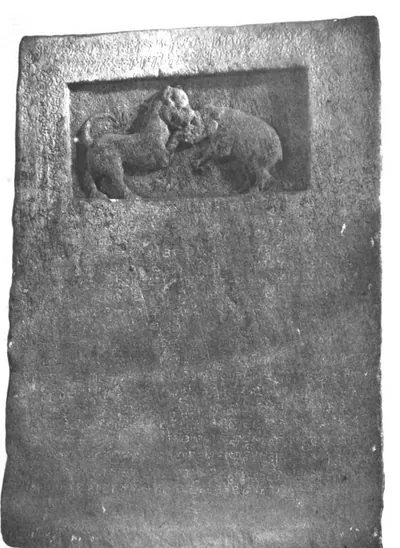
A damaged Kannada inscription at Khajipet, near Hanamkonda in the Warangal district, names a king Amoghavarsha.9 It introduces his feudatory Satyasraya Bhimarasa, perhaps of the Chalukya family, with the title mahasamantadhipati (lord of great vassals).9 It records money awards to local officers and sets fines for certain offences.9 P. B. Desai (1961) read only the cyclic year Nandana, which he took as 932–33.9 So he thought the king might be Amoghavarsha III.9
Where the sources disagree
- The Khajipet king. Amoghavarsha III, in 932–33 (Desai, 1961).9 The Inscriptions of Warangal District (2016), as summarised in Epigraphia Telanganica, made it a record of Amoghavarsha I, dated 872.10
- How Govinda IV fell. D. R. Bhandarkar (1903) thought the feudatories killed Govinda and then asked his uncle to take the vacant throne.8 Venkataramanayya thought Govinda was driven out, not killed.5
- His reign. Venkataramanayya dated it 935 to 939.2 Fleet had no dated record of his.1
Footnotes
-
Fleet, “Dynasties of the Kanarese Districts” (1896), p. 418 (archive.org (opens in a new tab)). ↩ ↩2 ↩3 ↩4 ↩5 ↩6 ↩7 ↩8 ↩9 ↩10
-
N. Venkataramanayya, The Chalukyas of L(V)emulavada (1953), p. 12 (archive.org (opens in a new tab)). Paraphrased. ↩ ↩2
-
Nilakanta Sastri and Venkataramanayya, in The Early History of the Deccan (1960), p. 484 (archive.org (opens in a new tab)). Cite-only; paraphrased. ↩ ↩2 ↩3
-
Venkataramanayya, The Chalukyas of L(V)emulavada (1953), p. 37 (archive.org (opens in a new tab)). Paraphrased. ↩ ↩2 ↩3 ↩4 ↩5
-
Venkataramanayya, The Chalukyas of L(V)emulavada (1953), p. 38 (archive.org (opens in a new tab)). Paraphrased. ↩ ↩2 ↩3 ↩4 ↩5 ↩6 ↩7
-
J. F. Fleet, “Dynasties of the Kanarese Districts”, Gazetteer of the Bombay Presidency I, pt. II (1896), p. 414 (archive.org (opens in a new tab)). ↩
-
K. A. Nilakanta Sastri and N. Venkataramanayya, “The Eastern Chalukyas”, in G. Yazdani (ed.), The Early History of the Deccan, Parts VII–XI (1960), p. 483 (archive.org (opens in a new tab)). Cite-only; paraphrased. ↩
-
D. R. Bhandarkar, “Cambay Plates of Govinda IV; Saka-Samvat 852”, Epigraphia Indica VII (1903), p. 34 (archive.org (opens in a new tab)). ↩ ↩2 ↩3
-
Kannada Inscriptions of Andhra Pradesh (Andhra Pradesh Government Archaeological Series 3, 1961), p. 25, No. 71 (archive.org (opens in a new tab)). Paraphrased. ↩ ↩2 ↩3 ↩4 ↩5 ↩6
-
Gajjala Vasanta Lakshmi (ed.), Epigraphia Telanganica I: Pre-Kakatiya Telangana (2023), p. 79, Rashtrakuta No. 10, summarising Inscriptions of Warangal District (2016), pp. 1–4. Cite-only; paraphrased. ↩
Related
Dynasties
References
Notes (0)
Sources (6)
Spotted an error on this page? Tell us
Last updated: