Govinda IV (Rashtrakuta)
Govinda IV, also called Gojjiga, was a Rashtrakuta king of the 920s and early 930s, the son of Indra III. He lost his hold on the Telugu country. The Eastern Chalukya king Chalukya-Bhima II claimed to have destroyed a great army that Govinda sent against Vengi, and Arikesari II of Vemulavada defeated another army sent against him. With Arikesari's help, Govinda's uncle Baddega took the throne as Amoghavarsha III. D. R. Bhandarkar thought the rebels killed Govinda; N. Venkataramanayya thought he fled.
Download
Govinda IV was a king of the Rashtrakutas, the son of Indra III.1 In his reign the Rashtrakutas lost their grip on the Telugu country.23 The king of Vengi threw off their control, and the Chalukya chiefs of Vemulavada and Mudigonda rose against him.3 The revolt cost Govinda his throne.4
Who he was
Govinda IV was the second son of Indra III.1 His name also appears in its Kannada form, Gojjiga.1 J. F. Fleet thought that Govinda quietly set aside his elder brother, known only as Amoghavarsha II, and took the throne.1 Fleet’s dates for him run from December 918 to August 933.1
Later grants blame his fall on his own life of pleasure.5 The Deoli grant of 940 says that he took to vicious ways, lost the love of his people and weakened the government.5 D. R. Bhandarkar noted in 1903 that even Govinda’s own Cambay plates seem to defend him against such charges.6
The loss of Vengi
The Eastern Chalukya king Chalukya-Bhima II claimed to have destroyed a great army sent against him by Govinda.5 K. A. Nilakanta Sastri and N. Venkataramanayya (1960) told the story more fully.23 In their account, Govinda had banished his uncle Baddega and Baddega’s son Kannara.2 From exile the two stirred up the Chalukya chiefs of Vemulavada and Mudigonda to revolt.3
Govinda sent an army against the rebels, but it could not put them down.3 Chalukya-Bhima II then joined the rebels to win back his ancestral kingdom.3 Govinda’s forces were defeated, and his protege in Vengi, Yuddhamalla II, had to flee.3 Bhima was crowned king of Vengi in 934–35.3
Vemulavada and the end
Govinda sent another army, under a noble named Pandyarya, against Arikesari II of Vemulavada.78 He did so because Arikesari had given shelter to a Chalukya prince named Bijja.78 Arikesari’s Vemulavada inscription says that he overthrew this army.8 N. Venkataramanayya identified Bijja with Bijayita, a chief of the Chalukyas of Mudigonda.7
Venkataramanayya wrote that this battle “practically sealed the fate of Govinda IV”.7 Arikesari invited Baddega to Vemulavada to join him against the king.7 Baddega came with his son Krishna, and together with the rebels they defeated Govinda and drove him out.74 Baddega then took the throne as Amoghavarsha III.4 See Arikesari II.
Where the sources disagree
- Killed or driven out. Bhandarkar (1903) read Pampa’s poem to mean that the rebel feudatories killed Govinda IV in battle.9 Venkataramanayya thought Pampa’s words need mean only that the king was ruined.4 He cited records of Govinda’s chief queen, which say that Govinda fled to his father-in-law, the Chola king Parantaka I.4
- His dates. Fleet had dates from 918 to 933.1 Nilakanta Sastri and Venkataramanayya wrote that he came to the throne in 930, and Venkataramanayya’s own book gives 929 to 935.210
- His elder brother. Fleet thought Amoghavarsha II never reigned.1 Bhandarkar argued that he did reign for a short time, and that Govinda was suspected of hastening his death.9
Footnotes
-
J. F. Fleet, “Dynasties of the Kanarese Districts”, Gazetteer of the Bombay Presidency I, pt. II (1896), p. 416 and notes (archive.org (opens in a new tab)). ↩ ↩2 ↩3 ↩4 ↩5 ↩6 ↩7
-
K. A. Nilakanta Sastri and N. Venkataramanayya, “The Eastern Chalukyas”, in G. Yazdani (ed.), The Early History of the Deccan, Parts VII–XI (1960), p. 483 (archive.org (opens in a new tab)). Cite-only; paraphrased. ↩ ↩2 ↩3 ↩4
-
Nilakanta Sastri and Venkataramanayya, in The Early History of the Deccan (1960), p. 484 (archive.org (opens in a new tab)). Cite-only; paraphrased. ↩ ↩2 ↩3 ↩4 ↩5 ↩6 ↩7 ↩8
-
Venkataramanayya, The Chalukyas of L(V)emulavada (1953), p. 38 and note 57 (archive.org (opens in a new tab)). Paraphrased. ↩ ↩2 ↩3 ↩4 ↩5
-
Fleet, “Dynasties of the Kanarese Districts” (1896), p. 417 (archive.org (opens in a new tab)). ↩ ↩2 ↩3
-
D. R. Bhandarkar, “Cambay Plates of Govinda IV; Saka-Samvat 852”, Epigraphia Indica VII (1903), p. 33 (archive.org (opens in a new tab)). ↩
-
Venkataramanayya, The Chalukyas of L(V)emulavada (1953), p. 37 and note 55 (archive.org (opens in a new tab)). Paraphrased except for the short phrase quoted. ↩ ↩2 ↩3 ↩4 ↩5 ↩6
-
Venkataramanayya, The Chalukyas of L(V)emulavada (1953), p. 84 (archive.org (opens in a new tab)). Paraphrased. ↩ ↩2 ↩3
-
Bhandarkar, “Cambay Plates of Govinda IV” (1903), p. 34 (archive.org (opens in a new tab)). ↩ ↩2
-
N. Venkataramanayya, The Chalukyas of L(V)emulavada (1953), p. 12 (archive.org (opens in a new tab)). Paraphrased. ↩
Photos
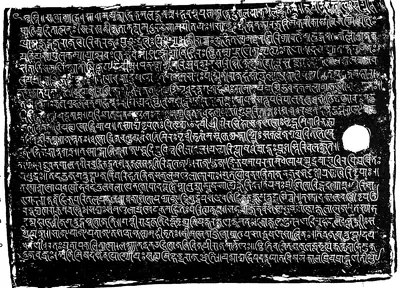 "Cambay Plates of Govinda IV.—Saka-Samvat 852." side i (Epigraphia Indica VII, plate i (between pp. 38 and 39), first page; PDF p. 53 of the archive.org scan epigraphiaindica014351mbp)Inscription rubbing · 1903
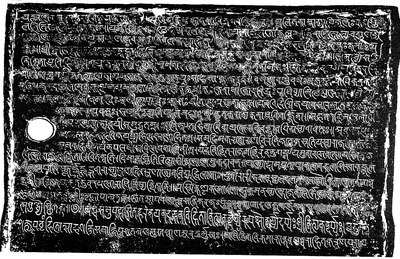 "Cambay Plates of Govinda IV.—Saka-Samvat 852." side iia (Epigraphia Indica VII, plate i (between pp. 38 and 39), second page; PDF p. 54 of the archive.org scan epigraphiaindica014351mbp)Inscription rubbing · 1903
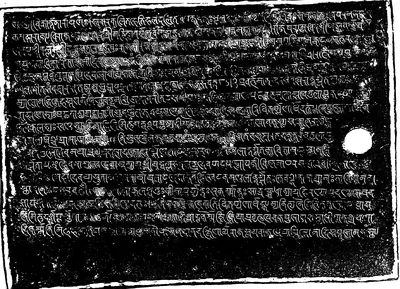 "Cambay Plates of Govinda IV.—Saka-Samvat 852." side iib (Epigraphia Indica VII, plate ii (between pp. 40 and 41), first page; PDF p. 57 of the archive.org scan epigraphiaindica014351mbp)Inscription rubbing · 1903
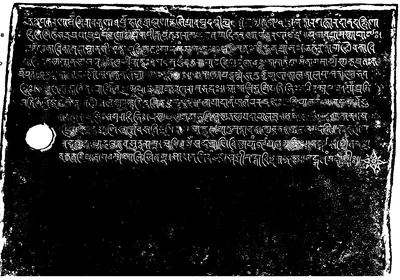 "Cambay Plates of Govinda IV.—Saka-Samvat 852." side iii (Epigraphia Indica VII, plate ii (between pp. 40 and 41), second page; PDF p. 58 of the archive.org scan epigraphiaindica014351mbp)Inscription rubbing · 1903
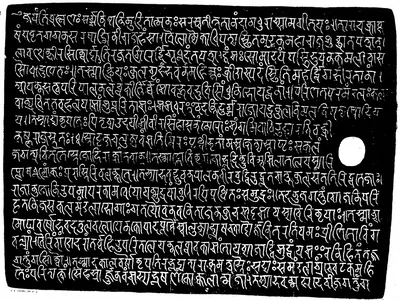 "Rashtrakuta grant of Govinda-Suvarnavarsha.—Saka 855." (the Sangli plates of Govinda IV, A.D. 933), side i (Indian Antiquary XII, plate 15 (sides I–IIa), facing p. 250, first page; PDF p. 282 of the archive.org scan in.ernet.dli.2015.176349)Inscription rubbing · 1883
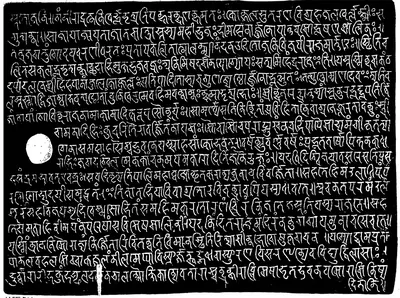 "Rashtrakuta grant of Govinda-Suvarnavarsha.—Saka 855." (the Sangli plates of Govinda IV, A.D. 933), side iia (Indian Antiquary XII, plate 15 (sides I–IIa), facing p. 250, second page; PDF p. 283 of the archive.org scan in.ernet.dli.2015.176349)Inscription rubbing · 1883
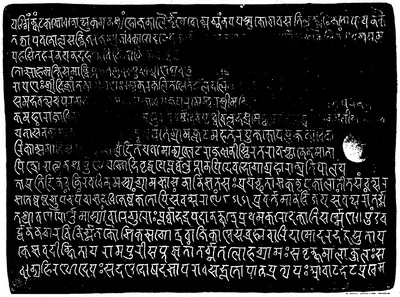 "Rashtrakuta grant of Govinda-Suvarnavarsha.—Saka 855." (the Sangli plates of Govinda IV, A.D. 933), side iib (Indian Antiquary XII, plate 16 (sides IIb and III), facing p. 251, first page; PDF p. 284 of the archive.org scan in.ernet.dli.2015.176349)Inscription rubbing · 1883
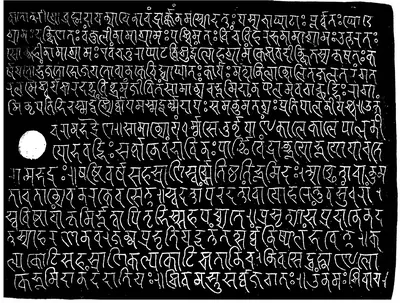 "Rashtrakuta grant of Govinda-Suvarnavarsha.—Saka 855." (the Sangli plates of Govinda IV, A.D. 933), side iii (Indian Antiquary XII, plate 16 (sides IIb and III), facing p. 251, second page; PDF p. 285 of the archive.org scan in.ernet.dli.2015.176349)Inscription rubbing · 1883
Related
Dynasties
References
Notes (0)
Sources (4)
Spotted an error on this page? Tell us
Last updated: