Indra III (Rashtrakuta)
Indra III, called Nityavarsha, was the Rashtrakuta king crowned in February 915, a grandson of Krishna II. A pillar inscription of his reign at Padaturu, in the Nalgonda country, names a chief who governed the Kollipaka Seven Thousand. The Cuddapah gazetteer dates the Rashtrakuta push into Kadapa to his reign. K. A. Nilakanta Sastri and N. Venkataramanayya wrote that he sent a large army into Vengi to put Yuddhamalla II on the Eastern Chalukya throne, and his daughter married Arikesari II of Vemulavada.
Download
Indra III was a king of the Rashtrakutas, crowned in 915.1 Records of his time reach into the Telugu country, from the Nalgonda district to the Penner valley in Kadapa.23 Historians also give him a large part in the civil wars of Vengi.45
Who he was
Indra III was the grandson of the Rashtrakuta king Krishna II.61 His father Jagattunga died without coming to the throne, so the crown passed from grandfather to grandson.61 Indra took the title Nityavarsha, “the perpetual rainer”.1 According to his Nausari grants, his coronation festival was held on 24 February 915.1 On that day, J. F. Fleet writes, he had himself weighed against gold and, while still in the scales, gave a village to a Brahman.1
Records in the Telugu country
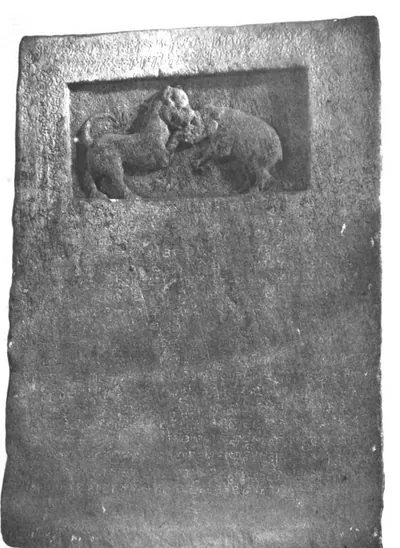
A Kannada inscription on a pillar at Padaturu, in the Nalgonda district, belongs to Nityavarsha’s reign.2 It is dated Saka 835 (913; Saka is an Indian way of counting years).2 It names a great vassal, Nurmadidhavala, and his subordinate Gommarasa, who governed the Kollipaka Seven Thousand division.2 It records gifts of land to a temple at Padaturu.2 See Kolanupaka.
The Cuddapah gazetteer (1915) wrote that the Rashtrakutas took up a policy of conquest only in Indra III’s reign.3 Kannada verses praising his general stand at Danavulapadu, on the north bank of the Penner, five miles south of Jammalamadugu.3 See Kadapa.
Indra III and Vengi
After the death of the king Vijayaditya IV, the Eastern Chalukya kingdom of Vengi fell into a long civil war.4 K. A. Nilakanta Sastri and N. Venkataramanayya (1960) wrote that Indra III took part in it.45 In their account, the relatives of the king Amma I turned against him and got help from Indra III.4 Amma beat them and kept his throne.4 See Amma I.
Later, they wrote, Indra wanted to bring Vengi into the Rashtrakuta empire.5 So he sent a large army to help the prince Yuddhamalla II.5 With it Yuddhamalla drove out the king Bhima and seized the throne.5 But Rashtrakuta officers held a large part of the country and paid him little heed.5 See Yuddhamalla II.
Vemulavada
The Chalukyas of Vemulavada, in today’s Karimnagar district, were Indra III’s vassals.7 N. Venkataramanayya argued that their king Narasimha II won his famous northern victories in the service of Indra III.7 The Cambay plates of Indra’s son credit most of the same victories to Indra himself.7 Narasimha’s son Arikesari II married Revakanirmadi, the daughter of Indraraja.8 See Narasimha II and Arikesari II.
Where the sources disagree
- The length of his reign. Fleet’s latest date for Indra III is 916–17, and his first for Govinda IV is December 918.910 Venkataramanayya gave Indra III the years 915 to 929.11
- The Padaturu date. The summary in Epigraphia Telanganica dates the record to 913, in Nityavarsha’s reign.2 Fleet dated Indra III’s coronation to February 915.1
- Amma I’s enemies. Nilakanta Sastri and Venkataramanayya placed the revolt against Amma I in Indra III’s reign.4 Fleet told the same story under Indra’s son Govinda IV, for whom he had a date as early as December 918.10
Footnotes
-
Fleet, “Dynasties of the Kanarese Districts” (1896), p. 415 (archive.org (opens in a new tab)). ↩ ↩2 ↩3 ↩4 ↩5 ↩6 ↩7
-
Gajjala Vasanta Lakshmi (ed.), Epigraphia Telanganica I: Pre-Kakatiya Telangana (2023), p. 80, Rashtrakuta No. 13, summarising Indian Archaeology 1992–93, pp. 114–115. Cite-only; paraphrased. ↩ ↩2 ↩3 ↩4 ↩5 ↩6
-
C. F. Brackenbury, Madras District Gazetteers: Cuddapah, Vol. I (1915), p. 29 (archive.org (opens in a new tab)). ↩ ↩2 ↩3
-
K. A. Nilakanta Sastri and N. Venkataramanayya, “The Eastern Chalukyas”, in G. Yazdani (ed.), The Early History of the Deccan, Parts VII–XI (1960), p. 482 (archive.org (opens in a new tab)). Cite-only; paraphrased. ↩ ↩2 ↩3 ↩4 ↩5 ↩6
-
Nilakanta Sastri and Venkataramanayya, in The Early History of the Deccan (1960), p. 483 (archive.org (opens in a new tab)). Cite-only; paraphrased. ↩ ↩2 ↩3 ↩4 ↩5 ↩6
-
J. F. Fleet, “Dynasties of the Kanarese Districts”, Gazetteer of the Bombay Presidency I, pt. II (1896), p. 414 (archive.org (opens in a new tab)). ↩ ↩2
-
Venkataramanayya, The Chalukyas of L(V)emulavada (1953), p. 25 (archive.org (opens in a new tab)). Paraphrased. ↩ ↩2 ↩3
-
Venkataramanayya, The Chalukyas of L(V)emulavada (1953), p. 84 (archive.org (opens in a new tab)). Paraphrased. ↩
-
Fleet, “Dynasties of the Kanarese Districts” (1896), p. 416 (archive.org (opens in a new tab)). ↩
-
Fleet, “Dynasties of the Kanarese Districts” (1896), p. 417 (archive.org (opens in a new tab)). ↩ ↩2
-
N. Venkataramanayya, The Chalukyas of L(V)emulavada (1953), p. 11 (archive.org (opens in a new tab)). Paraphrased. ↩
Related
Dynasties
References
Notes (0)
Sources (5)
Spotted an error on this page? Tell us
Last updated: