Somesvara II (Chalukya of Kalyani)
Somesvara II, called Bhuvanaikamalla, was the eldest son of Somesvara I and king of the Western Chalukyas of Kalyani from 1068 to 1076. As a prince he bore the title 'lord of Vengi, the best of towns'. Records of his reign stand across Telangana, at Alampur, Kolanupaka, Bodhan, Palamuru and Inavolu; at Kolanupaka his governor Asagamarasa ruled the Kollipaka Seven Thousand. He allied with Kulottunga I, the 'lord of Vengi', against his brother Vikramaditya VI, who defeated them and took the throne.
Download
Somesvara II, called Bhuvanaikamalla, was a king of the Chalukyas of Kalyani from 1068 to 1076.12 Telangana was then part of the Chalukya kingdom, and records of his short reign are found across it.345 His reign ended when his brother defeated him and his ally, the king of Vengi.2
Prince and king
Somesvara II was the eldest son of Somesvara I.6 In 1053, in his father’s lifetime, he governed the Belvola and Purigere districts in the Kannada country.6 An inscription at Mulgund gives him the title “lord of Vengi, the best of towns”.6 J. F. Fleet explained such titles by the provinces that each prince governed.6
His father drowned himself in the Tungabhadra.1 Somesvara II succeeded at once, and his brother Vikramaditya did not oppose him at first.1 Fleet knew about twenty records of the reign, which he called uneventful except for quarrels within the family.1
Records in Telangana
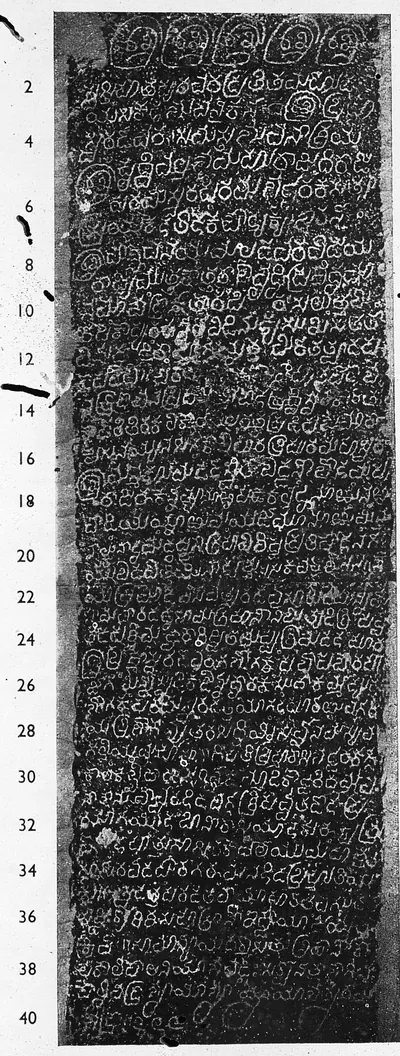
At Kolanupaka, a record of 1070 says that the emperor Bhuvanaikamalla was ruling from his capital at Kampili.3 By order of his subordinate Asagamarasa, a pillar was set up at Butugapalli, in the Kollipaka district.3 It declared that the reddi-manya (land held by the village headman) was free of all taxes, as by old custom.3 A Telugu and Kannada record of 1075 calls Asagamarasa the governor of the Kollipaka Seven Thousand.7 Asagamarasa bore the old Rashtrakuta titles Rattaradheya and “lord of Lattalur”.7 He gave a merchant of Kollipaka, “the capital”, the tolls of the place and house sites in front of the palace.7
At Alampur, in 1073, the Choda chief Chiddana gave land to the god Brahmesvara.5 He governed four districts along the Tungabhadra, among them the Pedakal Eight Hundred, under Somesvara II “from Bankapura”.5 See the Alampur inscription of 1073.
Other records of his reign come from Palamuru, in Telugu (1071), and from Bodhan (1072).84 The Bodhan record is an epitaph for a Jaina teacher named Chandraprabhadeva.4 A record of 1076 at Inavolu, in the Warangal district, was issued a few months before Vikramaditya VI overthrew him.9
The fall
Fleet tells the end from the Vikramankadevacharita of the poet Bilhana.2 Rajiga, “the lord of Vengi”, seized the Chola throne at Kanchi.2 Fleet identified Rajiga with the Eastern Chalukya king Kulottunga I.2 Rajiga persuaded Somesvara II to join him against Vikramaditya.2 Vikramaditya won the battle, Rajiga fled and Somesvara was taken prisoner.2
Vikramaditya at first meant to set his brother free and give him back the throne, Bilhana says.2 But he then had himself crowned, and Fleet wrote that Somesvara’s later fate is not known.2 See Vikramaditya VI and Kulottunga I.
Where the sources disagree
- The title “lord of Vengi”. Fleet at first took the Vengi title to mean that Somesvara’s mother was an Eastern Chalukya princess.6 Later he gave up this view, because the Gadag inscriptions say that Somesvara and his brothers had one mother.6
- His capital. The Kolanupaka record of 1070 has him ruling from Kampili.3 The records of 1073 and 1075 have him ruling from Bankapura.57
- The Kolanupaka date of 1070. The record gives Saka 980, which falls in his father’s reign.3 The editors took the cyclic year as correct and dated it to 4 July 1070.3
Footnotes
-
Fleet, “Dynasties of the Kanarese Districts” (1896), p. 442 (archive.org (opens in a new tab)). ↩ ↩2 ↩3 ↩4
-
Fleet, “Dynasties of the Kanarese Districts” (1896), p. 445 (archive.org (opens in a new tab)). ↩ ↩2 ↩3 ↩4 ↩5 ↩6 ↩7 ↩8 ↩9
-
Gajjala Vasanta Lakshmi (ed.), Epigraphia Telanganica I: Pre-Kakatiya Telangana (2023), p. 176, No. 167, summarising Inscriptions of Andhra Pradesh, Nalgonda District II (1994), pp. 12–17. Cite-only; paraphrased. ↩ ↩2 ↩3 ↩4 ↩5 ↩6 ↩7
-
Epigraphia Telanganica I (2023), p. 178, No. 171. Cite-only; paraphrased. ↩ ↩2 ↩3
-
Kannada Inscriptions of Andhra Pradesh (Andhra Pradesh Government Archaeological Series 3, 1961), p. 35, No. 94 (archive.org (opens in a new tab)). Paraphrased except for the short phrase quoted. ↩ ↩2 ↩3 ↩4
-
J. F. Fleet, “Dynasties of the Kanarese Districts”, Gazetteer of the Bombay Presidency I, pt. II (1896), p. 440 and note 3 (archive.org (opens in a new tab)). ↩ ↩2 ↩3 ↩4 ↩5 ↩6
-
Epigraphia Telanganica I (2023), p. 186, No. 180, summarising Inscriptions of Andhra Pradesh, Nalgonda District II (1994), pp. 17–21. Cite-only; paraphrased except for the short phrases quoted. ↩ ↩2 ↩3 ↩4
-
Epigraphia Telanganica I (2023), p. 177, No. 168. Cite-only; paraphrased. ↩
-
Epigraphia Telanganica I (2023), p. 188, No. 183, summarising Indian Archaeology 1980–81: A Review, p. 79. Cite-only; paraphrased. ↩
Photos
References
Notes (0)
Sources (3)
Spotted an error on this page? Tell us
Last updated: