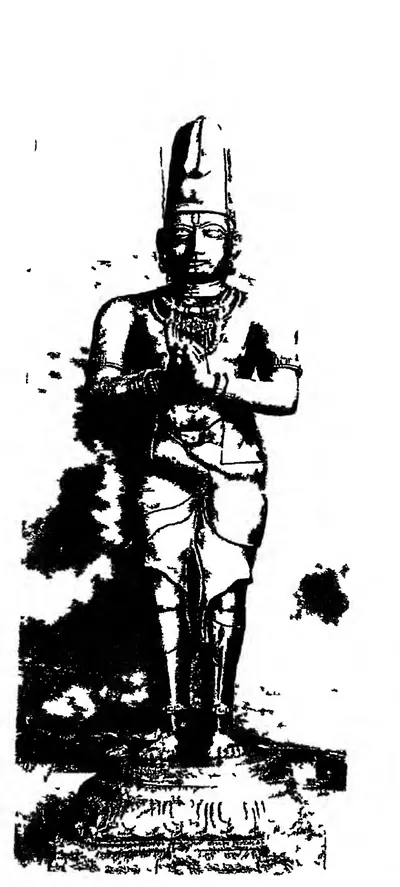
Vijaya Raya (Bukka III)
Vijaya Raya, also called Vira Vijaya and Bukka III, was a son of Deva Raya I and king of Vijayanagara for a short time after his father's death in 1422. As a prince he governed Mulbagal and the Arcot country. As king he faced the new Bahmani sultan Ahmad Shah on the Tungabhadra, with help from Warangal. The Warangal troops left him, his camp was surprised, and Ahmad plundered his kingdom until he paid the arrears of tribute. The sources disagree on whether his reign lasted months or years, and on whether these events belong to him or to his son Deva Raya II.
Download
Vijaya Raya, also called Vira Vijaya and Bukka III, was king of Vijayanagara for a short time after his father Deva Raya I died in 1422.12 Sewell’s later work says that he died in 1423, after a reign of only a few months.2 His reign is remembered for one war: the new Bahmani sultan Ahmad Shah defeated him on the Tungabhadra and plundered his kingdom.345 See Vijayanagara and Deva Raya I.
Family
Sewell took his family tree from the Epigraphia Indica.6 According to it, Vira Vijaya was a son of Deva Raya I and Hemambika, and the father of Deva Raya II by his wife Narayanambika.6 A grant made by Vijaya himself in 1410 also names his mother Hemambika.7
Prince
Sewell’s list of inscriptions shows him governing for his father under several names, “Bhupati Raya”, “Vijaya Bhupati” and “Bukka III”:879
- in the North Arcot district in 1407 and 141389
- as viceroy at Mulbagal in 14107
- near Punganur in the Chittoor district in 1410, where he founded a village for Brahmans near Palamaner7
- in the Chingleput district in 14149
An inscription of 1411 in Mysore prays for the success of his arms.7 Nilakanta Sastri wrote that Vira Vijaya helped his father in his wars, and that his own son, the later Deva Raya II, shared in the government almost from the start of his reign.10
Wolseley Haig gives Vira Vijaya the victory at Pangal over Sultan Firuz Shah.11 In Haig’s account, Vira Vijaya made an alliance with the raja of Telangana (then Telingana) and marched to relieve the besieged town.11 Other writers give this victory to his father.110
The war with Ahmad Shah
Firuz Shah died in September 1422, and his brother Ahmad Shah took the Bahmani throne.2 Ahmad at once prepared to attack Vijayanagar.23 Sewell’s later summary of Ferishta says that Bukka III got help from Warangal, and the two armies camped on the Tungabhadra.2 Haig says the Hindu army was huge, with nearly a million foot soldiers and gunners.3
For forty days Ahmad waited on the north bank.3 Then a Bahmani force crossed the river by night, upstream of the Hindu camp.3 The Warangal troops withdrew and left their allies.2 The king was sleeping in a sugarcane garden behind his army.312 When the Bahmani horsemen burst in, he hid in the cane.312
The soldiers found him, took him for a labourer and made him run before them carrying a load of sugarcane.412 When the alarm spread through the camp, they left him to go and plunder.412 He escaped and joined his nobles, but he took the event as a bad omen and fled to Vijayanagar.412
Ahmad then plundered the open country.42 Haig wrote that no army in these wars was ever so cruel.4 Whenever the number of people killed reached 20,000, the sultan halted for three days of feasting.42 In March 1423, out hunting, Ahmad himself was nearly killed by a large body of Hindu horsemen.45
At last Ahmad besieged Vijayanagar, and the king had to ask for peace.52 He paid the arrears of tribute for several years.5 Haig says the treasure was carried to the sultan’s camp on the best royal elephants, escorted by the king’s son Deva Raya.5 The Bahmani army kept the many captives it had taken.5 See Ahmad Shah I and the Bahmanis.
Death
Sewell’s later work says that Bukka III seems to have died in 1423, and that his son Deva Raya II followed him.2 See Deva Raya II.
Where the sources disagree
- How long he reigned. Nuniz, who calls him “Visarao”, gives him six years in which he “did nothing worth relating”.13 Sewell (1900) found his inscriptions from 1413–14 to 1416–17, and thought his son began to reign in 1419.14 Sewell’s later work (1932) gives him only a few months in 1422–23.2 Nilakanta Sastri gives him about five years, 1422–26, after a reign of a few months by his brother Ramachandra.10
- Whose war it was. Haig, Sewell’s later work and Nilakanta Sastri tell the story of Ahmad Shah’s war and the sugarcane garden of Vira Vijaya.3210 Sewell (1900) told it of Deva Raya II.1512 In 1932 Sewell noted that Ferishta calls the king “Dewul Roy”, or Deva Raya. He thought this an error, and Bukka III almost certainly the king, though it may have been his son.2
Footnotes
-
Sewell, Historical Inscriptions (1932), p. 213 (archive.org (opens in a new tab)). ↩ ↩2
-
Sewell, Historical Inscriptions (1932), p. 214 and note (archive.org (opens in a new tab)). ↩ ↩2 ↩3 ↩4 ↩5 ↩6 ↩7 ↩8 ↩9 ↩10 ↩11 ↩12 ↩13
-
Haig, Cambridge History of India, Vol. III (1928), p. 396 (archive.org (opens in a new tab)). ↩ ↩2 ↩3 ↩4 ↩5 ↩6 ↩7 ↩8
-
Haig, Cambridge History of India, Vol. III (1928), p. 397 (archive.org (opens in a new tab)). ↩ ↩2 ↩3 ↩4 ↩5 ↩6 ↩7 ↩8
-
Haig, Cambridge History of India, Vol. III (1928), p. 398 (archive.org (opens in a new tab)). ↩ ↩2 ↩3 ↩4 ↩5 ↩6
-
Robert Sewell, A Forgotten Empire (Vijayanagar) (1900), p. 24, pedigree after Epigraphia Indica III (archive.org (opens in a new tab)). ↩ ↩2
-
Sewell, Historical Inscriptions (1932), p. 210 (archive.org (opens in a new tab)). ↩ ↩2 ↩3 ↩4 ↩5
-
Robert Sewell, ed. S. Krishnaswami Aiyangar, The Historical Inscriptions of Southern India (1932), p. 209 (archive.org (opens in a new tab)). ↩ ↩2
-
Sewell, Historical Inscriptions (1932), p. 211 (archive.org (opens in a new tab)). ↩ ↩2 ↩3
-
K. A. Nilakanta Sastri, A History of South India from Prehistoric Times to the Fall of Vijayanagar, 3rd ed. (1966), p. 269 (archive.org (opens in a new tab)). Paraphrased. ↩ ↩2 ↩3 ↩4
-
Wolseley Haig, “The Kingdom of the Deccan”, in Wolseley Haig (ed.), The Cambridge History of India, Vol. III (1928), p. 394 (archive.org (opens in a new tab)). ↩ ↩2
-
Sewell, A Forgotten Empire (1900), p. 67, quoting Ferishta (archive.org (opens in a new tab)). ↩ ↩2 ↩3 ↩4 ↩5 ↩6
-
Fernao Nuniz, “Chronicle”, in Sewell, A Forgotten Empire (1900), p. 302 (archive.org (opens in a new tab)). ↩
-
Sewell, A Forgotten Empire (1900), p. 62 (archive.org (opens in a new tab)). ↩
-
Sewell, A Forgotten Empire (1900), p. 66 (archive.org (opens in a new tab)). ↩
Related
Dynasties
References
Notes (0)
Sources (4)
Spotted an error on this page? Tell us
Last updated: