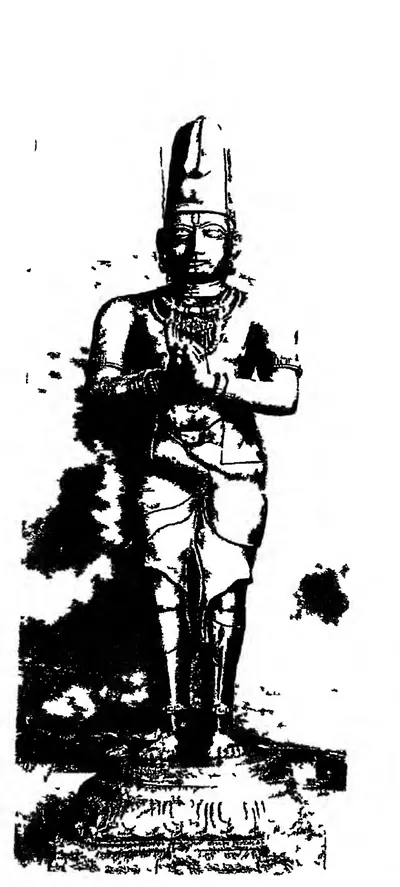
Deva Raya I (Vijayanagara)
Deva Raya I, a son of Harihara II, was crowned king of Vijayanagara on 5 November 1406 and ruled until 1422. As a prince he had governed Udayagiri and the Guntur country, and Sewell took his queen Hemambika to be a niece of the Reddi king Anavema of Kondavidu. Early in his reign a war with the Bahmani sultan Firuz Shah cost him the fort of Bankapur and a daughter given in marriage. Later he joined the Reddis of Rajahmundry against Kondavidu, and in 1419 his army routed Firuz at Pangal. Kondavidu was then divided between him and the Velamas.
Download
Deva Raya I was king of Vijayanagara from 1406 to 1422.123 He was a son of Harihara II, and a younger brother of King Bukka II.42 Before he became king he governed Udayagiri and other Telugu lands for his father.56 As king he fought the Bahmani sultan Firuz Shah, and he was drawn into the wars of the Reddi kingdoms on the Telugu coast.78 See Vijayanagara and Harihara II.
Prince in the Telugu country
The 1961 Nellore district handbook says that in 1382 Harihara II’s son, the later Deva Raya I, governed the Udayagiri province for him.5 Nilakanta Sastri also names him as governor of Udayagiri.9 Sewell’s list of inscriptions shows him in these places as a prince:106112
- at Udayagiri and in the Kadapa (then Cuddapah) district in 139610
- in the Guntur district in 13996
- in the Salem district in 140311
- in the Chittoor district in 1405 and 1406, for his brother Bukka II2
Bukka II died between August and November 1406.2 An inscription at Hassan in Mysore fixes Deva Raya’s coronation on 5 November 1406.12
Family
Sewell’s later work names his queen Hemambika, from a grant of 1410 made by her son.12 The grant calls her the daughter of Nuka Bhupala.12 Sewell took him to be the Reddi chief Nalla Nunka, who married Vemasani, a sister of Anavema Reddi of Kondavidu.12 If so, Deva Raya’s queen came from the Reddi royal family.12
Several of his sons governed provinces for him, according to Sewell’s list:131214
- Vijaya Bukka, also called Bukka III, was viceroy at Mulbagal and ruled the North Arcot district.1214
- Harihara ruled in the Coimbatore district.1214
- Ramachandra was viceroy of the Udayagiri province in 1416.14
- Mallappa granted a village in memory of his mother Mallayavve.12
The farmer’s daughter of Mudgal
Ferishta tells a famous story of the start of his reign.151617 A Brahman told the king of a beautiful girl, a farmer’s daughter at Mudgal (then Mudkal), in the land disputed with the Bahmanis.1516 The king sent rich gifts, but the girl refused to enter his palace, because she would never see her parents again.16 So the king sent 5,000 horsemen across the Tungabhadra to seize her.1617 News of the troops reached Mudgal first, and the girl and her family fled.17
The raid led to war. In the winter of 1406, Sultan Firuz Shah attacked Vijayanagar itself.17 His troops were driven out of the city streets, but they wasted the country around it and took the fort of Bankapur.1718 Deva Raya had to make a humiliating peace.18 He gave Firuz his daughter in marriage, paid a huge sum and gave up Bankapur for ever.18
Firuz came to the city for the wedding, and the road from the gate to the palace was spread with cloth of gold.1819 But the two kings parted in anger.19 Firuz later sent for the farmer’s daughter, Pertal, and married her to his son Hasan Khan.19 See Firuz Shah.
The Reddi wars and Pangal
Nilakanta Sastri tells how the war spread to the Telugu country.7 The Reddis of Kondavidu, perhaps in league with Firuz, attacked Udayagiri, and they were not driven out until 1413.7 Sewell’s list records Deva Raya reigning in the Guntur district in that year.14
The Telugu Choda chief Anadeva, who held land between the Krishna and the Godavari, was another friend of Firuz.7 Against him Deva Raya joined his brother-in-law Kataya Vema, the Reddi ruler of Rajahmundry.7 The fighting began in 1415.7 Firuz came to Anadeva’s help, Kataya Vema was killed, and Deva Raya’s army was beaten too.7
Deva Raya struck back by taking Pangal, and Firuz besieged it for two years.7 Sewell’s list says the siege began in 1417.20 According to Ferishta, disease broke out in the sultan’s camp, and many nobles deserted.2122 The Velamas of Rachakonda (then Rajakonda) joined Deva Raya.8 In 1419 his army fell on the retreating Bahmanis and won a great victory.83
Nilakanta Sastri says that after this the Reddi kingdom of Kondavidu came to an end.8 In 1420 its land was divided between Deva Raya and the Velamas of Rachakonda.8 He adds that Deva Raya’s son Vira Vijaya and his minister Lakshmidhara helped him in these wars, and that Lakshmidhara saved him from a plot to kill him.8 See Kondavidu, the Reddis of Kondavidu and the Recherla Velamas.
The army and the city
S. Krishnaswami Aiyangar noted that, according to inscriptions, Deva Raya I employed a force of Muslim horsemen.23 Nuniz says that a king he calls “Ajarao” built new walls round the city and dammed the Tungabhadra to bring water into it.247 Sewell thought that “Ajarao” stood for two kings, Bukka II and Deva Raya I.24 Nilakanta Sastri also gives this work to the two brothers.7
Death
Sewell’s later work says that Deva Raya I died before 3 August 1422.3 On 2 August his son Harihara granted a village to Brahmans so that “Deva Raya Maharaja might attain to the world of merit”.3 His son Vijaya Bukka followed him on the throne.3 See Vijaya (Bukka III).
Where the sources disagree
- His reign. Sewell (1900) wrote that he lived till at least 1412, and that his last inscription is of 1412–13.21 Sewell’s later work (1932) has him reign until 1422.3 Nilakanta Sastri also has him die in 1422.8
- The victory at Pangal. Sewell’s later work and Nilakanta Sastri give it to Deva Raya I.38 Haig gives it to his son Vira Vijaya.25 In 1900 Sewell had given it to Deva Raya II, who he thought began to reign in 1419.2122
- The Mudgal story. Sewell and Nilakanta Sastri tell it of Deva Raya I.157 Haig tells it of Bukka II.2627 Nilakanta Sastri adds that another account puts the war down to Firuz’s wish to wage holy war, not to the girl.7
- Nicolo Conti’s visit. The Italian traveller came to the city in 1420 or 1421.283 Sewell (1900) placed this shortly after Deva Raya II came to the throne.28 Nilakanta Sastri places it towards the end of Deva Raya I’s reign.8
Footnotes
-
Sewell, A Forgotten Empire (1900), p. 56 (archive.org (opens in a new tab)). ↩ ↩2
-
Sewell, Historical Inscriptions (1932), p. 208 (archive.org (opens in a new tab)). ↩ ↩2 ↩3 ↩4 ↩5 ↩6
-
Sewell, Historical Inscriptions (1932), p. 213 (archive.org (opens in a new tab)). ↩ ↩2 ↩3 ↩4 ↩5 ↩6 ↩7 ↩8
-
Robert Sewell, A Forgotten Empire (Vijayanagar) (1900), p. 24, pedigree after Epigraphia Indica III (archive.org (opens in a new tab)). ↩
-
A. Chandra Sekhar, Census of India 1961, Andhra Pradesh: District Census Handbook, Nellore District (1967), p. xii (PDF p. 28) (censusindia.gov.in (opens in a new tab)). Cite-only; paraphrased. ↩ ↩2
-
Sewell, Historical Inscriptions (1932), p. 206 (archive.org (opens in a new tab)). ↩ ↩2 ↩3
-
Nilakanta Sastri, A History of South India, 3rd ed. (1966), p. 268 (archive.org (opens in a new tab)). Paraphrased. ↩ ↩2 ↩3 ↩4 ↩5 ↩6 ↩7 ↩8 ↩9 ↩10 ↩11 ↩12
-
Nilakanta Sastri, A History of South India, 3rd ed. (1966), p. 269 (archive.org (opens in a new tab)). Paraphrased. ↩ ↩2 ↩3 ↩4 ↩5 ↩6 ↩7 ↩8 ↩9
-
K. A. Nilakanta Sastri, A History of South India from Prehistoric Times to the Fall of Vijayanagar, 3rd ed. (1966), p. 267 (archive.org (opens in a new tab)). Paraphrased. ↩
-
Robert Sewell, ed. S. Krishnaswami Aiyangar, The Historical Inscriptions of Southern India (1932), p. 205 (archive.org (opens in a new tab)). ↩ ↩2
-
Sewell, Historical Inscriptions (1932), p. 207 (archive.org (opens in a new tab)). ↩ ↩2
-
Sewell, Historical Inscriptions (1932), p. 210 (archive.org (opens in a new tab)). ↩ ↩2 ↩3 ↩4 ↩5 ↩6 ↩7 ↩8
-
Sewell, Historical Inscriptions (1932), p. 209 (archive.org (opens in a new tab)). ↩
-
Sewell, Historical Inscriptions (1932), p. 211 (archive.org (opens in a new tab)). ↩ ↩2 ↩3 ↩4 ↩5
-
Sewell, A Forgotten Empire (1900), p. 57, quoting Ferishta (archive.org (opens in a new tab)). ↩ ↩2 ↩3
-
Sewell, A Forgotten Empire (1900), p. 58, quoting Ferishta (archive.org (opens in a new tab)). ↩ ↩2 ↩3 ↩4
-
Sewell, A Forgotten Empire (1900), p. 59, quoting Ferishta (archive.org (opens in a new tab)). ↩ ↩2 ↩3 ↩4 ↩5
-
Sewell, A Forgotten Empire (1900), p. 60, quoting Ferishta (archive.org (opens in a new tab)). ↩ ↩2 ↩3 ↩4
-
Sewell, A Forgotten Empire (1900), p. 61, quoting Ferishta (archive.org (opens in a new tab)). ↩ ↩2 ↩3
-
Sewell, Historical Inscriptions (1932), p. 212 (archive.org (opens in a new tab)). ↩
-
Sewell, A Forgotten Empire (1900), p. 62 (archive.org (opens in a new tab)). ↩ ↩2 ↩3
-
Sewell, A Forgotten Empire (1900), p. 63, quoting Ferishta (archive.org (opens in a new tab)). ↩ ↩2
-
S. Krishnaswami Aiyangar, “Hindu States in Southern India”, in Wolseley Haig (ed.), The Cambridge History of India, Vol. III (1928), p. 492 (archive.org (opens in a new tab)). ↩
-
Sewell, A Forgotten Empire (1900), p. 51 (archive.org (opens in a new tab)). ↩ ↩2
-
Haig, Cambridge History of India, Vol. III (1928), p. 394 and note (archive.org (opens in a new tab)). ↩
-
Wolseley Haig, “The Kingdom of the Deccan”, in Wolseley Haig (ed.), The Cambridge History of India, Vol. III (1928), p. 391 (archive.org (opens in a new tab)). ↩
-
Haig, Cambridge History of India, Vol. III (1928), p. 392 (archive.org (opens in a new tab)). ↩
-
Sewell, A Forgotten Empire (1900), p. 81 (archive.org (opens in a new tab)). ↩ ↩2
Related
Dynasties
References
Notes (0)
Sources (5)
Spotted an error on this page? Tell us
Last updated: