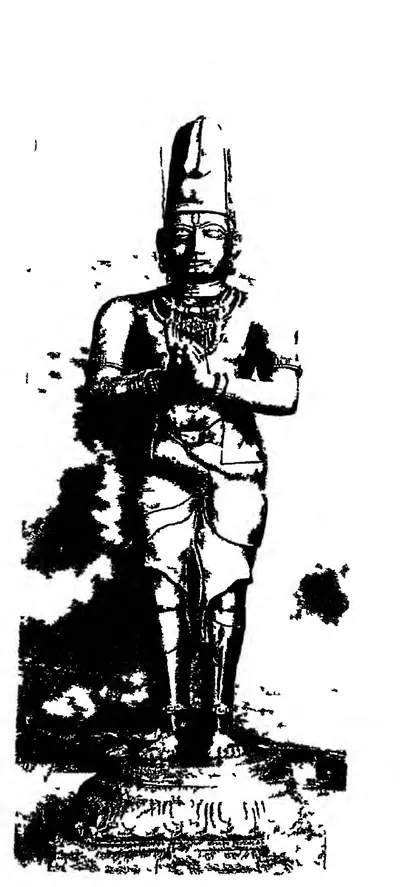
Deva Raya II (Vijayanagara)
King of Vijayanagara from 1422 or 1423 to 1446, the greatest ruler of the first dynasty. He enlisted Muslim archers in his army, survived an attempt on his life in 1443 and received the Persian envoy Abdur Razzaq. His inscriptions reach the Godavari delta and the Guntur and Nellore country. The Telugu poet Vallabharaya governed Vinukonda for him, and Srinatha was bathed in gold in his Pearl Hall. After his death the Bahmani sultan and the Gajapati of Orissa besieged his capital together.
Deva Raya II was king of Vijayanagara from the early 1420s to 1446. Krishnaswami Aiyangar called him “by far the greatest ruler of the first dynasty”, excelled perhaps only by Krishnadeva Raya.1 See Vijayanagara.
The sources give different dates for his reign:
- Sewell’s later work dates his earliest record to 25 February 1423 and his death to 24 May 1446.2
- Sewell had earlier put his accession in 1419, when he thought he was “probably a mere boy”, and his death in 1444 or later.34
- S. Krishnaswami Aiyangar wrote that he died in February 1449.1
Family
Sewell took a pedigree from the Epigraphia Indica.5 According to it, Deva Raya II was the son of Vira Vijaya and Narayanambika, and a grandson of Deva Raya I and Hemambika.5 Deva Raya I was himself a son of Harihara II, the son of Bukka I, according to the same pedigree.5
The Kamadhenu is a commentary on Vamana’s Kavyalankara Sutra.6 Krishnaswami Aiyangar’s extract from it says that Saluva Tippa, grandfather of its author, married Harima, an elder sister of Deva Raya II.6 Sewell’s later pedigree names the king’s queens as Siddala and Ponnala.7 His son Mallikarjuna succeeded him.87
Who the father of the last Sangama king, Virupaksha, was is disputed. Sewell’s pedigree of 1900 makes Virupaksha II a son of Mallikarjuna.5 Krishnaswami Aiyangar read the Srisailam plates of 1465 in 1919.9 They make Virupaksha a son of Pratapadeva Raya and Siddhala Devi.9
Krishnaswami Aiyangar took Pratapadeva Raya for Deva Raya II himself.910 This makes Virupaksha a younger brother of Mallikarjuna, as he also wrote in 1928.910 Sewell in 1932 read the same and other plates.7 He made Pratapa Deva Raya a younger brother of Deva Raya II, and Virupaksha his son.7
Wars and the army
Deva Raya II came to the throne in the middle of the long war with the Bahmanis. Ferishta says that when Ahmad Shah attacked, the Vijayanagara generals sent to Warangal for help.111213 But “the troops of Warangal deserted the Raya and withdrew” before the battle.111213 Ahmad later took Warangal itself.111213
Krishnaswami Aiyangar wrote that after a defeat about 1440 the king decided that the strength of the Muslim armies lay in their mounted archers.141 He enlisted “a special force of 2000 Muhammadan archers” and gave them a mosque in the city.141 He placed a copy of the Koran before his throne, so that their bow was made to it.141 With an army reformed in this way he invaded the Bahmani kingdom in 1443.141
Krishnaswami Aiyangar credited the able government of the reign to the Brahman minister Lakkanna, “the great Danayak” of the Persian envoy.1 See the Bahmanis and Ahmad Shah I.
The attempt on his life and Abdur Razzaq
Between November 1442 and April 1443 one of the king’s close relatives tried to kill him.15 Abdur Razzaq, who was then at Calicut, calls the assassin the king’s brother, and Nuniz calls him a nephew.15 Abdur Razzaq, ambassador of Shah Rukh of Samarqand, came to Vijayanagara later in 1443 and saw the king. Of the city he wrote that “the pupil of the eye has never seen a place like it”.1617
He described the king’s dominion as stretching “from the frontier of Serendib to the extremities of the country of Kalbergah”.1617 Sewell noted that one copy of the envoy’s narrative calls the king “exceedingly young” at that time.18 The Italian Nicolo Conti had visited the city about 1420 or 1421, “shortly after the accession of Deva Raya II”.19
The Telugu country
Deva Raya II’s rule reached far into the Telugu districts. Sewell’s list of inscriptions shows him recognised in these places:2021
- in 1425 in the Godavari district, where a gift was made for the merit of Allada Reddi of Rajahmundry2021
- in the Nellore district in 1428, 1429 and 14322021
- in the Kadapa (then Cuddapah) and Anantapur districts2021
- in the Kurnool district in 14412021
- in 1444 at Draksharama and in the Guntur district2021
The Telugu poet Vinukonda Vallabharaya translated the Kridabhiramamu.2223 He was the king’s governor of the fort of Vinukonda and keeper of his storehouse of precious stones.2223 Krishnaswami Aiyangar called this “the first instance of a governorship in this particular frontier”.2223 See Allada Reddi, the Reddis of Rajahmundry and Draksharama.
Poets at court
The Telugu poet Srinatha, Krishnaswami Aiyangar wrote, “enjoyed the patronage of Deva Raya II and Sarvagna Singama”.23 Verses attributed to Srinatha say that he was kept waiting at the capital and disliked its food.246 They say he was bathed in gold coins in the Pearl Hall of the emperor.246 They also say he broke the bell-metal drum of the Gauda poet Dindima Bhatta after a contest.246
A verse of his Kasikhandam recalls the bathing in gold “in the Pearl Hall of the Emperor of Karnata”.6 A Sanskrit champu (a work in mixed prose and verse) on the story of Rama, the Mahanataka Sudhanidhi, is attributed to the king himself.25
After his death
Krishnaswami Aiyangar wrote that the kingdom “passed on without dispute” to Mallikarjuna.26 The Bahmani sultan and the Gajapati king of Orissa then laid siege to the capital together and were beaten off.268 A Sanskrit drama of the time, the Gangadasapratapavilasam, records the joint attack.8
In the following years, Krishnaswami Aiyangar wrote, the Gajapatis advanced along the coast as far as the Nellore district.2728 It was this advance that gave the Saluva chief Narasimha his opportunity.2728 See the Gajapatis, Kapilendra and Saluva Narasimha.
Footnotes
-
Krishnaswami Aiyangar, in Cambridge History of India, Vol. III (1928), p. 492 (archive.org (opens in a new tab)). ↩ ↩2 ↩3 ↩4 ↩5 ↩6 ↩7
-
Sewell, Historical Inscriptions (1932), p. 403, notes to the pedigrees (archive.org (opens in a new tab)). ↩
-
Sewell, A Forgotten Empire (1900), p. 63 and note (archive.org (opens in a new tab)). ↩
-
Sewell, A Forgotten Empire (1900), p. 65, chapter heading (archive.org (opens in a new tab)). ↩
-
Robert Sewell, A Forgotten Empire (Vijayanagar) (1900), p. 24, pedigree after Epigraphia Indica III (archive.org (opens in a new tab)). ↩ ↩2 ↩3 ↩4
-
Krishnaswami Aiyangar, Sources of Vijayanagar History (1919), p. 62, the Kasikhandam and extract 21, the Kamadhenu of Saluva Gopa Tippa (archive.org (opens in a new tab)). ↩ ↩2 ↩3 ↩4 ↩5 ↩6
-
Sewell, Historical Inscriptions (1932), p. 400 (archive.org (opens in a new tab)). ↩ ↩2 ↩3 ↩4
-
Krishnaswami Aiyangar, Sources of Vijayanagar History (1919), p. 65, extract 25, the Gangadasapratapavilasam (archive.org (opens in a new tab)). ↩ ↩2 ↩3
-
Krishnaswami Aiyangar, Sources of Vijayanagar History (1919), p. 68, extract 26, the Srisailam plates of Virupaksha (archive.org (opens in a new tab)). ↩ ↩2 ↩3 ↩4
-
Krishnaswami Aiyangar, in Cambridge History of India, Vol. III (1928), p. 494 (archive.org (opens in a new tab)). ↩ ↩2
-
Sewell, A Forgotten Empire (1900), p. 66 (archive.org (opens in a new tab)). ↩ ↩2 ↩3
-
Sewell, A Forgotten Empire (1900), p. 67, quoting Ferishta (archive.org (opens in a new tab)). ↩ ↩2 ↩3
-
Sewell, A Forgotten Empire (1900), p. 71 (archive.org (opens in a new tab)). ↩ ↩2 ↩3
-
S. Krishnaswami Aiyangar, “Hindu States in Southern India”, in Wolseley Haig (ed.), The Cambridge History of India, Vol. III (1928), p. 491 (archive.org (opens in a new tab)). ↩ ↩2 ↩3 ↩4
-
Sewell, A Forgotten Empire (1900), pp. 72–73 (archive.org (opens in a new tab)). ↩ ↩2
-
Sewell, A Forgotten Empire (1900), p. 73 (archive.org (opens in a new tab)). ↩ ↩2
-
Sewell, A Forgotten Empire (1900), p. 88, quoting Abdur Razzaq (archive.org (opens in a new tab)). ↩ ↩2
-
Sewell, A Forgotten Empire (1900), p. 77 (archive.org (opens in a new tab)). ↩
-
Sewell, A Forgotten Empire (1900), p. 81 (archive.org (opens in a new tab)). ↩
-
Robert Sewell, ed. S. Krishnaswami Aiyangar, The Historical Inscriptions of Southern India (1932), pp. 215–216 (archive.org (opens in a new tab)). ↩ ↩2 ↩3 ↩4 ↩5 ↩6
-
Sewell, Historical Inscriptions (1932), pp. 217–220 (archive.org (opens in a new tab)). ↩ ↩2 ↩3 ↩4 ↩5 ↩6
-
Krishnaswami Aiyangar, Sources of Vijayanagar History (1919), p. 56, extract 17, the Kridabhiramamu (archive.org (opens in a new tab)). ↩ ↩2 ↩3
-
S. Krishnaswami Aiyangar (ed.), Sources of Vijayanagar History (1919), introduction, pp. 4–5 (archive.org (opens in a new tab)). ↩ ↩2 ↩3 ↩4
-
Krishnaswami Aiyangar, Sources of Vijayanagar History (1919), p. 61, extract 20, verses about Srinatha’s visit to Vijayanagar (archive.org (opens in a new tab)). ↩ ↩2 ↩3
-
Krishnaswami Aiyangar, Sources of Vijayanagar History (1919), p. 60, extract 19, the Mahanataka Sudhanidhi (archive.org (opens in a new tab)). ↩
-
Krishnaswami Aiyangar, in Cambridge History of India, Vol. III (1928), p. 493 (archive.org (opens in a new tab)). ↩ ↩2
-
Krishnaswami Aiyangar, Sources of Vijayanagar History (1919), introduction, pp. 5–6 (archive.org (opens in a new tab)). ↩ ↩2
-
Krishnaswami Aiyangar, Sources of Vijayanagar History (1919), introduction, p. 7 (archive.org (opens in a new tab)). ↩ ↩2
Related
Dynasties
References
Notes (0)
Sources (4)
Spotted an error on this page? Tell us
Last updated: