Osmania University
The university of Hyderabad State, ordered by the seventh Nizam in April 1917 and set up by a charter in 1918. It taught in Urdu, with English as a compulsory language. Its first college opened in 1919; colleges of law, medicine, engineering and teacher training, intermediate colleges at Warangal and Aurangabad and a college for women followed by 1930.
Download
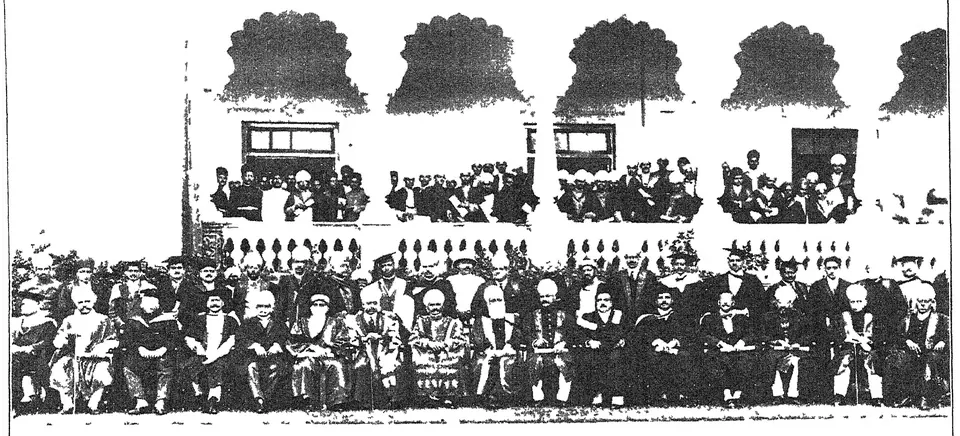
Osmania University was the university of the Nizam’s Hyderabad State.1 The seventh Nizam, Mir Osman Ali Khan, ordered it in 1917, and a charter set it up in 1918.21 It taught in Urdu, with English as a compulsory second language.1 For its founding and its campus at Adikmet, see the Osmania University monument page.
Why a new university
Before 1917 the state had only two places of higher learning, says the university’s Registrar in the census of 1931.3 They were the Dar-ul-ulum and the Nizam College.3 For over half a century the University of Madras had controlled higher education in the state.1 The university’s own account of 1931 calls the results “so discouraging”.1
In 1917 Akbar Hydari, Secretary in the Education Department, sent the Nizam a memorandum.1 He argued that teaching through a foreign language wasted students’ time and strained their memory.2 He admitted that most people of the state spoke other languages.2 But he called Urdu the cultural and official language of the state.2 The Nizam approved the plan by a farman (royal order) of April 1917.2 He named it the Osmania University “in commemoration of my accession to the throne”.4
The first college
The Osmania University College opened in Hyderabad in August 1919, according to the university’s calendar.5 It began with 90 students in its first-year class, and 50 more joined later.6 A year later the first and second years had 181 and 107 students.6 There were two hostels, one for Muslims and one for Hindus.7
Students could choose Telugu, Marathi or Kannada besides Urdu, Persian and Arabic.6 In 1919–20, eight first-year students and one second-year student took Telugu.6 The college’s first staff list names R. Subba Rao as the teacher of Telugu.8 According to K. Sitaramaiya, the university invited the poet Rayaprolu Subba Rao to its new Telugu chair in 1918–19.9
Growth to 1931
The first Intermediate examination was held in April 1921, and the first B.A. examination in 1923.5 By 1928 the college had nearly 600 students.5 A law class opened in August 1923, and the medical college in July 1927.5 Colleges of engineering and of teacher training opened in 1929.10 The Nizam approved about 1,400 acres of land for new university buildings.5
As students grew, intermediate colleges opened in the City High School at Hyderabad, at Aurangabad and at Warangal.11 Intermediate and then degree classes were added at the Zenana School, Nampally, for women who kept purdah (seclusion from men).11 In 1930–31 this Zenana College had 8 students in the Intermediate classes and 4 in the B.A.12
In 1930 the university had these students in its faculties:13
- arts and science, 75213
- law, 7213
- medicine, 7013
- engineering, 3113
- theology, 2813
- teacher training, 1013
Books in Urdu
The university’s Bureau of Translation put college textbooks into Urdu.1 By 1931 it had published more than 300 volumes.14 All the books needed for the Intermediate, B.A. and LL.B. examinations had been translated.1 The Nizamiah Observatory, founded in 1908, came under the university in 1919.15
Telugu and the other languages
The university kept research scholarships of Rs. 75 a month for Telugu, Marathi and Kannada.13 In 1938–42 Telugu was still among the subjects taught, and among those open to research for the M.A.16 Special scholarships for research in Telugu, Marathi and Kannada continued.17
In 1936 a Hyderabad education committee proposed that the Nizam College should become an associated college of the university.18 The college would teach the university’s courses in English, for students who could not study in Urdu.18
Where the sources disagree
The sources give different years for the opening of the first college:85
- The university’s report for 1919–20 says it opened on 28 August 1918.8
- The university’s calendar for 1928–29 says it opened in August 1919.5
The same report of 1919–20 says, in the Government’s review, that the college opened “towards the close of 1328 F.” (Fasli, the revenue year).6 Its own year 1329 F. began on 7 October 1919.19
Footnotes
-
Osmania University, Hyderabad Deccan, 1930–31 (1931), p. 1 (archive.org (opens in a new tab)). ↩ ↩2 ↩3 ↩4 ↩5 ↩6 ↩7 ↩8
-
Osmania University Calendar, 1335–1336 Fasli (1928–29), Introduction, p. 26 (archive.org (opens in a new tab)). ↩ ↩2 ↩3 ↩4 ↩5
-
Census of India 1931, Vol. XXIII: H.E.H. the Nizam’s Dominions, Part I: Report (1933), p. 216, “The Osmania University” by H. A. Ansari, Registrar (archive.org (opens in a new tab)). ↩ ↩2
-
Osmania University Calendar, 1928–29, Introduction, p. 27, quoting the Nizam’s farman (archive.org (opens in a new tab)). ↩
-
Osmania University Calendar, 1928–29, Introduction, p. 29 (archive.org (opens in a new tab)). ↩ ↩2 ↩3 ↩4 ↩5 ↩6 ↩7
-
Annual Administration Report of the Osmania University, 1329 F., Government review, p. 1 (archive.org (opens in a new tab)). ↩ ↩2 ↩3 ↩4 ↩5
-
Annual Administration Report of the Osmania University, 1329 F., Government review, p. 2 (archive.org (opens in a new tab)). ↩
-
Annual Administration Report of the Osmania University, 1329 F., report of the Principal, first page (PDF p. 9) (archive.org (opens in a new tab)). ↩ ↩2 ↩3
-
K. Sitaramaiya, A Hand Book of Telugu Literature (1943), p. 91 and note (archive.org (opens in a new tab)). Cite-only; paraphrased. ↩
-
Osmania University, 1930–31 (1931), p. 2 (archive.org (opens in a new tab)). ↩
-
Osmania University Calendar, 1928–29, Introduction, p. 30 (archive.org (opens in a new tab)). ↩ ↩2
-
Osmania University, 1930–31 (1931), p. 10 (archive.org (opens in a new tab)). ↩
-
Osmania University, 1930–31 (1931), p. 6 (archive.org (opens in a new tab)). ↩ ↩2 ↩3 ↩4 ↩5 ↩6 ↩7 ↩8
-
Osmania University, 1930–31 (1931), p. 9 (archive.org (opens in a new tab)). ↩
-
Osmania University, 1930–31 (1931), p. 7 (archive.org (opens in a new tab)). ↩
-
Osmania University Calendar, 1348–1351 Fasli (1938–42), p. 133 (archive.org (opens in a new tab)). Paraphrased. ↩
-
Osmania University Calendar, 1938–42, p. 134 (archive.org (opens in a new tab)). Paraphrased. ↩
-
Committee for the Reorganisation of Education in the Hyderabad State: Report of the Sub-Committee (1936), p. 3 (archive.org (opens in a new tab)). Paraphrased. ↩ ↩2
-
Annual Administration Report of the Osmania University for the year 1329 F. (1919–20), title page (archive.org (opens in a new tab)). ↩
Photos
 "Osmania University Convocation" (Mudiraj, Pictorial Hyderabad, 1929)Historic photograph · 1929
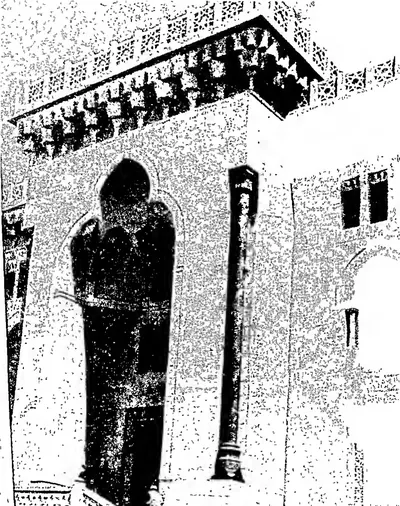 "Temple of Learning — Entrance to the Arts College, Osmania University" (Hyderabad Reborn, 1949, plate facing p. 41)Historic photograph · 1949
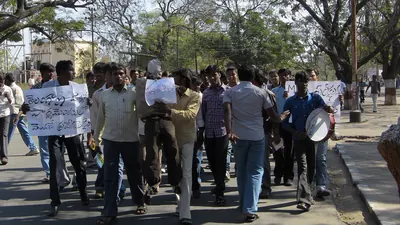 A students' rally at Osmania University, described on Commons as part of the Telangana agitation (2010–11)Photograph · 2011
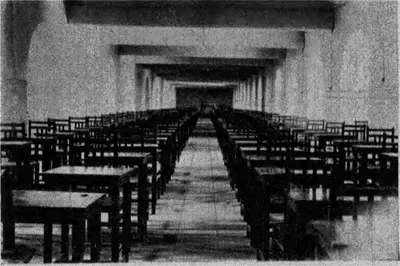 "Examination Hall (North Wing Basement Floor)", Osmania University (Osmania University Buildings Project report, 1934, Plate XV (PDF p. 57))Historic photograph · 1934
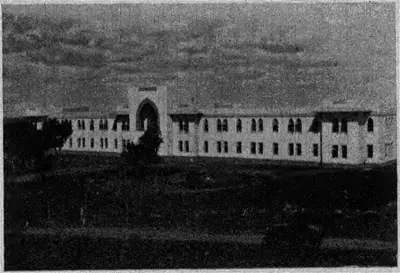 "Hostel A (Completed)", Osmania University (Osmania University Buildings Project report, 1934, Plate XVIII (PDF p. 65))Historic photograph · 1934
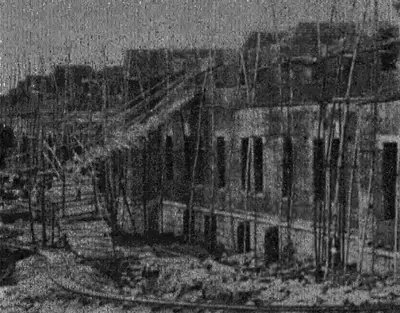 "Hostel A (Under Construction)", Osmania University (Osmania University Buildings Project report, 1934, Plate XVII (PDF p. 63))Historic photograph · 1934
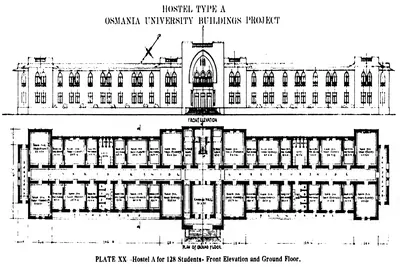 "Hostel A for 128 Students: Front Elevation and Ground Floor", Osmania University (Osmania University Buildings Project report, 1934, Plate XX (PDF p. 69))Plan · 1934
References
Notes (0)
Sources (7)
Spotted an error on this page? Tell us
Last updated: