C. P. Brown
Charles Philip Brown was an officer of the Madras Civil Service from 1817 to 1855 who spent his best years in the Telugu districts. He collected and corrected Telugu manuscripts, printed the verses of Vemana with an English translation in 1829, and wrote a Telugu grammar and large Telugu–English and English–Telugu dictionaries. He gave his collection of about 2,440 manuscripts to the Madras Literary Society.
Download
Charles Philip Brown was a British officer who gave most of his life to the Telugu language.12 He worked in the Madras Civil Service from 1817 to 1855, much of the time in the Telugu districts.12 He collected old Telugu books, corrected them and printed them. He also wrote a Telugu grammar and two large dictionaries.34
An officer in the Telugu districts
C. S. Srinivasachari wrote a survey of Brown’s work in 1938. According to him, Brown served in the Madras Civil Service from 1817 to 1855.1 He rose to be Postmaster General of the Madras Presidency.1 K. Purushotham, writing in 2020, gives his years as 1798–1884.5 After he went back to England he became Honorary Professor of Telugu in the University of London.1
William Taylor knew his work at first hand. In 1857 he wrote that Brown knew almost every language of India, but was “particularly attached” to Telugu.2 “The best years of his official life were passed in those districts where that dialect is current.”2
Collecting Vemana
Brown tells in his own preface how he came to the poet Vemana. In 1824 he looked for Telugu poems that were popular with the people and easy for a learner to read.6 He was then posted at Machilipatnam (then Masulipatam).6
The manuscripts he found were full of mistakes, and no two of them had the verses in the same order.6 So he gathered more copies from Visakhapatnam, Nellore, Guntur, Kadapa (then Cuddapah) and Madras.6 He compared nine copies side by side and found that about 2,500 verses came down to a little over 2,000.6 He printed the verses with an English translation in 1829.3
Grammar and dictionaries
Srinivasachari reprints a list of Brown’s works that Brown made himself.32 It includes:3
- a Telugu grammar, first printed in 1840 and later rewritten
- an English–Telugu dictionary of 1,400 pages
- a Telugu–English dictionary of 1,300 pages
- a dictionary of the mixed Telugu used in business
- a book on Telugu and Sanskrit prosody (the rules of metre), printed in 1827
- The Wars of the Rajas, a Telugu record of events in the Bellary district about 1750, with a translation3
Brown also printed the classic poems Manu Charitra and Vasu Charitra with a commentary in Telugu.7 He spent twenty years on a Telugu version of the Bible.7
His grammar had a hard beginning. In a note on his own copy, Brown wrote that he planned it in 1828 and finished it in England in 1837.8 The College at Madras rejected it in 1838, and he printed it in 1840.8
The dictionaries outlived him. His English–Telugu dictionary came out in four volumes at Madras in 1852.4 A revised edition of his Telugu–English dictionary was printed in 1895 and again in 1903. Its revisers included M. Venkataratnam, W. H. Campbell and Kandukuri Veeresalingam.4
Saving the manuscripts
Brown also looked after old manuscripts. Srinivasachari says he brought to light the manuscripts of the East India House Library in 1837, and had them moved to the Madras Literary Society in 1844.19 He then gave the Society his own library of about 2,440 manuscripts.9 More than half were Sanskrit works written in Telugu script, and most of the rest were in Telugu.9 He kept adding to the gift until he left for England in 1855.9
In a note written late in life, Brown claimed that he had found Telugu literature “dead” in 1825 and brought it back to life in thirty years.10
What later writers said
Taylor called him the first man who “applied himself to a thorough examination” of Telugu literature.2 He added that anyone who followed would do so “only by the light of those aids which he has left”.2 In 1928 Chenchiah and Bhujanga Rao wrote that the collections of Brown and Colin Mackenzie “deserve grateful recognition”.11
Where the sources disagree
Why Brown matters. Brown himself claimed that he alone raised Telugu literature from the dead.10 Srinivasachari reports the claim and leaves it to students of Telugu literature to judge, though the journal’s editor added a note that the claim is “justifiable”.10 Chenchiah and Bhujanga Rao give him a smaller place, naming him with Mackenzie, the Andhra Sahitya Parishat and the Government Oriental Library among those who recovered old books.11
Footnotes
-
C. S. Srinivasachari, “Charles Philip Brown: A Survey of his Services to South Indian History and Telugu Literature”, Journal of the Andhra Historical Research Society, Vol. XI (1937–38), p. 89 (archive.org (opens in a new tab)). Cite-only; paraphrased. ↩ ↩2 ↩3 ↩4 ↩5 ↩6
-
William Taylor, A Catalogue Raisonnée of Oriental Manuscripts in the Library of the (late) College, Fort Saint George, Vol. I (1857), p. xxiii (archive.org (opens in a new tab)). ↩ ↩2 ↩3 ↩4 ↩5 ↩6 ↩7
-
Srinivasachari, “Charles Philip Brown”, JAHRS XI (1937–38), p. 91, Brown’s list No. I (archive.org (opens in a new tab)). Cite-only; paraphrased. ↩ ↩2 ↩3 ↩4 ↩5
-
Srinivasachari, “Charles Philip Brown”, JAHRS XI (1937–38), p. 95 (archive.org (opens in a new tab)). Cite-only; paraphrased. ↩ ↩2 ↩3
-
K. Purushotham, “From Social Reform to Dandora: A Critical Perspective of Telugu Dalit Short Stories in Historical Outline”, Kakatiya Journal of Historical Studies, Vol. XV, No. 1 (2020), p. 1 (archive.org (opens in a new tab)). Cite-only; paraphrased. ↩
-
C. P. Brown (tr.), The Verses of Vemana (1911 reprint of the 1829 edition), preface, PDF p. 5 (archive.org (opens in a new tab)). ↩ ↩2 ↩3 ↩4 ↩5
-
Srinivasachari, “Charles Philip Brown”, JAHRS XI (1937–38), p. 92, Brown’s list No. II (archive.org (opens in a new tab)). Cite-only; paraphrased. ↩ ↩2
-
Srinivasachari, “Charles Philip Brown”, JAHRS XI (1937–38), p. 93 (archive.org (opens in a new tab)). Cite-only; paraphrased. ↩ ↩2
-
Srinivasachari, “Charles Philip Brown”, JAHRS XI (1937–38), p. 90 (archive.org (opens in a new tab)). Cite-only; paraphrased. ↩ ↩2 ↩3 ↩4
-
Srinivasachari, “Charles Philip Brown”, JAHRS XI (1937–38), p. 98, with the editor’s footnote (archive.org (opens in a new tab)). Cite-only; paraphrased. ↩ ↩2 ↩3
-
P. Chenchiah and Raja M. Bhujanga Rao, A History of Telugu Literature (1928), p. 110 (archive.org (opens in a new tab)). ↩ ↩2
Photos
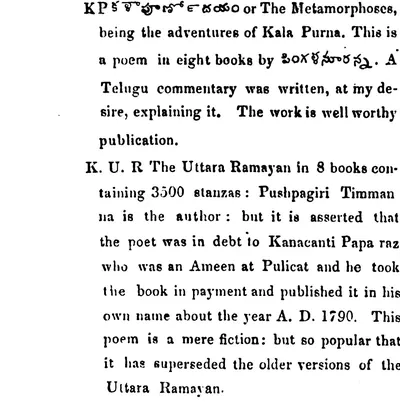 C. P. Brown on the Kalapurnodayamu and on the Uttara Ramayanamu of "Kanacanti Papa raz" (Telugu dictionary, 1852, p. x)Book plate · 1852
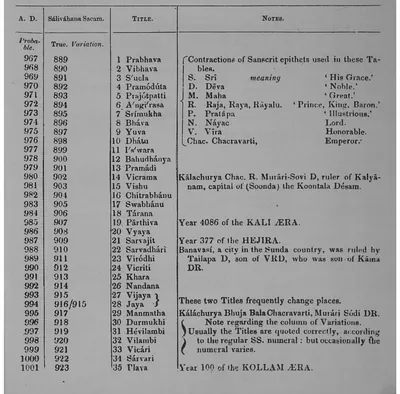 C. P. Brown's Cyclic Tables (1850), p. 1: A.D. 967 to 1001, Saka 889 to 923, cycle years 1 Prabhava to 35 PlavaBook plate · 1850
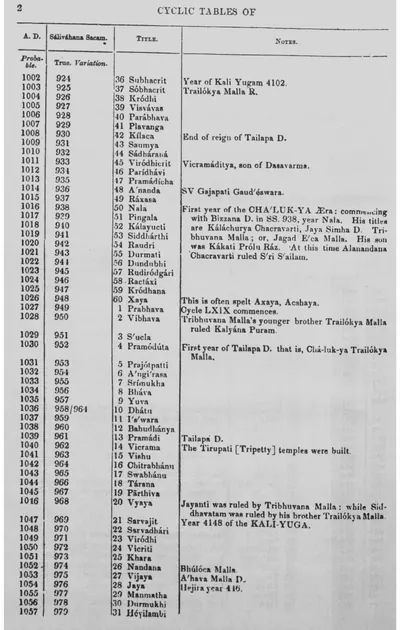 Second page of C. P. Brown's Cyclic Tables (1850): A.D. 1002 to 1057, Saka 924 to 979, cycle years 36 Subhacrit to 60 Xaya and 1 Prabhava to 31 HevilambiBook plate · 1850
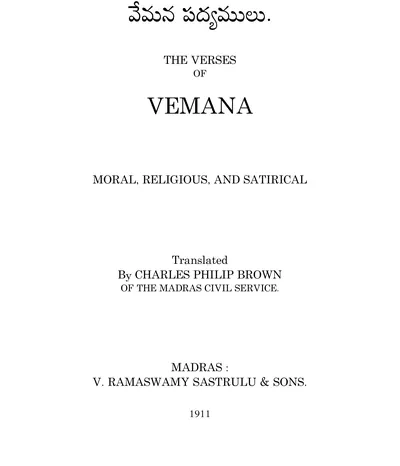 Title page of C. P. Brown's "The Verses of Vemana" (1911 reprint of the 1829 edition)Book plate · 1911
References
Notes (0)
Sources (5)
Spotted an error on this page? Tell us
Last updated: