Farrukhsiyar
Farrukhsiyar was the Mughal emperor from 1713 to 1719. Early in his reign he gave Nizam-ul-Mulk control of the six provinces of the Deccan, and Mubariz Khan soon became governor of Hyderabad. Coins of his reign were struck at Telugu-country mints: small gold coins in the southern style at Adoni and Gooty, and gold mohurs at Srikakulam. Muhammad Burhanuddin's history says that he recognised Ibrahim Khan Panni as the rightful holder of Kurnool after 1715.
Download
Farrukhsiyar was the Mughal emperor from 1713 to 1719.1 In his reign the Telugu country was ruled for the empire through the Mughal province (subah) of Hyderabad.23 Coins struck in his name at Adoni, Gooty and Srikakulam show the reach of Mughal rule there.45 See Mughals in the Telugu country.
The Deccan appointments of 1713
When Farrukhsiyar came to the throne, he made new arrangements for the six provinces of the Deccan.6 He gave their supreme control to Chin Qilich Khan, with the title Nizam-ul-Mulk, and fixed his headquarters at Aurangabad.6 Saadatullah Khan was made deputy in the two Karnatak provinces.2 Hyderabad was to stay for the time under its governor, Yusuf Khan.2 See Nizam-ul-Mulk.
Mubariz Khan, who had governed Gujarat, was soon moved to Hyderabad.3 By William Irvine’s reckoning he governed it for nearly twelve years.3 Syed Ali Asgar Bilgrami wrote that the city wall of Hyderabad was built in the last days of Mubariz Khan’s governorship, “during the reign of the Moghal King Farrukh-Siyar”.7
Kurnool
In 1715 Daud Khan Panni, the holder of the Kurnool jagir (land grant), was killed in battle.89 Muhammad Burhanuddin’s history (1905) says that Farrukhsiyar was saddened by the news.8 Daud Khan’s brother Ibrahim Khan then took the fort of Kurnool from the emperor’s commander by a trick.89 The Kurnool manual says that he hid soldiers in palanquins sent in as his women’s party.9
Ibrahim wrote to Mubariz Khan, governor of Hyderabad, for the usual robes of honour, and an imperial sanad (deed of grant) was sent to him.89 Burhanuddin adds that Farrukhsiyar declared him “the rightful successor” to Kurnool.8
Coins of the Telugu country
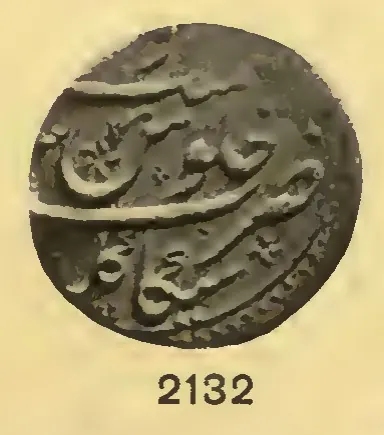
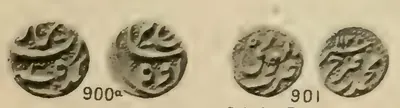
Stanley Lane-Poole noted a new feature of Farrukhsiyar’s coinage: a very small gold coin, “resembling that of southern India”.4 It was struck at Imtiyazgarh, the Mughal name for Adoni, and at Gooty.4 Arcot also appears as a mint for the first time under him.4
R. B. Whitehead recorded gold mohurs of Farrukhsiyar from the mint of Sikakul.5 He identified it with Chicacole, now Srikakulam, the capital of the Mughal sarkar (district) of that name.5 Irvine counted eight coins of the reign from the mints of the Hyderabad province: three from Arcot, one from Adoni, three from Chinapatan and one from Gooty.10
Where the sources disagree
- The Kurnool commander. Burhanuddin calls him Idris Khan; the Kurnool manual calls him Iras Khan.89
- The Hyderabad wall. Bilgrami places it in Farrukhsiyar’s reign, “in the last days of the Subadarship of Mubariz Khan”.7 Mubariz Khan’s governorship ended in 1724, five years after Farrukhsiyar’s reign.31
Footnotes
-
Stanley Lane-Poole, The Coins of the Moghul Emperors of Hindustan in the British Museum (1892), pp. xlvii–xlix, table of mint cities (archive.org (opens in a new tab)). ↩ ↩2
-
Irvine, Later Mughals, Vol. I (1922), p. 263 (archive.org (opens in a new tab)). ↩ ↩2 ↩3
-
Irvine, Later Mughals, Vol. II (1922), p. 138 (archive.org (opens in a new tab)). ↩ ↩2 ↩3 ↩4
-
Lane-Poole, Coins of the Moghul Emperors (1892), p. lviii (archive.org (opens in a new tab)). ↩ ↩2 ↩3 ↩4
-
R. B. Whitehead, Catalogue of Coins in the Panjab Museum, Lahore, Vol. II (1914), p. lxxxvi (archive.org (opens in a new tab)). ↩ ↩2 ↩3
-
William Irvine, ed. Jadunath Sarkar, Later Mughals, Vol. I (1922), p. 262 (archive.org (opens in a new tab)). ↩ ↩2
-
Syed Ali Asgar Bilgrami, Landmarks of the Deccan (1927), pp. 94–95 (archive.org (opens in a new tab)). ↩ ↩2
-
Muhammad Burhanuddin Siddiqui, The Carnatic & Kurnool, their Last Muhammedan Rulers (1905), p. 60 (archive.org (opens in a new tab)). Paraphrased except for the short phrase quoted. ↩ ↩2 ↩3 ↩4 ↩5 ↩6
-
Narahari Gopalakristnamah Chetty, A Manual of the Kurnool District (1886), p. 30 and note (archive.org (opens in a new tab)). ↩ ↩2 ↩3 ↩4 ↩5
-
Irvine, Later Mughals, Vol. I (1922), p. 400 (archive.org (opens in a new tab)). ↩
Photos
References
Notes (0)
Sources (7)
Spotted an error on this page? Tell us
Last updated: