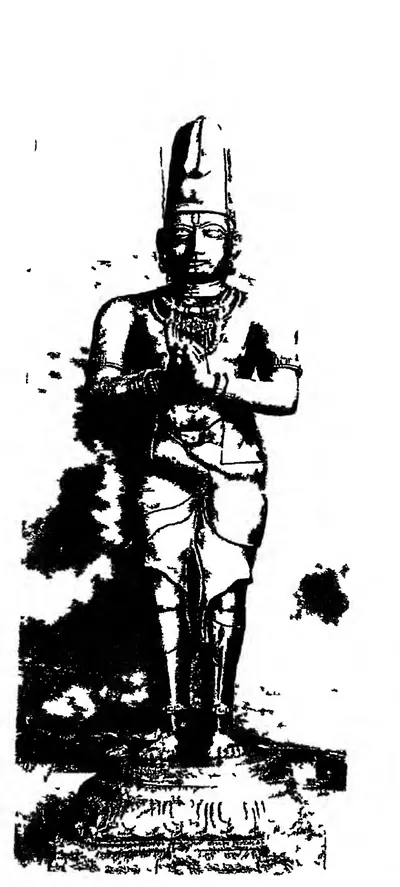
Harihara II (Vijayanagara)
Harihara II, son of Bukka I, ruled Vijayanagara from 1377 to 1404 and was the first of its kings to take imperial titles. His sons governed its provinces, and Deva Raya held Udayagiri in the Nellore country for him. In his reign the empire took Kurnool, Nellore and part of Guntur from the Reddis of Kondavidu. A raid across the Krishna in 1398 ended in defeat by the Bahmani sultan Firuz Shah and a heavy ransom. The sources give different years for his reign.
Download
Harihara II was king of Vijayanagara from 1377 to 1404. He was a son of Bukka I, one of the brothers who founded the empire.123 He was the first king of the line to give himself imperial titles, as Maharajadhiraja (king of great kings).1 S. Krishnaswami Aiyangar wrote that Harihara II “reaped the fruits” of the founders’ work, so that with him the kingdom “may be said to begin”.3
In his reign Vijayanagara pushed into the Telugu country, at the cost of the Reddi kings of Kondavidu.4 His reign also saw the first long war with Firuz Shah, the Bahmani sultan.5 See Vijayanagara and Bukka I.
Family
Sewell wrote that Bukka I was succeeded by Harihara II, his son by his wife Gauri.1 The king’s wife, or one of his chief wives, was Malladevi, also called Mallambika.6 The Portuguese writer Fernao Nuniz calls him “Pureoyre Deorao”.7 He says that this king struck gold coins (pardaos) that were still known by his name, and that kings’ names were given to coins from then on.7
Nilakanta Sastri wrote that Harihara made his own sons, in place of his cousins, the governors of provinces.4 In his view, this was to check the ambitions of more distant relatives.4 Sewell’s list of inscriptions shows three sons governing for him: Bukka II, Deva Raya I and Virupaksha.89
Prince Virupaksha wrote a Sanskrit play, the Narayanivilasam.10 In it he calls himself governor of the Karnata, Tundira, Chola and Pandya lands, and claims a pillar of victory in Sri Lanka (then Ceylon).10
Ministers, poets and traders
Sewell thought that Sayana, the brother of Madhavacharya, was his chief minister.1 A pillar in a Jain temple near Kamalapura bears the name of his general Iruga, in an inscription of 1385.1 Sewell took this as proof that the king was tolerant in religion.1 Another Jain general, Irugapa Dandanatha, wrote a Sanskrit book of words, the Nanartharatnamala.11 Its opening says that Harihara II “was delighted to let the burden of Empire rest on Irugapa”.11
The scholar Chennubhatta says in his commentary on the Tarkabhasha that Harihara II was his patron.12 Srinatha’s Telugu poem Haravilasam, as Krishnaswami Aiyangar summarised it, names a merchant of Nellore, Avachi Tippayya Setti.13 Tippayya traded overseas in his own ships, bringing horses from Ormuz and elephants from Sri Lanka.13 He held the sole right to supply goods to the courts of Harihara II, of Firuz Shah and of Kumaragiri Reddi of Kondavidu.13
The Telugu frontier
The empire was wide. Sewell found inscriptions of Harihara II in Mysore, Dharwar, Kanchipuram (then Conjeeveram), Chingleput and Trichinopoly.6 He worshipped Siva as Virupaksha.6 His first records, of 1377, include one in the Nellore district.2
Udayagiri, in the Nellore country, was the seat of a province.14 The 1961 Nellore district handbook says that in 1382 the king’s son, the later Deva Raya I, governed Udayagiri for him.14 In 1386 Harihara II built the Siddheswara temple at Udayagiri, with a holy tank for people to bathe in.14 Sewell’s list shows Deva Raya at Udayagiri and in the Kadapa (then Cuddapah) district in 1396, and in the Guntur district in 1399.159
Nilakanta Sastri says that in 1382–85 Vijayanagara took from the Reddis of Kondavidu their lands in Kurnool, Nellore and part of Guntur.4 N. Ramesan tells of a war with Kumaragiri Reddi.16 In his account Harihara’s army took the strong fort of Tripurantakam and went on to Vinukonda.16 Kumaragiri sent his brother-in-law Kataya Vema against it, and Kataya Vema won.16 A treaty followed, and Harihara gave his daughter Hariharamba to Kataya Vema in marriage.16
The empire gained in other places too. In 1380, according to a copper-plate grant in Sewell’s list, the king’s nephew Channappa took the fort of Adoni from the Muslims.8 He gave it to the king and was made its governor.8 Nilakanta Sastri adds that Prince Bukka II led two campaigns into the Warangal country before the end of 1390, without a clear result.4 He says Pangal was taken about seven years later, but was soon lost.4
War with Firuz Shah
For about twenty years Vijayanagara and the Bahmani sultans were at peace.17 Wolseley Haig wrote that Harihara II broke this peace in 1398, when he invaded the Raichur doab (the land between the Krishna and the Tungabhadra).5 Firuz Shah advanced to the Krishna, but Harihara’s huge army held its southern bank.5
So a Bahmani officer, Qazi Siraj-ud-din, crossed the river with a band of men dressed as wandering performers.1819 They were called to perform before Harihara’s son, and in the middle of a sword dance they killed him.1819 In the confusion that night, Firuz Shah’s army crossed the river and attacked the camp at dawn.19 The king fled to Vijayanagar, carrying his son’s body.19
Firuz’s troops then plundered the land south of the city and carried off many captives, among them 10,000 Brahmans.19 The leading Brahmans of the city pressed for peace, and Vijayanagara paid a ransom of about £330,000.19 Sewell dates the treaty to a few months before September 1399. It left the borders as they had been before the war.20
Haig adds that Harihara later held back the tribute he had paid since this war.21 He did so because the rulers of Gujarat, Malwa and Khandesh had promised to help him against Firuz.21
Death and the fight for the throne
Sewell’s later work dates Harihara’s death to 16 August 1404.22 The date comes from an inscription that records a village granted soon after his death.22 A hall that he had ordered at Srisailam was finished after his death.22
His sons then fought over the throne.2223 Sewell read the records to mean that Bukka II was king for a short time, that Virupaksha pushed him out, and that Bukka II took the throne back before July 1405.24 See Bukka II and Deva Raya I.
Where the sources disagree
- His reign. Sewell (1900) gives 1379 to the end of 1399.620 Sewell’s later work (1932) has his first records in 1377 and his death on 16 August 1404.222 Nilakanta Sastri also dates his death to August 1404.23
- Who led the war of 1398. Haig says Harihara II invaded the doab himself and left the fighting to his son.519 Sewell thought the old king left the whole raid to his son Bukka.2517
- Who was killed in camp. Haig says it was Harihara’s son.18 Sewell, following Ferishta, says it was the son of Bukka, Harihara’s eldest son.172627
Footnotes
-
Robert Sewell, A Forgotten Empire (Vijayanagar) (1900), p. 48 (archive.org (opens in a new tab)). ↩ ↩2 ↩3 ↩4 ↩5 ↩6
-
Robert Sewell, ed. S. Krishnaswami Aiyangar, The Historical Inscriptions of Southern India (1932), p. 201 (archive.org (opens in a new tab)). ↩ ↩2 ↩3
-
S. Krishnaswami Aiyangar, “Hindu States in Southern India”, in Wolseley Haig (ed.), The Cambridge History of India, Vol. III (1928), p. 491 (archive.org (opens in a new tab)). ↩ ↩2
-
K. A. Nilakanta Sastri, A History of South India from Prehistoric Times to the Fall of Vijayanagar, 3rd ed. (1966), p. 267 (archive.org (opens in a new tab)). Paraphrased. ↩ ↩2 ↩3 ↩4 ↩5 ↩6
-
Wolseley Haig, “The Kingdom of the Deccan”, in Wolseley Haig (ed.), The Cambridge History of India, Vol. III (1928), p. 387 (archive.org (opens in a new tab)). ↩ ↩2 ↩3 ↩4
-
Sewell, A Forgotten Empire (1900), p. 49 (archive.org (opens in a new tab)). ↩ ↩2 ↩3 ↩4
-
Fernao Nuniz, “Chronicle”, in Sewell, A Forgotten Empire (1900), p. 301 and note (archive.org (opens in a new tab)). ↩ ↩2
-
Sewell, Historical Inscriptions (1932), p. 202 (archive.org (opens in a new tab)). ↩ ↩2 ↩3
-
Sewell, Historical Inscriptions (1932), p. 206 (archive.org (opens in a new tab)). ↩ ↩2
-
Krishnaswami Aiyangar, Sources of Vijayanagar History (1919), p. 53, extract 15, the Narayanivilasam of Prince Virupaksha (archive.org (opens in a new tab)). ↩ ↩2
-
Krishnaswami Aiyangar, Sources of Vijayanagar History (1919), p. 52, extract 14, the Nanartharatnamala of Irugapa Dandanatha (archive.org (opens in a new tab)). ↩ ↩2
-
Krishnaswami Aiyangar, Sources of Vijayanagar History (1919), p. 51, extract 12, the colophon of Chennubhatta’s Tarkabhasha Vyakhya (archive.org (opens in a new tab)). ↩
-
S. Krishnaswami Aiyangar (ed.), Sources of Vijayanagar History (1919), introduction, p. 4 (archive.org (opens in a new tab)). ↩ ↩2 ↩3
-
A. Chandra Sekhar, Census of India 1961, Andhra Pradesh: District Census Handbook, Nellore District (1967), p. xii (PDF p. 28) (censusindia.gov.in (opens in a new tab)). Cite-only; paraphrased. ↩ ↩2 ↩3
-
Sewell, Historical Inscriptions (1932), p. 205 (archive.org (opens in a new tab)). ↩
-
N. Ramesan, Copper Plate Inscriptions of Andhra Pradesh Government Museum, Hyderabad, Vol. I (1962), p. 168 (archive.org (opens in a new tab)). Paraphrased. ↩ ↩2 ↩3 ↩4
-
Sewell, A Forgotten Empire (1900), p. 51 (archive.org (opens in a new tab)). ↩ ↩2 ↩3
-
Haig, Cambridge History of India, Vol. III (1928), p. 388 (archive.org (opens in a new tab)). ↩ ↩2 ↩3
-
Haig, Cambridge History of India, Vol. III (1928), p. 389 (archive.org (opens in a new tab)). ↩ ↩2 ↩3 ↩4 ↩5 ↩6 ↩7
-
Sewell, A Forgotten Empire (1900), p. 55 (archive.org (opens in a new tab)). ↩ ↩2
-
Haig, Cambridge History of India, Vol. III (1928), p. 391 (archive.org (opens in a new tab)). ↩ ↩2
-
Sewell, Historical Inscriptions (1932), p. 207 and note (archive.org (opens in a new tab)). ↩ ↩2 ↩3 ↩4 ↩5
-
Nilakanta Sastri, A History of South India, 3rd ed. (1966), p. 268 (archive.org (opens in a new tab)). Paraphrased. ↩ ↩2
-
Sewell, Historical Inscriptions (1932), p. 208 (archive.org (opens in a new tab)). ↩
-
Sewell, A Forgotten Empire (1900), p. 50 (archive.org (opens in a new tab)). ↩
-
Sewell, A Forgotten Empire (1900), p. 52 (archive.org (opens in a new tab)). ↩
-
Sewell, A Forgotten Empire (1900), p. 54, quoting Ferishta (archive.org (opens in a new tab)). ↩
Related
Dynasties
References
Notes (0)
Sources (7)
Spotted an error on this page? Tell us
Last updated: