Muhammad Shah III
Bahmani sultan (1463–1482) who came to the throne as a boy. He brought Rajahmundry, Kondapalli and the Krishna–Godavari coast under Bahmani rule, and spent three years settling Telangana. In 1481 he had his great minister Mahmud Gawan executed because of a forged letter, a deed the sources blame for the break-up of the kingdom.
Muhammad Shah III was the thirteenth king of the Bahmani dynasty. In his reign Bahmani power reached the Krishna–Godavari coast and its widest extent in the Telugu country. His reign also saw the killing of his minister, Mahmud Gawan, which every account in the library treats as the turning point in the dynasty’s decline. Ferishta and his translator John Briggs call him “Mahomed Shah II”, because Ferishta called the earlier Muhammad Shah II (1378–1397) Mahmud. The Imperial Gazetteer calls that a mistake.123
Coming to the throne as a child
He was a son of Humayun Shah, “the Cruel”, and succeeded his brother Nizam Shah, who died in July 1463.4 Ferishta says he came to the throne “in his ninth year”.41 His mother and two regents, Khwaja Jahan and Mahmud Gawan, ran the government.41
He was educated under Khwaja Jahan’s care.5 Ferishta ranks him as the most learned Bahmani king after Firuz.5 In time Khwaja Jahan took control of the state and kept his colleague busy on the frontiers. The queen mother then urged her son to act.56 In the boy’s presence Nizam-ul-Mulk Turk cut Khwaja Jahan down.56 Mahmud Gawan then received his title and his office.56 At fourteen the king married and took charge of affairs.56
Conquest of the coast
In AH 876 (1471–72; AH is the Islamic way of counting years) a cousin of the late king of Orissa asked for help against a rival who had seized the throne.789 Ferishta calls this cousin Ambur Ray, and Haig calls him Hambar.789 Ferishta says Muhammad Shah “had a great desire to possess” Rajahmundry and Kondapalli.789 On Mahmud Gawan’s advice he sent Malik Hasan, newly titled Nizam-ul-Mulk.789 Malik Hasan restored the claimant and then took both places, and he was made governor of all Telingana.789
The Godavari District Gazetteer tells the story differently.10 In its account the Gajapati king Purushottama asked for help against a rival and paid for it with the two districts.10
Then came a two-year famine, in which Ferishta says no grain was sown in Telingana or Maharashtra.1112 After it the garrison at Kondapalli mutinied.1112 It killed its governor and called in the king of Orissa, who besieged Nizam-ul-Mulk in Rajahmundry.1112
Muhammad Shah marched in person, and when the Orissa army withdrew he followed it.1314 Late in AH 882 (1478) he raided the Orissa country until its king gave up twenty-five prized elephants.1314
On his return he besieged Kondapalli for six months; see Kondapalli Fort.15 When it surrendered he broke down its temple and killed some of its Brahman priests with his own hands.15 He built a mosque on the site and took the title Ghazi (warrior for the faith).15
Ferishta reports the belief of the Deccan about this act, the first killing of a Brahman by a king of his line.1516 People held that it was inauspicious and brought on the dynasty’s troubles.1516 Gribble calls it an act regarded at the time as sacrilege.1516 Haig places both the revolt and the siege at Kondavidu rather than Kondapalli.171819 He does so in his Cambridge History as in his earlier book.171819
The Burhan-i Ma’asir’s account
The Burhan-i Ma’asir, the other main history of the dynasty, tells the coastal wars differently.20 It says that news came from Telingana that “the Raya of Orisa, who was the principal raya of Telingana, was dead”.20 Nizam-ul-Mulk Bahri offered to make the conquest.20 He defeated the Orissan army and took “Rajamundari” and the mountain fort of “Kondavir”.20
Some years later, after a famine, the Raya of Orissa invaded again and Nizam-ul-Mulk fell back.2122 When the king reached Rajahmundry he found a Raya called Narsinha dug in beyond the river with a vast army.2122 Narsinha fled without fighting, and the fort then surrendered and was given back to Nizam-ul-Mulk.2122
In Ramazan AH 885 (November 1480), it says, the people of Kondavir rebelled and put themselves under Narsinha.2324 When the king besieged the fort they surrendered.2324 They said that the king’s ministers had set “disreputable, tyrannical oppressors” over them.2324 He pardoned them and gave the fort to Nizam-ul-Mulk.2324
It says nothing of a temple or of Brahmans killed, but it dates the sack of Kanchi to 11 Muharram AH 886, which King converts to 12 March 1481.25
Settling Telangana
On Mahmud Gawan’s advice the king stayed nearly three years at Rajahmundry.15 He drove out the zamindars (local chiefs) who resisted him and set up military posts.15 He then divided the province.26 Nizam-ul-Mulk kept Rajahmundry and Kondapalli, while Warangal and its districts went to Azim Khan.26 Haig traces the later quarrel between Nizam-ul-Mulk and Mahmud Gawan to this division.27
The king next marched south against the land of a raja whom Ferishta calls Nursing Ray.2829 Haig thought he was probably a governor of the Vijayanagara kings, or the descendant of one, who had grown strong at their expense.19 He took Machilipatnam (then Masulipatam).2829 Then, with a small force of horsemen, he rode to Kanchipuram and sacked its temple and town.2829
Mahmud Gawan’s execution
On the minister’s advice the kingdom’s four provinces were now divided into eight, and Telingana into the governments of Rajahmundry and Warangal.30 Haig says the plan was completed at Kondapalli.30 Provincial governors lost control of their forts, and the muster of troops was made stricter.3132
Nobles who disliked these rules plotted with Nizam-ul-Mulk.3334 They got Mahmud Gawan’s seal from a drunken slave and wrote above it a treasonable letter to the king of Orissa.3334 Muhammad Shah, himself drunk according to Ferishta, would not hear the minister’s denial.3334 He had him executed on the spot, on 5 April 1481 (Briggs) or 6 April (Haig).3334
The Burhan-i Ma’asir says instead that the letter was addressed to Narsinha Raya.2435 It also says that the complaints of the people of Kondavir had already turned the king against his minister.2435 The full story is on the Mahmud Gawan page.
Last year and death
Ferishta says that when no bearer of the letter could be found, the king saw that he had been deceived.36 The governors of Berar left his camp, and his leading nobles would come near him only at a distance and under guard.36
He made Nizam-ul-Mulk his minister, named his young son Mahmud as heir, and sank into drink.37382 He died on 1 Safar AH 887.37382 Briggs converts this to 24 March 1482, and Sewell gives it as 21 March.37382 Ferishta says that in his last fit he cried out that Mahmud Gawan was tearing him to pieces.37382
By Gribble’s reckoning he was in his twenty-ninth year.39 Under his son the provincial governors made themselves independent.4034 One of them, Sultan Quli, founded the Qutb Shahi kingdom of Golconda.4034
Coins
Wright’s catalogue of 1907 has a gold coin of the king struck at Muhammadabad (Bidar) in AH 878 (1473–74), and a silver coin of the same type.41 Codrington lists these coins:42
- gold dated AH 873 and 87742
- silver of Ahsanabad of AH 877 to 88042
- copper of most years from AH 868 to 88242
Footnotes
-
Muhammad Qasim Ferishta, tr. John Briggs, History of the Rise of the Mahomedan Power in India, Vol. II (1829), p. 477 (archive.org (opens in a new tab)). ↩ ↩2 ↩3
-
Robert Sewell, The Historical Inscriptions of Southern India (1932), p. 327 (archive.org (opens in a new tab)). ↩ ↩2 ↩3 ↩4 ↩5
-
Imperial Gazetteer of India: Hyderabad State (1909), p. 12, note (archive.org (opens in a new tab)). ↩
-
Ferishta, tr. Briggs, Vol. II (1829), p. 476 (archive.org (opens in a new tab)). ↩ ↩2 ↩3
-
Ferishta, tr. Briggs, Vol. II (1829), p. 478 (archive.org (opens in a new tab)). ↩ ↩2 ↩3 ↩4 ↩5 ↩6
-
Ferishta, tr. Briggs, Vol. II (1829), p. 479 (archive.org (opens in a new tab)). ↩ ↩2 ↩3 ↩4
-
Ferishta, tr. Briggs, Vol. II (1829), p. 487 (archive.org (opens in a new tab)). ↩ ↩2 ↩3 ↩4 ↩5
-
Ferishta, tr. Briggs, Vol. II (1829), p. 488 (archive.org (opens in a new tab)). ↩ ↩2 ↩3 ↩4 ↩5
-
T. W. Haig, Historic Landmarks of the Deccan (1907), p. 81 (archive.org (opens in a new tab)). ↩ ↩2 ↩3 ↩4 ↩5
-
F. R. Hemingway, Madras District Gazetteers: Godavari, Vol. I (1907), p. 26 (archive.org (opens in a new tab)). ↩ ↩2
-
Ferishta, tr. Briggs, Vol. II (1829), pp. 493–494 (archive.org (opens in a new tab)). ↩ ↩2 ↩3
-
Ferishta, tr. Briggs, Vol. II (1829), p. 495 (archive.org (opens in a new tab)). ↩ ↩2 ↩3
-
Ferishta, tr. Briggs, Vol. II (1829), pp. 495–496 (archive.org (opens in a new tab)). ↩ ↩2
-
Hemingway, Godavari (1907), p. 27 (archive.org (opens in a new tab)). ↩ ↩2
-
Ferishta, tr. Briggs, Vol. II (1829), pp. 496–497 (archive.org (opens in a new tab)). ↩ ↩2 ↩3 ↩4 ↩5 ↩6 ↩7 ↩8
-
J. D. B. Gribble, A History of the Deccan, Vol. I (1896), p. 122 (archive.org (opens in a new tab)). ↩ ↩2 ↩3
-
Haig, Historic Landmarks (1907), pp. 81–82 (archive.org (opens in a new tab)). ↩ ↩2
-
Wolseley Haig (ed.), The Cambridge History of India, Vol. III (1928), p. 417 (archive.org (opens in a new tab)). ↩ ↩2
-
Haig, Cambridge History of India, Vol. III (1928), p. 418 (archive.org (opens in a new tab)). ↩ ↩2 ↩3
-
J. S. King, The History of the Bahmani Dynasty, founded on the Burhan-i Ma’asir (1900), p. 104 (archive.org (opens in a new tab)). ↩ ↩2 ↩3 ↩4
-
King, History of the Bahmani Dynasty (1900), p. 108 (archive.org (opens in a new tab)). ↩ ↩2 ↩3
-
King, History of the Bahmani Dynasty (1900), p. 109 (archive.org (opens in a new tab)). ↩ ↩2 ↩3
-
King, History of the Bahmani Dynasty (1900), p. 110 (archive.org (opens in a new tab)). ↩ ↩2 ↩3 ↩4
-
King, History of the Bahmani Dynasty (1900), p. 111 (archive.org (opens in a new tab)). ↩ ↩2 ↩3 ↩4 ↩5 ↩6
-
King, History of the Bahmani Dynasty (1900), p. 112 (archive.org (opens in a new tab)). ↩
-
Ferishta, tr. Briggs, Vol. II (1829), p. 498 (archive.org (opens in a new tab)). ↩ ↩2
-
Haig, Historic Landmarks (1907), p. 82 (archive.org (opens in a new tab)). ↩
-
Ferishta, tr. Briggs, Vol. II (1829), pp. 498–501 (archive.org (opens in a new tab)). ↩ ↩2 ↩3
-
Ferishta, tr. Briggs, Vol. II (1829), p. 501 (archive.org (opens in a new tab)). ↩ ↩2 ↩3
-
Haig, Cambridge History of India, Vol. III (1928), p. 419 (archive.org (opens in a new tab)). ↩ ↩2
-
Ferishta, tr. Briggs, Vol. II (1829), pp. 502–505 (archive.org (opens in a new tab)). ↩
-
Haig, Historic Landmarks (1907), p. 83 (archive.org (opens in a new tab)). ↩
-
Ferishta, tr. Briggs, Vol. II (1829), pp. 505–509 (archive.org (opens in a new tab)). ↩ ↩2 ↩3 ↩4
-
Haig, Historic Landmarks (1907), p. 84 (archive.org (opens in a new tab)). ↩ ↩2 ↩3 ↩4 ↩5 ↩6
-
King, History of the Bahmani Dynasty (1900), p. 113 (archive.org (opens in a new tab)). ↩ ↩2
-
Ferishta, tr. Briggs, Vol. II (1829), pp. 514–516 (archive.org (opens in a new tab)). ↩ ↩2
-
Ferishta, tr. Briggs, Vol. II (1829), p. 517 (archive.org (opens in a new tab)). ↩ ↩2 ↩3 ↩4
-
Ferishta, tr. Briggs, Vol. II (1829), p. 518 (archive.org (opens in a new tab)). ↩ ↩2 ↩3 ↩4
-
Gribble, History of the Deccan (1896), p. 127 (archive.org (opens in a new tab)). ↩
-
Imperial Gazetteer: Hyderabad (1909), p. 13 (archive.org (opens in a new tab)). ↩ ↩2
-
H. Nelson Wright, Catalogue of the Coins in the Indian Museum, Calcutta, Vol. II (1907), p. 204 (archive.org (opens in a new tab)). ↩
-
O. Codrington, “On the Coins of the Bahmani Dynasty”, Numismatic Chronicle, 3rd series, XVIII (1898), p. 270 (archive.org (opens in a new tab)). ↩ ↩2 ↩3 ↩4
Photos
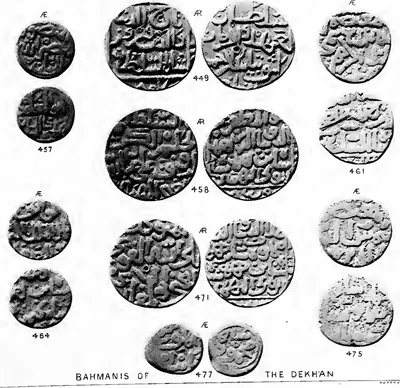 "Bahmanis of the Dekhan": coins of the Bahmani kings in the British Museum (Stanley Lane-Poole, The Coins of the Muhammadan States of India (1885), Plate XI, lower part)Coin · 1885
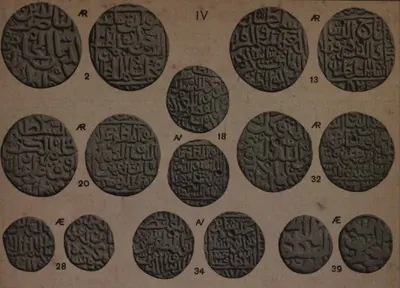 "IV. Bahmanis of Kulbarga": coins of the Bahmani kings in the Indian Museum, Calcutta (H. Nelson Wright, Catalogue of the Coins in the Indian Museum, Vol. II (1907), Plate VIII, upper part)Coin · 1907
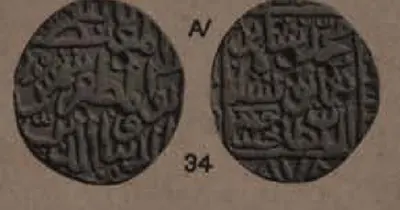 Gold coin of Muhammad Shah III Bahmani struck at Muhammadabad (Bidar), AH 878 (1473-74), obverse and reverse (Wright, Coins in the Indian Museum, Vol. II (1907), Plate VIII, No. 34)Coin · 1907
References
Notes (0)
Sources (10)
Spotted an error on this page? Tell us
Last updated: