Narasimha IV (Eastern Ganga)
Narasimha IV was the last Eastern Ganga king known from his own records, ruling Kalinga and Orissa from about 1378. His Puri copper plates of 1384 and 1395 give the whole family tree of the dynasty, and R. D. Banerji called their Oriya passages the earliest known specimens of the Oriya language. Gifts at Srikurmam and Simhachalam are dated in his reign, and a Reddi king also made a gift at Simhachalam in 1386. Banerji found Srikurmam records naming him as king until 1424–25.
Download
Narasimha IV was a king of the Eastern Gangas, who ruled Kalinga and Orissa from about 1378.12 R. D. Banerji called him “the last known king” of the dynasty.1 In his long reign Orissa was raided again and again, and in the Telugu south the Reddis reached as far as Simhachalam.34
Family
Banerji, in his History of Orissa (1930), made Narasimha IV the son of Bhanudeva III by queen Hiradevi, of the Chalukya family.1 Robert Sewell’s table (1932) names his queen as Parvati.2 A gift of gold at Simhachalam in Saka 1323, about 1401, was made by Parvatidevi, queen of Pratapavira-Narasimhadeva (Saka is an Indian way of counting years).5
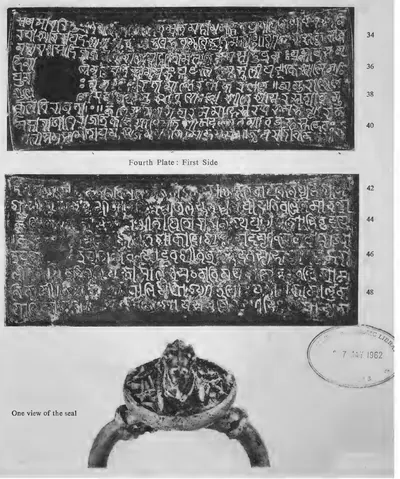
The Puri plates
Two copper-plate grants of Narasimha IV were found in the town of Puri.1 Between them they give the whole genealogy of the Eastern Gangas, from the Moon down to Narasimha IV.1 Both were issued from Varanasi-Kataka, that is Cuttack:16
- the first, of Saka 1305, his 8th anka (counted regnal year), grants the village of Kinari, and is dated 6 March 13841
- the second, of Saka 1316, his 22nd anka, grants land, and its dates run from 23 November 1395 to 24 February 139716
The plates name many officers, such as the commander-in-chief and the writers of accounts.67 Banerji noted that the parts about the donee and the land are written in the local language.7 He called them “the earliest known specimens of the Oriya language”.7 See the lesson Kalinga script and Odia.
Gifts in the Telugu north
V. Rangacharya’s lists show gifts of his reign in the two great temples of the Telugu north:
- at Srikurmam, a lamp in Saka 1301, the third year of Vira-Narasimhadeva8
- at Srikurmam, an image holding a lamp in Saka 1302, his fourth year8
- at Simhachalam, a gift of land by Pratapavira-Narasimhadeva himself in Saka 1301, about 13795
- at Simhachalam, a gift of gold by Vira-Narasimhadeva in Saka 13029
The Vizagapatam gazetteer of 1907 noted that the Reddi kings of Kondavidu “penetrated to Simhachalam”, where an inscription of one of them is dated 1385–86.4 Rangacharya listed a gift there in Saka 1308, about 1386, by the Reddi king Katamareddi-Vemireddi.10 See the Reddis of Kondavidu.
Raids and the end of the dynasty
Banerji listed the raids of his reign.3 Malik-ush-Sharq of Jaunpur is said to have forced the king to pay tribute between 1393 and 1399.3 The Bahmani sultan Firoz Shah invaded Orissa in 1412 and carried off elephants.3 In 1422 Hoshang of Malwa is said to have captured a king and released him for elephants, but Banerji was not sure that this happened in Orissa.3
Srikurmam records still name Narasimha IV as king in Saka 1346, about 1424–25.3 No later Ganga inscription has been found.3 The chronicle of the Jagannatha temple names the last Ganga king as Bhanudeva IV.3 After his death, his minister Kapilendra took the throne in 1434–35.311 See Kapilendra.
Where the sources disagree
- When did he come to the throne? Banerji put it in 1378, because the third anka of his reign fell in Saka 1301, about 1379.1 Rangacharya thought he came to the throne in 1376.5
- How long did he reign? Sewell’s table has him reigning to at least 1397.2 Banerji found Srikurmam records naming him until 1424–25, and thought his reign lasted nearly half a century.3
Footnotes
-
R. D. Banerji, History of Orissa from the Earliest Times to the British Period, Vol. I (1930), p. 283 (archive.org (opens in a new tab)). ↩ ↩2 ↩3 ↩4 ↩5 ↩6 ↩7 ↩8 ↩9
-
Robert Sewell, The Historical Inscriptions of Southern India (1932), p. 358, genealogical table of the Eastern Gangas (archive.org (opens in a new tab)). Paraphrased. ↩ ↩2 ↩3
-
Banerji, History of Orissa, Vol. I (1930), p. 287 (archive.org (opens in a new tab)). ↩ ↩2 ↩3 ↩4 ↩5 ↩6 ↩7 ↩8 ↩9 ↩10
-
W. Francis, Madras District Gazetteers: Vizagapatam, Vol. I (1907), p. 28 (archive.org (opens in a new tab)). ↩ ↩2
-
Rangacharya, Topographical List, Vol. III (1919), p. 1676, Vizagapatam Nos. 85–86 (archive.org (opens in a new tab)). ↩ ↩2 ↩3
-
Banerji, History of Orissa, Vol. I (1930), p. 284 (archive.org (opens in a new tab)). ↩ ↩2 ↩3
-
Banerji, History of Orissa, Vol. I (1930), p. 285 (archive.org (opens in a new tab)). ↩ ↩2 ↩3
-
V. Rangacharya, A Topographical List of the Inscriptions of the Madras Presidency, Vol. I (1919), p. 690, Ganjam Nos. 204 and 207 (archive.org (opens in a new tab)). ↩ ↩2
-
Rangacharya, Topographical List, Vol. III (1919), p. 1677, Vizagapatam No. 91 (archive.org (opens in a new tab)). ↩
-
Rangacharya, Topographical List, Vol. III (1919), p. 1678, Vizagapatam No. 105 (archive.org (opens in a new tab)). ↩
-
Banerji, History of Orissa, Vol. I (1930), p. 288 (archive.org (opens in a new tab)). ↩
Related
Dynasties
References
Notes (0)
Sources (5)
Spotted an error on this page? Tell us
Last updated: