Nizam Shah (Bahmani)
Nizam Shah was a boy king of the Bahmani dynasty, from 1461 to 1463, a son of Humayun Shah. His mother and the ministers Khwaja Jahan and Mahmud Gawan ruled for him. Early in his reign the king of Orissa and the chiefs of Telangana invaded by way of Rajahmundry, plundered as far as Kaulas and demanded Telangana back. A small cavalry charge near Bidar put them to flight. They returned when Malwa invaded, and the troops of Telangana were left to hold the province. Nizam Shah died suddenly on his wedding night in 1463.
Download
Nizam Shah was a king of the Bahmani dynasty from 1461 to 1463.12 He came to the throne as a boy of eight, after the death of his father Humayun Shah.13 In his short reign the king of Orissa and the chiefs of Telangana tried to win back Bahmani Telangana.43 See Kapilendra Gajapati for the Orissan side.
A boy king
Humayun died on 4 September 1461.3 The minister Khwaja Jahan and the nobles then seated Nizam Shah, aged eight, on the throne at Bidar.1 His mother, Makhduma-i-Jahan, was a granddaughter of Sultan Firuz Shah.1 She ran the government with Khwaja Jahan and Mahmud Gawan.13 Ferishta says that Khwaja Jahan was also made governor of Telangana.5
The invasion from Orissa
The neighbouring kings heard that a child sat on the throne and that the nobles were unhappy.4 Ferishta says that “the rays of Orissa, in conjunction with the zemindars of Tulingana, invaded the kingdom by the route of Rajmundry”.4 They plundered the country as far as Kaulas.4 The queen and the ministers marched against them with forty thousand men, taking the young king with them.4
The king of Orissa came within ten miles of Bidar.4 He meant to demand the return of Telangana and to make the boy king pay tribute.4 Then Shah Muhibbullah, with only 160 horsemen, charged his advance posts.6 The invaders thought the whole army was attacking, and they fell back and retreated by night.6 Khwaja Jahan chased them, and they took shelter in a fort.6 At last they paid a large sum and were allowed to go home.7 Haig says that the raja of southern Orissa paid half a million silver tangas (coins) for a safe retreat.3
John Briggs, who translated Ferishta, doubted this story.6 He thought it absurd that 160 men could break up an alliance formed “for the recovery of Tulingana”.6
The second attack
Soon after, Sultan Mahmud of Malwa invaded the kingdom from the north.73 At the same time the kings of Orissa and Telangana took the field again.73 The ministers left the troops of Telangana to protect that province, and marched with the rest of the army against Malwa.73
Death
The queen arranged a marriage for her son with a girl of her own family.2 On the night of the wedding feast, Ferishta says, cries from the royal rooms announced that Nizam Shah was dead.2 Briggs dates this to 13 Zi’l-qa’da AH 867, that is 29 July 1463.2 His younger brother Muhammad Shah III succeeded him.8
Coins
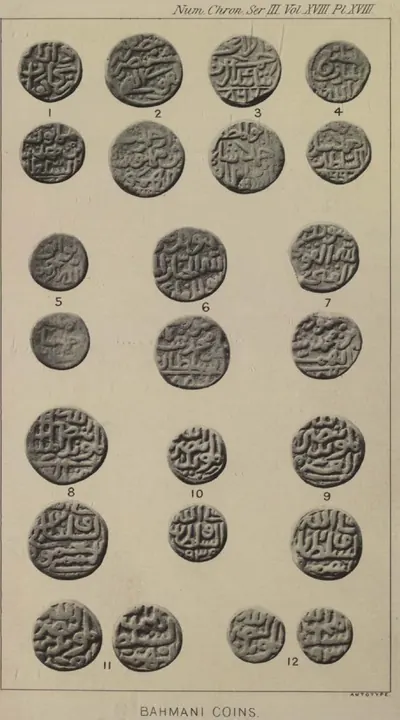
No coins in the name of Nizam Shah were known to Codrington in 1898.9 But he listed copper coins of AH 866 and 867, the years of this reign, in the name of Ahmad.910 One of them reads “Ahmad Shah bin Humayun Shah al-Bahmani”.9 His only explanation was that Nizam took the name Ahmad when he became king.9
Where the sources disagree
- Who invaded. Ferishta names the kings of Orissa together with the chiefs of Telangana.4 Haig names the Hindus of Orissa, joined by those of Telangana.3 The Burhan-i Ma’asir names only the raja of Orissa.111
- How near Bidar they came. Ferishta says ten miles.4 Haig says within twenty miles.3 The Burhan-i Ma’asir puts the battle ten farsakhs from Bidar, which King reckoned at about 34 miles.11
Footnotes
-
J. S. King, The History of the Bahmani Dynasty, founded on the Burhan-i Ma’asir (1900), p. 89 (archive.org (opens in a new tab)). ↩ ↩2 ↩3 ↩4 ↩5 ↩6
-
Ferishta, tr. Briggs, Vol. II (1829), p. 476 and margin (archive.org (opens in a new tab)). ↩ ↩2 ↩3 ↩4
-
Wolseley Haig (ed.), The Cambridge History of India, Vol. III (1928), p. 412 (archive.org (opens in a new tab)). ↩ ↩2 ↩3 ↩4 ↩5 ↩6 ↩7 ↩8 ↩9 ↩10
-
Ferishta, tr. Briggs, Vol. II (1829), p. 466 (archive.org (opens in a new tab)). ↩ ↩2 ↩3 ↩4 ↩5 ↩6 ↩7 ↩8 ↩9
-
Muhammad Qasim Ferishta, tr. John Briggs, History of the Rise of the Mahomedan Power in India, Vol. II (1829), p. 465 (archive.org (opens in a new tab)). ↩
-
Ferishta, tr. Briggs, Vol. II (1829), p. 467 and note (archive.org (opens in a new tab)). ↩ ↩2 ↩3 ↩4 ↩5
-
Ferishta, tr. Briggs, Vol. II (1829), p. 468 (archive.org (opens in a new tab)). ↩ ↩2 ↩3 ↩4
-
Ferishta, tr. Briggs, Vol. II (1829), p. 477 and note (archive.org (opens in a new tab)). ↩
-
O. Codrington, “On the Coins of the Bahmani Dynasty”, Numismatic Chronicle, 3rd series, XVIII (1898), p. 262 (archive.org (opens in a new tab)). ↩ ↩2 ↩3 ↩4
-
Codrington, “Coins of the Bahmani Dynasty” (1898), pp. 269–270 (archive.org (opens in a new tab)). ↩
-
King, History of the Bahmani Dynasty (1900), p. 90 and note 11 (archive.org (opens in a new tab)). ↩ ↩2
Photos
Related
Dynasties
References
Notes (0)
Sources (4)
Spotted an error on this page? Tell us
Last updated: