Tribal peoples of the Telugu lands
The Gonds, Koyas, Konda Reddis, Chenchus, Savaras, Yanadis and other tribal peoples of the hills and forests around the Telugu plains, from the old Gond kingdom of Chanda to the 1940s. The page covers how they farmed and gathered food, the Agency tracts and their special laws, the forest rules that limited shifting cultivation, the loss of tribal land, risings from the Visakhapatnam hills to Babijheri in 1940, and the Hyderabad reforms that followed Christoph von Fürer-Haimendorf's reports.
Download
Tribal peoples have lived for centuries in the hills and forests around the Telugu plains. Their homes were the Eastern Ghats north of the Godavari, the Godavari valley, the Amrabad hills and the forests of Adilabad.123 They include the Gonds, Koyas, Konda Reddis (hill Reddis), Chenchus, Savaras and Yanadis.2456 Their story shows how forest laws, moneylenders and settlers from the plains changed a free life in the hills, and how the hill peoples resisted.78
About the sources. Almost everything written about these peoples before 1950 was written by outsiders: district gazetteers, census reports and officials of the Madras and Hyderabad governments.91 The fullest accounts come from the anthropologist Christoph von Fürer-Haimendorf, who toured Hyderabad’s tribal areas for the Nizam’s government from 1940.43 Like other writers of his time, he sorted people into racial types, an idea no longer accepted.4 This page uses these works for what people did and how they lived, and leaves such judgements aside. For songs and dances, see Folk songs & oral traditions.
Gond kings and the Koyas
The Gonds once had kingdoms of their own. According to Siraj ul Hassan, who wrote for the Nizam’s government in 1920, one Gond kingdom covered part of today’s Adilabad and the Chanda country.2 He names Bhim Ballal as its founder. He says the tenth king, Khandakya Ballal, moved the capital to Chanda in 1261.2
The kingdom later came under the Bhonsles of Nagpur.2 In 1743 the Gonds rose against them. Raghoji Bhonsle put down the rising and took the kingdom into his own lands.2
Siraj ul Hassan also describes the Koyas, whom he calls Kois or Koitor. They lived in the Warangal district of his day, along the Godavari from Bhadrachalam down towards Khammam.2 Their own tradition said that famine and quarrels had driven them there from the highlands of Bastar.2 The Gonds of Adilabad spoke Gondi, while the Koyas spoke a dialect full of Telugu words. Koya men were addressed as Doralu (lords).10
Living from the forest
Most hill peoples farmed by podu (shifting cultivation). The Gonds used neither plough nor hoe. They cut and burnt the trees and sowed seed in holes made in the ashes. When the soil tired after two or three years, they moved to a fresh patch.7 They grew jonna (great millet), rice, chillies, maize and pulses. The women did the largest share of the field work.7 When the harvest ran short, families ate mahua flowers, wild roots and fruit.7
The Konda Reddis of the Godavari hills farmed in the same way. They worked a hill slope for two or three years and then left it to grow back into forest for ten or twelve years.11 They grew jonna, ragi and small millets, and pounded the pith of a forest palm into flour for porridge.11 Haimendorf found few signs of lasting damage to the forest, because heavy rain let it grow back quickly.12
The Chenchus of the Amrabad hills, then in Mahbubnagar district, did not farm at all.3 A Hyderabad report of 1942 described them as food-gatherers. They lived on roots, fruit and small game such as hares and squirrels, which they shot with bows and arrows.3 They lived in small hamlets called pentas, and each hamlet had its own part of the jungle for hunting and gathering.3
Other peoples lived differently again. In the hills of Visakhapatnam (then Vizagapatam), the 1907 gazetteer counted about 50,000 Savaras. Some lived on the high hills and others, called Kapu Savaras, in the lower country near the Palakonda hills.5 Among them were weavers of tribal cloth, basket-makers and iron-workers.5 Their headmen were called Gomangos. Every spring they held a great sacrifice for those who had died during the year.13
On the coast of Nellore, the Yanadis numbered 78,819 in 1921, about seven in every hundred people of the district.6 The 1942 gazetteer said that nothing definite was known about their origin.6 On the island of Sriharikota, the government collected forest produce through the Yanadis.14 It had opened a school for them there as early as 1858, teaching Telugu, basket-making and the growing of chay root (a plant used for red dye).15
The Agency tracts and their laws
The British treated the hill tracts as a separate problem. After years of unrest in the Visakhapatnam and Ganjam hills, the Madras government sent a Special Commissioner there in 1832.9 Then Act XXIV of 1839 took these hill tracts out of much of the ordinary law.9 The Collector governed them directly, as “Agent to the Governor”.9 In Visakhapatnam about seven-eighths of the district became such an Agency.16
In 1879 the same system came to the Godavari hills. Bhadrachalam, Rekapalli and the Rampa country were made an Agency under the Scheduled Districts Act of 1874.9 In the Agency, civil cases followed a simpler set of rules than the courts of the plains.17 By 1931 the census described the Agency tracts as the part of the Eastern Ghats north of the Godavari, governed through “Agents to the Governor”.1
Land was the next worry. Haimendorf records that a Madras law of 1917 (Act I of 1917) barred any transfer of land from a tribal owner to an outsider without the Agent’s sanction.18 In Hyderabad, a Land Alienation Act of 1349 Fasli (1939–40) did the same.18 But he found the Madras law often evaded. At Rampa village itself, the Reddis had mortgaged all their plough land to outsiders.18
Forests close in
By 1920 the forests were no longer open to all. Siraj ul Hassan wrote that new forest laws and roads were bringing in settlers and pushing the Gonds to take up the plough.7 The new life brought new needs, and so the Gonds fell into debt to moneylenders from the plains.7
The Konda Reddis changed in the same way. Haimendorf found that within forty or fifty years most Reddis near the Godavari had become forest labourers.12 Merchant families had settled in their river villages and sent bamboo and timber down to Rajahmundry.12
About three years before Haimendorf’s visit of 1940, the forest department drew the boundaries of its reserved forests. Only small areas around each Reddi village were left for podu.19 On the Madras side of the river the forest lines lay farther from the villages, so many Reddis moved across.19 The 1931 Madras census called podu “at once an agricultural, a forest and a social problem”. Hill peoples who gave it up would need some other way to grow their food.20
Some families lost everything. At Anantavaram, Reddis told Haimendorf that their fathers had owned fields and cattle and could cut podu freely.21 Then they sold their fields to a trader and borrowed from him when the money ran out. He took their cattle, and now they worked for him for a little grain.21
Risings in the hills
The hill peoples rose many times. The Visakhapatnam gazetteer lists the fituris (risings) after 1839:22
- the Golgonda hills in 1845–48, 1857–58, 1879–80, 1886 and 1891
- the Jeypore estate in 1849–50 and 1855–56
- the Savaras of Gunupur in 1864 and 1865
- Korravanivalasa, in Salur taluk, in 190022
In the Rampa hills of the Godavari there was resistance in 1858 and 1862, and in 1879 came the “Rampa rebellion”.23 In Adilabad, Ramji Gond led an uprising of the Gonds, and was later hanged.2425 These risings, and Chandrayya’s part in the Rampa rebellion, are told on Reform, freedom & people’s movements.
A second Rampa rebellion broke out in 1922. It stayed within the Agency areas of the Godavari and Visakhapatnam districts.2627 It was led by Alluri Sitarama Raju, then about 25 years old.26 Sarojini Regani writes that the hill people were angry at the limits on clearing jungle and on podu.27 Two Koya brothers, Gam Mallu Dora and Gam Gantam Dora, had lost their lands, and became Sitarama Raju’s chief helpers.27 The rising began with a raid on the Chintapalli police station on 22 August 1922.27
Babijheri, 1940
In 1940 a clash in the forests of Asifabad, in Adilabad, cost many Gond lives.2829 Haimendorf wrote about it in a note of 1943.30 He had not seen the official report, so his account gives mainly the Gonds’ side.31
The Gonds’ leader was Kumra Bhimu, from Sankepalli near Asifabad. He could read and write.8 A Gond headman told Haimendorf the root of the trouble. Outsiders of every community could get a patta (title deed) for land, but the Gonds could not.8 Bhimu had moved from village to village looking for land, and finally settled at Babijheri.8
When the lines of a state forest were drawn, Babijheri fell inside them. The villagers had no pattas, so they were told to leave, and forest guards burnt their houses.8 The Gonds moved to Jhoreghat nearby. A forest watchman took 500 rupees from them, and then demanded 2,000 more.832
Bhimu and four other Gonds went to Hyderabad. People believed they brought back permission to farm 57 acres at Jhoreghat.32 Bhimu also sent a petition to the district forest officer. But the next day a forest party came to evict them and burnt the outlying huts.32 An armed guard shot Bhimu through the hand, and the Gonds beat the party.32
After this, several hundred Gonds gathered to support Bhimu.33 Some people said he wanted to found a “Gond Raj” (a Gond kingdom), but Haimendorf thought this entirely wrong. In his view the Gonds only wanted to farm at Jhoreghat in peace and to be free of grazing fees and the forest guards’ demands.33 When Bhimu refused to give himself up, the police advanced into the hills. Bhimu fired a shot, and the police killed eleven Gonds on the spot.34 Gonds who had known him spoke highly of his intelligence and character, and blamed the forest officers for his death.34
Haimendorf and the Hyderabad reforms
Haimendorf’s work changed government policy. In November and December 1940 he toured the Konda Reddi villages of the Paloncha samasthan (an estate under its own Raja), around today’s Palvancha.4 In 1942 the Hyderabad Revenue Department proposed a Chenchu Reserve, using his advice.3 Only 426 Chenchus then lived on the Amrabad plateau.3 The government approved the reserve on 23 February 1942. It covered about 100,000 acres of forest.353
In Adilabad the changes went further. W. V. Grigson, the Nizam’s Revenue and Police Member, wrote a foreword to Haimendorf’s reports in 1945.36 He wrote that hereditary village officers who were not tribal had again and again taken tribal land.37 In 1939, when the rains failed, no warning reached the government until hungry Gonds and Kolams came down from the hills to the towns.37 His department proposed special “Tribal Areas”, run on the lines of the Madras Agencies.37
By then the government had posted a Special Officer for the tribal areas at Marlavai, in Utnur taluk.38 It had given Gonds pattas for many thousands of acres.38 The Haimendorfs had started a training centre for tribal teachers at Marlavai, with a growing network of schools around it.38 Some tribal men were also appointed as forest watchers and guards.38
Where the sources disagree
How many Koyas? The Hyderabad census figures, as Grigson set them out, show the Koyas falling from over 60,000 in 1891 to 31,094 in 1941. Over the same years the Gonds rose from 38,000 to 142,000.39 The 1911 census did not count the Koyas separately at all, but put them with the Gonds.39 Grigson warned that the figures showed confusion between the two peoples, not a real fall in the number of Koyas.39
How many died at Babijheri? Haimendorf writes in one place that the police killed eleven Gonds on the spot.34 In another he speaks of the loss of twelve lives.29 He also says that his account is mainly the Gonds’ version, since he had not seen the official report.31
Footnotes
-
Census of India, 1931, Vol. XIV: Madras, Part I, Report (1932), p. 13 (archive.org (opens in a new tab)). ↩ ↩2 ↩3
-
Siraj ul Hassan, Castes and Tribes (1920), p. 230 (archive.org (opens in a new tab)). ↩ ↩2 ↩3 ↩4 ↩5 ↩6 ↩7 ↩8
-
Hyderabad Revenue Department, report to the government of February 1942, in Fürer-Haimendorf, The Chenchus (1943), p. 376 (archive.org (opens in a new tab)). Cite-only; paraphrased. ↩ ↩2 ↩3 ↩4 ↩5 ↩6 ↩7 ↩8
-
Christoph von Fürer-Haimendorf, Tribal Hyderabad: Four Reports (1945), p. 1, “Notes on the Hill Reddis in the Samasthan of Paloncha” (archive.org (opens in a new tab)). Paraphrased. ↩ ↩2 ↩3 ↩4
-
Francis, Vizagapatam (1907), p. 95 (archive.org (opens in a new tab)). ↩ ↩2 ↩3
-
Madras District Gazetteers: Nellore (1942), p. 116 (archive.org (opens in a new tab)). ↩ ↩2 ↩3
-
Siraj ul Hassan, The Castes and Tribes of H.E.H. the Nizam’s Dominions, Vol. I (1920), p. 229 (archive.org (opens in a new tab)). ↩ ↩2 ↩3 ↩4 ↩5 ↩6
-
Fürer-Haimendorf, Tribal Hyderabad (1945), p. 123 (archive.org (opens in a new tab)). Paraphrased. ↩ ↩2 ↩3 ↩4 ↩5 ↩6
-
F. R. Hemingway, Madras District Gazetteers: Godavari, Vol. I (1907), p. 190 (archive.org (opens in a new tab)). ↩ ↩2 ↩3 ↩4 ↩5
-
Siraj ul Hassan, Castes and Tribes (1920), p. 231 (archive.org (opens in a new tab)). ↩
-
Fürer-Haimendorf, Tribal Hyderabad (1945), p. 2 (archive.org (opens in a new tab)). Paraphrased. ↩ ↩2
-
Fürer-Haimendorf, Tribal Hyderabad (1945), p. 3 (archive.org (opens in a new tab)). Paraphrased. ↩ ↩2 ↩3
-
Francis, Vizagapatam (1907), p. 96 (archive.org (opens in a new tab)). ↩
-
Nellore gazetteer (1942), p. 147 (archive.org (opens in a new tab)). ↩
-
Nellore gazetteer (1942), p. 213 (archive.org (opens in a new tab)). ↩
-
Francis, Vizagapatam (1907), p. 196 (archive.org (opens in a new tab)). ↩
-
Hemingway, Godavari (1907), p. 191 (archive.org (opens in a new tab)). ↩
-
Fürer-Haimendorf, The Reddis of the Bison Hills (1945), p. 288 (archive.org (opens in a new tab)). Cite-only; paraphrased. ↩ ↩2 ↩3
-
Fürer-Haimendorf, Tribal Hyderabad (1945), p. 4 (archive.org (opens in a new tab)). Paraphrased. ↩ ↩2
-
Census of India, 1931, Vol. XIV: Madras, Part I (1932), p. 201 (archive.org (opens in a new tab)). ↩
-
Christoph von Fürer-Haimendorf, The Reddis of the Bison Hills (The Aboriginal Tribes of Hyderabad, Vol. II, 1945), p. 287 (archive.org (opens in a new tab)). Cite-only; paraphrased. ↩ ↩2
-
W. Francis, Madras District Gazetteers: Vizagapatam, Vol. I (1907), p. 58 (archive.org (opens in a new tab)). ↩ ↩2
-
F. R. Hemingway, Madras District Gazetteers: Godavari, Vol. I (1907), p. 37 (archive.org (opens in a new tab)). ↩
-
The Freedom Struggle in Hyderabad, Vol. II (1956), p. xv (archive.org (opens in a new tab)). Paraphrased. ↩
-
The Freedom Struggle in Hyderabad, Vol. II (1956), p. xvi (archive.org (opens in a new tab)). Paraphrased. ↩
-
Sarojini Regani, Highlights of the Freedom Movement in Andhra Pradesh (1956), p. 95 (archive.org (opens in a new tab)). Cite-only; paraphrased. ↩ ↩2
-
Regani, Highlights (1956), p. 96 (archive.org (opens in a new tab)). Cite-only; paraphrased. ↩ ↩2 ↩3 ↩4
-
Fürer-Haimendorf, Tribal Hyderabad (1945), p. 116, note of 1943 on the Asifabad, Rajura and Utnur taluks (archive.org (opens in a new tab)). Paraphrased. ↩
-
Fürer-Haimendorf, Tribal Hyderabad (1945), p. 119 (archive.org (opens in a new tab)). Paraphrased. ↩ ↩2
-
Fürer-Haimendorf, Tribal Hyderabad (1945), table of contents (archive.org (opens in a new tab)). ↩
-
Fürer-Haimendorf, Tribal Hyderabad (1945), p. 122 (archive.org (opens in a new tab)). Paraphrased. ↩ ↩2
-
Fürer-Haimendorf, Tribal Hyderabad (1945), p. 124 (archive.org (opens in a new tab)). Paraphrased. ↩ ↩2 ↩3 ↩4
-
Fürer-Haimendorf, Tribal Hyderabad (1945), p. 125 (archive.org (opens in a new tab)). Paraphrased. ↩ ↩2
-
Fürer-Haimendorf, Tribal Hyderabad (1945), p. 126 (archive.org (opens in a new tab)). Paraphrased. ↩ ↩2 ↩3
-
R. M. Crofton, Appendix VIII, “The Creation of a Chenchu Reserve”, in Fürer-Haimendorf, The Chenchus (1943), p. 375 (archive.org (opens in a new tab)). Cite-only; paraphrased. ↩
-
Fürer-Haimendorf, Tribal Hyderabad: Four Reports, with a foreword by W. V. Grigson (Hyderabad: Revenue Department, 1945), title page (archive.org (opens in a new tab)). ↩
-
W. V. Grigson, Foreword to Fürer-Haimendorf, Tribal Hyderabad (1945), p. x (archive.org (opens in a new tab)). Paraphrased. ↩ ↩2 ↩3
-
Grigson, Foreword to Tribal Hyderabad (1945), p. xi (archive.org (opens in a new tab)). Paraphrased. ↩ ↩2 ↩3 ↩4
-
W. V. Grigson, Foreword to Fürer-Haimendorf, The Chenchus: Jungle Folk of the Deccan (1943), p. xvi (archive.org (opens in a new tab)). Cite-only; paraphrased. ↩ ↩2 ↩3
Photos
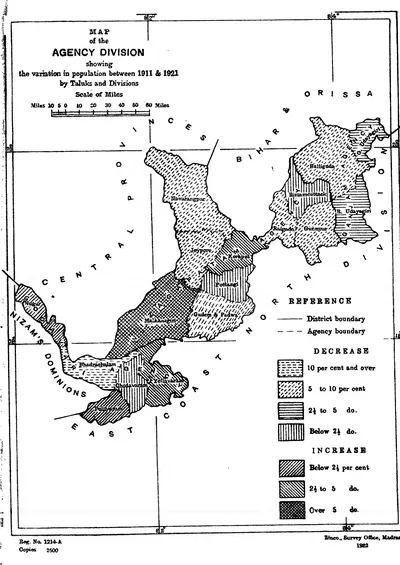 "Map of the Agency Division showing the variation in population between 1911 & 1921 by Taluks and Divisions": the hill tracts of Ganjam, Vizagapatam and Godavari (Census of India 1921, Madras, Part I, 1922)Map · 1922
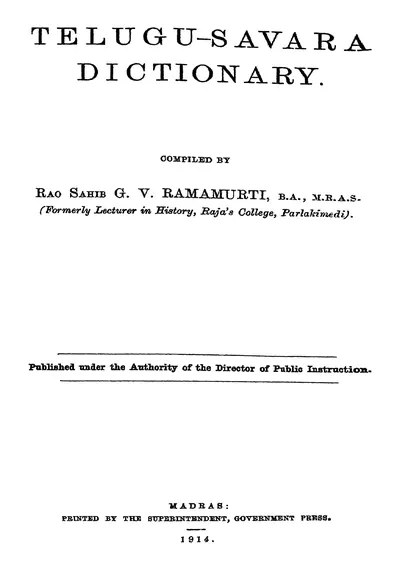 Title page of G. V. Ramamurti's "Telugu-Savara Dictionary" (Madras, 1914)Book plate · 1914
References
Notes (0)
Sources (10)
Spotted an error on this page? Tell us
Last updated: