Lesson 6
The Telugu script in the inscriptions, record by record
Telugu letters did not appear all at once. They grew slowly, over many centuries, out of the Brahmi script of the Buddhist caskets at Bhattiprolu. This lesson follows that growth through real inscriptions that have their own pages on this site, from the 2nd century BCE to the first printed Telugu books. It builds on the lesson The Telugu-Kannada script through the centuries, which sets out the stages; here you meet the records themselves.12
Our main guide is C. Sivaramamurti of the Madras Government Museum. In his Indian Epigraphy and South Indian Scripts (first published in 1948) he traced the Telugu script through a chain of dated inscriptions, and printed a drawing of a few lines from each.1 Where an inscription’s own editor described its letters, this lesson gives that description too.
Seven letters in nine records
The table below shows seven letters (a, ka, ga, ta, ma, ra, la) as they appear in nine records. Each letter is cut from a published alphabet table, and each row names the inscription and the plate it comes from.3 Read down a column to watch one letter change. Ka starts as a plain cross and grows a long curling tail in the Ikshvaku age.4 By the 10th century it has become rounded and short, the shape that leads to the ka of printed Telugu in the last row.5
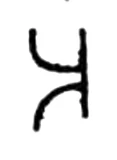
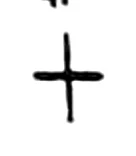

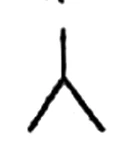

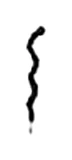
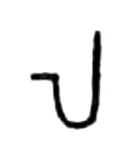
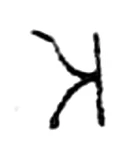
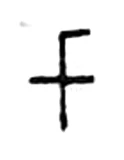
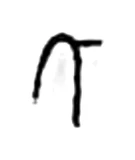
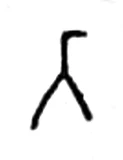
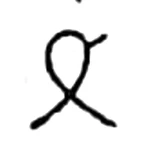
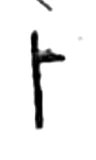
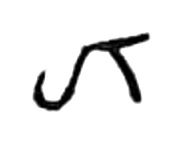
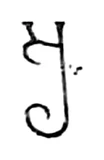
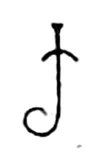

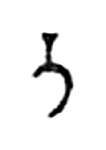
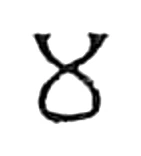
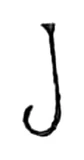
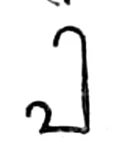
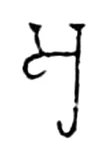
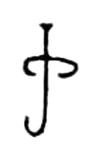
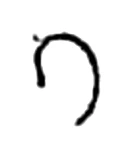
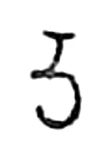
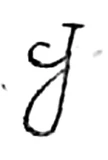
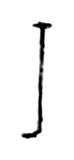
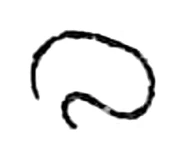
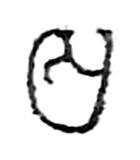
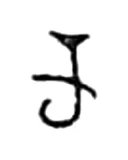
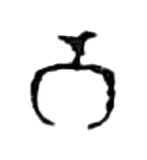
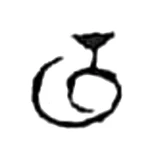
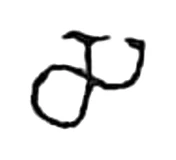

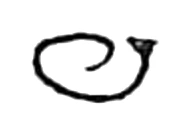
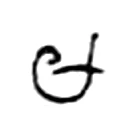
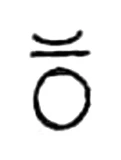
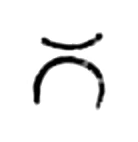
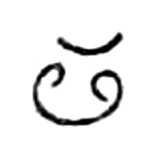
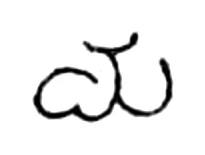
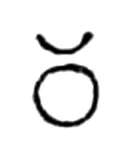
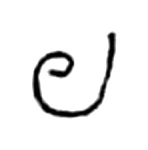
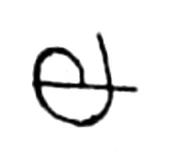
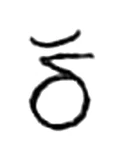
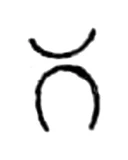
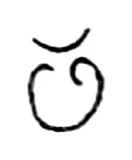
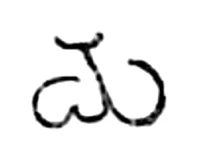
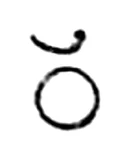
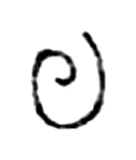
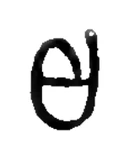
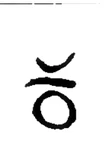
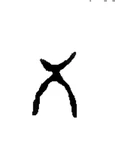
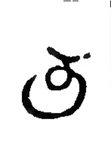
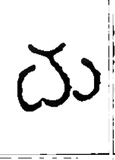



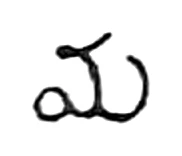
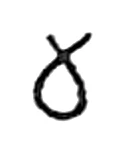

Four of these records have pages of their own and appear again below: the Bhattiprolu caskets, the Jaggayyapeta pillars, the Mayidavolu plates and the Chebrolu pillar of 1213. The table also gives Asoka’s Brahmi from Girnar, so that you can compare it with the Bhattiprolu letters.3
Brahmi on the Bhattiprolu caskets
The oldest writing of the Telugu country is on the Bhattiprolu relic caskets, in Guntur district. They are in Prakrit, not Telugu, and in a form of Brahmi.6 Georg Bühler found that twenty-three of their letters agree exactly with the Brahmi of Asoka’s edicts.67 But five letters are “entirely abnormal”, and there is an extra letter for a hard ḷ sound.67
Sivaramamurti notes that the Bhattiprolu a is made of straight strokes, while other early forms of the letter are curved.8 You can see the difference in the first two rows of the table.
The ornate letters of the Krishna valley
In the 3rd century CE the Ikshvakus ruled from the Krishna valley.9 Their scribes wrote Brahmi with long, sweeping strokes. Bühler called the script of the Jaggayyapeta inscriptions a “highly ornamental variety” of the eastern Deccan.9 Sivaramamurti describes the Ikshvaku ka: the foot of its upright stroke is very long and curls up “tremendously”.4
The copper plates of the early Pallavas came next. The Mayidavolu plates are in Prakrit. Their editor E. Hultzsch called their alphabet “an epigraphic curiosity”, because a few letters differ from those of every other Indian alphabet.10
Copper plates of the Salankayanas and Vishnukundins
The Salankayanas issued their grants from Vengi (Vengipura).11 Sivaramamurti found their script “essentially the same” as the earlier Brahmi, but without the Ikshvaku ornaments.1 The small head-stroke (serif) on each letter is now clearly marked.1
The Vishnukundin plates show the next step. In the Chikkulla plates, ta has a loop that na does not. Letters such as pa, ma, va and ga have a clear notch at the base.12 Their editor F. Kielhorn placed the characters in “the southern class of alphabets”.13
Another Vishnukundin grant, the Tundi plates, was found near Draksharama in the Godavari district.14 R. Subrahmanyam edited it for the Andhra Pradesh government in 1962. He had to work from ink impressions, because he had lost the plates themselves while moving house.14 He held that its donor was the same king as the donor of the Chikkulla plates.15 He also found the Chikkulla script “of a more developed variety” than the Tundi script.16
The first Telugu on stone
Up to this time the inscriptions were in Prakrit or Sanskrit. Among the earliest records known to be written wholly in Telugu are the stones of the Telugu Chola chiefs in Kadapa (then Cuddapah) district.17 The Kalamalla pillar of about 575 is one of them.17 Its editors described its bold letters as the early Telugu-Kannada script, the form used by the Chalukyas of Badami.18
The Erragudipadu stone has almost the same letters, written in a more running hand.19 In both, a letter written below another keeps its full shape, which is a mark of this early script.19 The Tippaluru stone is different again. Its ornate letters look more like the Pallava-Grantha script of the Tamil country than the usual Telugu-Kannada of the time.20
Sivaramamurti adds a small find of his own. On the back of an early Eastern Chalukya door-guardian figure from Bezwada (Vijayawada), he found the words Veginathu velanju, “servant of the lord of Vegi”. They are in letters of the 7th century, a very early use of Telugu in an inscription.21
The Eastern Chalukya plates
The Eastern Chalukyas came next. Sivaramamurti saw their first script, under Kubja Vishnuvardhana, as close to that of the Western Chalukyas under his brother Pulakesin. Then it grew its own local form.12 He follows it through four grants on this site:2223242
- In the Timmapuram plates of Vishnuvardhana I, ka and ra are shorter than before, and ya grows a small circle on its left.22
- By the Masulipatam plates of Vijayaditya III, about two centuries later, ya is “nearly modern” and la is “definitely modern”.2223
- In the 10th century, as in the Vandram plates of Amma II, the letters look as if cast “in a square mould with rounded corners”, with a thick, nail-like serif.2325
- In the 11th century, as in the Korumelli plates of Rajaraja I, the serif becomes a large V, nearly as big as the letter. Ka and ra are now a circle under that V.242
The hands of single scribes show the same change. In the Nandamapundi grant of 1053, Kielhorn found two stages of the script on one set of plates. Its seal carries a legend in Telugu letters.26
The first Telugu poems on stone come from this age. Sivaramamurti places the Bezwada pillar of Yuddhamalla in the script of the 10th century. He calls the Addanki inscription of Pandaranga, of the 9th century, earlier still.21
The Kakatiya hand: letters take their final shape
For Sivaramamurti, the script of the Kakatiya age was “the best example of proto-Telugu script”. He found it “most graceful”. From here on, he wrote, the letters change only “here and there”.2
His example is the Chebrolu inscription of Jaya of 1213, which is in very good condition.2 Its editor E. Hultzsch said its letters “can be read as easily as print”.27 In it, says Sivaramamurti, a and ā take their modern shape. Pa, ma, la, va and several other letters “practically assume the modern form”.2 Look at the Chebrolu row of the table and compare it with the printed row of 1918.
Fifty years earlier, at Hanamkonda, J. F. Fleet had called the letters of the Thousand Pillar Temple inscription “well executed and well preserved Old-Canarese characters”.28
Reddis and Vijayanagara
After the Kakatiyas the letters changed very little. One change was a small curved stroke under bha, which later became a fixed upright stroke.29 Sivaramamurti’s example of this period is the Phirangipuram pillar of 1410, under the Reddi kings. Part of it is in Telugu verse, and it names the poet Srinatha as its composer.2921 Sivaramamurti thought its letters show what a manuscript of Srinatha’s own poems would have looked like.29
The Vijayanagara kings ruled both the Kannada and the Telugu country. Sivaramamurti found that their inscriptions used the same script for both languages.30 The special features that now set Kannada letters apart from Telugu came later.30 In the Vijayanagara script he noted a small upright stroke under aspirated letters such as bha, tha and dha, and letters that were squeezed in height.31
Not every Vijayanagara grant used this script. The Kanuma grant of 1548 is in Nandinagari letters, a southern form of Nagari. Only its signature is in Telugu.32
From the stone to the printed page
Printing among the Telugus, C. P. Brown wrote in 1852, began about 1806.33 A. D. Campbell’s Telugu grammar of 1816 set out the alphabet in print. He described “the round and flowing characters of the Teloogoo”, which he said were nothing like the square Devanagari.34
Why the round shape? A. C. Burnell gave one answer in 1878. The round Telugu hand, he said, was the local hand of northern Nellore, and it became the model when Telugu printing began at Madras.35 The last row of the table comes from G. H. Ojha’s plate of printed Telugu of 1918.3
Where the sources disagree
When the Chikkulla plates were cut. F. Kielhorn assigned the Chikkulla plates to the end of the 8th century. He based this on the style of the letters and on the use of number symbols for the date.16 R. Subrahmanyam, who edited the Tundi plates of what he took to be the same king, found this date “difficult to accept”.16
What to call the script of the 12th and 13th centuries. J. F. Fleet called the Hanamkonda letters of 1163 “Old-Canarese”.28 Sivaramamurti called the Kakatiya script of the same age “proto-Telugu”.2 Both names describe the one script that Telugu and Kannada then shared. A. C. Burnell found that by 1300 this alphabet showed scarcely any differences from the coast of Canara to Rajahmundry.36 The lesson on the Telugu-Kannada script calls it by that shared name.
Try it yourself
Look at the ka in the Pagunavaram row of the 10th century and in the Chebrolu row of 1213. Which one has the heavier head-stroke? Which one looks closer to the printed ka of 1918?3
Answer
In the 10th century, Sivaramamurti says, ka and ra have a short, box-like body, and the serif on top is thick and nail-like.2325 In the 11th century the serif grew into a large V, nearly as big as the letter.24 In the Kakatiya script of Chebrolu it became a broader angle, lighter than in the 11th century.2 So the Pagunavaram ka has the heavier head, and the Chebrolu ka is the one closer to the printed letter.23
Footnotes
-
C. Sivaramamurti, Indian Epigraphy and South Indian Scripts (Bulletin of the Madras Government Museum, new series, general section, vol. III, no. 4; 1st ed. 1948), p. 209 (archive.org (opens in a new tab)). ↩ ↩2 ↩3 ↩4
-
Sivaramamurti, Indian Epigraphy and South Indian Scripts (1948), p. 216, on the Korumelli plates (Fig. 117) and the Kakatiya script of the Chebrolu inscription (Fig. 118) (archive.org (opens in a new tab)). ↩ ↩2 ↩3 ↩4 ↩5 ↩6 ↩7 ↩8 ↩9
-
The letters in the table are cropped from Gaurishankar Hirachand Ojha, Bharatiya Prachin Lipimala, 2nd ed. (1918), Plates 1, 4, 12, 13, 48, 50, 51 and 80 (archive.org, Plate 50 (opens in a new tab)), and from A. C. Burnell, Elements of South-Indian Palaeography, 2nd ed. (1878), Pl. IX (archive.org (opens in a new tab)); each cell links to its plate. ↩ ↩2 ↩3 ↩4 ↩5
-
Sivaramamurti, Indian Epigraphy and South Indian Scripts (1948), p. 85, on the letter ka (archive.org (opens in a new tab)). ↩ ↩2
-
Sivaramamurti, Indian Epigraphy and South Indian Scripts (1948), p. 86, on the letter ka (archive.org (opens in a new tab)). ↩
-
G. Bühler, “The Bhattiprolu Inscriptions”, Epigraphia Indica II (1894), p. 323 (archive.org (opens in a new tab)). ↩ ↩2 ↩3
-
Bühler, “The Bhattiprolu Inscriptions” (1894), p. 324 (archive.org (opens in a new tab)). ↩ ↩2
-
Sivaramamurti, Indian Epigraphy and South Indian Scripts (1948), p. 56, on the letter a (archive.org (opens in a new tab)). ↩
-
G. Bühler, Indian Palaeography, tr. J. F. Fleet (Appendix to the Indian Antiquary XXXIII, 1904), p. 43, § 20 C (archive.org (opens in a new tab)). ↩ ↩2
-
E. Hultzsch, “Mayidavolu Plates of Sivaskandavarman”, Epigraphia Indica VI (1901), p. 86 (archive.org (opens in a new tab)). ↩
-
Sivaramamurti, Indian Epigraphy and South Indian Scripts (1948), p. 210, translation of the Salankayana passage in Fig. 112 (archive.org (opens in a new tab)). ↩
-
Sivaramamurti, Indian Epigraphy and South Indian Scripts (1948), p. 211 (archive.org (opens in a new tab)). ↩ ↩2
-
F. Kielhorn, “Chikkulla Plates of Vikramendravarman II”, Epigraphia Indica IV (1897), p. 194 (archive.org (opens in a new tab)). ↩
-
R. Subrahmanyam, The Tundi Copper Plate Grant of Vishnukundin King Vikramendravarma (Andhra Pradesh Government Archaeological Series No. 8, 1962), foreword by N. Ramesan (dated 15 February 1962) and p. 1 with n. 1. ↩ ↩2
-
Subrahmanyam, Tundi Copper Plate Grant (1962), p. 2, n. 1. ↩
-
Subrahmanyam, Tundi Copper Plate Grant (1962), p. 4. ↩ ↩2 ↩3
-
Nilakanta Sastri and Venkataramayya, “Telugu Chola Records” (1956), p. 221 (archive.org (opens in a new tab)). Paraphrased. ↩ ↩2
-
K. A. Nilakanta Sastri and M. Venkataramayya, “Telugu Chola Records from Anantapur and Cuddapah”, Epigraphia Indica XXVII (1956), p. 220 (archive.org (opens in a new tab)). Paraphrased. ↩
-
Nilakanta Sastri and Venkataramayya, “Telugu Chola Records” (1956), p. 225 (archive.org (opens in a new tab)). Paraphrased. ↩ ↩2
-
Nilakanta Sastri and Venkataramayya, “Telugu Chola Records” (1956), p. 231 (archive.org (opens in a new tab)). Paraphrased. ↩
-
Sivaramamurti, Indian Epigraphy and South Indian Scripts (1948), pp. 54–55 (archive.org (opens in a new tab)). ↩ ↩2 ↩3
-
Sivaramamurti, Indian Epigraphy and South Indian Scripts (1948), p. 212, on the Timmapuram grant (Fig. 114) (archive.org (opens in a new tab)). ↩ ↩2 ↩3
-
Sivaramamurti, Indian Epigraphy and South Indian Scripts (1948), p. 213, on the Masulipatam plates of Vijayaditya III (Fig. 115) and the script of the 10th century (archive.org (opens in a new tab)). ↩ ↩2 ↩3 ↩4
-
Sivaramamurti, Indian Epigraphy and South Indian Scripts (1948), p. 215, on the script of the 11th century (archive.org (opens in a new tab)). ↩ ↩2 ↩3
-
Sivaramamurti, Indian Epigraphy and South Indian Scripts (1948), p. 214, on the Vandram plates of Amma II (Fig. 116) (archive.org (opens in a new tab)). ↩ ↩2
-
F. Kielhorn, “Nandamapundi Grant of Rajaraja I”, Epigraphia Indica IV (1897), p. 301 (archive.org (opens in a new tab)). ↩
-
E. Hultzsch, “Chebrolu Inscription of Jaya; after Saka-Samvat 1135”, Epigraphia Indica V (1899), p. 142 (archive.org (opens in a new tab)). ↩
-
J. F. Fleet, “Sanskrit and Old-Canarese Inscriptions, No. CXVIII”, Indian Antiquary XI (1882), p. 9 (archive.org (opens in a new tab)). ↩ ↩2
-
Sivaramamurti, Indian Epigraphy and South Indian Scripts (1948), p. 218, on the Phirangipuram inscription (Fig. 119) (archive.org (opens in a new tab)). ↩ ↩2 ↩3
-
Sivaramamurti, Indian Epigraphy and South Indian Scripts (1948), p. 220 (archive.org (opens in a new tab)). ↩ ↩2
-
Sivaramamurti, Indian Epigraphy and South Indian Scripts (1948), pp. 220–221 (archive.org (opens in a new tab)). ↩
-
S. V. Viswanatha, “The Kanuma Grant of Sadasiva-Raya: Saka 1470”, Epigraphia Indica XIV (1917–18), p. 341 (archive.org (opens in a new tab)). ↩
-
C. P. Brown, A Dictionary, Telugu and English (1852), p. iv (archive.org (opens in a new tab)). ↩
-
A. D. Campbell, A Grammar of the Teloogoo Language (1816), Introduction, p. xix (archive.org (opens in a new tab)). ↩
-
A. C. Burnell, Elements of South-Indian Palaeography, 2nd ed. (1878), p. 30 (archive.org (opens in a new tab)). ↩
-
A. C. Burnell, Elements of South-Indian Palaeography, 2nd ed. (1878), p. 25 (archive.org (opens in a new tab)). ↩
References
Notes (0)
Sources (14)
Spotted an error on this page? Tell us
Last updated: